RAD Physics Ch 4 Electromagnetic Energy
 Call Kai
 Learn
Learn Practice Test
 Spaced Repetition
 Match
Match Flashcards
 Knowt Play
1/88

There's no tags or description
Looks like no tags are added yet.
Name | Mastery | Learn | Test | Matching | Spaced | Call with Kai | Chat |
|---|
No analytics yet
Send a link to your students to track their progress
89 Terms
Who proved that visible light has both electrical and magnetic properties?
James Clerk Maxwell (late 19th century)

What does the term electromagnetic radiation mean?
It refers to energy that has both electric and magnetic properties, like visible light.

What did the Greeks call an atom of light?
Photon

What is a photon?
The smallest quantity of any kind of electromagnetic radiation (EMR).

What is a photon analogous to?
An atom or element.
What is a quantum?
A small bundle of energy—also known as a photon.

What are common types of photons mentioned in radiography?
X-ray photons, light photons, and photon radiation

What is electromagnetic radiation?
Energy that exists everywhere, spans a wide energy range, and has both electric and magnetic properties. it has no mass. it has no electric charge. it has Electric and magnetic properties. It exists everywhere.
What are the four main properties of photons?
Velocity, Amplitude, Frequency, and Wavelength.
What is the velocity of photon electromagnetic radiation (such as X-rays and gamma rays)?
It is constant and equal to the speed of light, c = 3 × 10⁸ m/s.

Do photons have mass?
No, photons have no mass, but their electric and magnetic fields are continuously changing.
What does sinusoidal mean?
Simple motion in the shape of a sine wave; shows variations of amplitude over time.

What is a field?
An interaction among different energies, forces, or masses that cannot be seen but can be described mathematically.
What are examples of invisible but measurable fields?
Electric and magnetic fields; they can't be seen but can be demonstrated or calculated.
What is the electromagnetic spectrum?
The range of all electromagnetic radiation

What is the frequency range of the electromagnetic spectrum?
From 10² to 10²⁴ Hz.
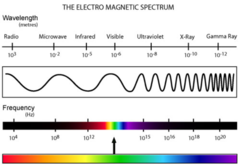
What is the wavelength range of the electromagnetic spectrum?
From 10⁶ to 10⁻¹⁶ meters (m).

What is an oscilloscope?
A device that displays electrical signals as waveforms, showing how voltage changes over time.

What is amplitude?
Amplitude is one-half the range from crest to valley over which a sine wave varies.

Is amplitude dependent on frequency or wavelength?
No, amplitude is independent of both frequency and wavelength.

What is frequency (f)?
The number of wavelengths (cycles) passing a point per second; measured in Hertz (Hz).

What does 1 Hertz (Hz) represent?
One cycle per second — the rate of rise and fall of the wave.

What is wavelength (λ)?
The distance from one crest to another, or from any point on a wave to the next corresponding point.

What is the wave equation?
Velocity = Frequency × Wavelength (V = fλ)

Is the wave equation the same for both sound and electromagnetic radiation (EMR)?
Yes, the equation is the same for both.
How does sound differ from electromagnetic radiation (EMR)?
Sound travels at different velocities and cannot travel through a vacuum, while EMR can.

How are wavelength and frequency related at a given velocity?
They are inversely proportional — as one increases, the other decreases.

Why is "c" used instead of velocity (v) in the electromagnetic wave equation?
Because electromagnetic radiation (EMR) always travels at the speed of light.

What are the three main regions of the electromagnetic spectrum important to us?
1️⃣ Radio frequency2️⃣ Visible light3️⃣ X-radiation

What are the three sub-regions of the electromagnetic spectrum?
1️⃣ Microwave radiation2️⃣ Infrared light3️⃣ Ultraviolet radiation

Are there clear boundaries between the regions of the electromagnetic spectrum?
No, there is overlap with no clear boundaries.

What determines the differences between regions in the electromagnetic spectrum?
Differences are based on frequency and wavelength.

How are light "waves" usually described?
By their wavelength (m).

What is refraction?
The deviation in the line of travel of light — seen in phenomena like prisms and rainbows.

What is the wavelength range of visible light?
400 nm (violet/short waves) to 700 nm (red/longer waves).

What portion of the electromagnetic spectrum does visible light occupy?
The smallest segment of the EM spectrum.

What are the two types of invisible light found in sunlight?
1️⃣ Infrared — heats substances it shines upon
2️⃣ Ultraviolet (UV Rays)— causes sunburn

How are radio "waves" usually described?
By their frequency (in Hertz, or cycles per second).

What does a radio station frequency like "WRVA 940 kHz" represent?
The frequency at which the station transmits radio waves — in this case, 940 kilohertz.

What type of waves does Bluetooth use?
Short-wavelength UHF radio waves in the ISM band (2.4-2.485 GHz) — used for devices like AirPods.

What does "10-m band" refer to for ham radio operators?
A radio frequency range where the wavelength is about 10 meters.
How is ionizing radiation usually described?
By its energy, measured in electron volts (eV).
What characterizes ionizing radiation?
The energy contained in each photon.

What is the energy range of typical diagnostic X-rays?
0-80 keV, often produced at around 80 kVp.
What is the main difference between X-rays and gamma rays?
Their origin.

Where do X-rays originate?
From the electron cloud of an atom.

Where do gamma rays originate?
From the nucleus of a radioactive atom.

How is visible light identified?
By its wavelength — it's also the form of radiation by which X-rays are viewed or read.

How is radio frequency identified?
By its frequency — for example, MRI operates at frequencies in the megahertz (MHz) range.
How are X-rays identified?
By their energy.

What is the relationship between a photon's energy and its frequency?
Energy is proportional to frequency.
↑ Frequency → ↑ Energy
↓ Frequency → ↓ Energy

What applications rely on identifying X-rays by energy?
High-quality radiographs and radiation therapy treatments.
How are photons of X-rays and visible light similar?
They are fundamentally the same type of electromagnetic radiation.

How do X-ray photons differ from visible light photons?
X-ray photons have a much higher frequency and a shorter wavelength.

What do these differences in frequency and wavelength cause?
They lead to different interactions with matter — X-rays penetrate deeper, while visible light does not.

How does visible light tend to behave?
More like waves than particles.

How do X-rays tend to behave?
More like particles than waves.

What is wave-particle duality?
The concept that both visible light and X-rays exhibit characteristics of both waves and particles.

In what unit is visible light usually measured?
Nanometers (nm).

How are radio waves and microwaves different?
Radio waves: Wavelengths measured in meters → require large antennas.
Microwaves: Wavelengths measured in centimeters → use small antennas.

What range of visible light can humans see?
Humans see visible light between violet and red wavelengths

What is the relationship between wavelength and photon energy?
The shorter the wavelength, the greater the photon energy.
What are the three ways light (and all EMR) can interact with matter?
Light can be transmitted, absorbed, or attenuated to varying degrees.
What determines how much light is transmitted, absorbed, or attenuated?
The transparency of the absorbing material.

What is transmission in light interaction?
When light passes through a material without interference.

What is reflection in light interaction?
When light bounces off a silvered surface, such as a mirror.

What is attenuation in radiation?
A reduction in intensity caused by scattering and absorption.

What is radiation attenuation?
The weakening of radiation as it passes through matter due to scattering and absorption.

What happens during absorption of light?
Light waves are absorbed, and their energy is converted to heat (e.g., black asphalt heating up in sunlight).

What type of material allows light to pass through almost unaltered/ This makes it what?
Transparent (e.g., glass)

What type of material alters or reduces the passage of light/ This makes it what?
Translucent (e.g., scratched glass)

What type of material absorbs all light and allows none to pass?
Opaque

What does radiolucent mean?
Structures that attenuate x-rays (allow most x-rays to pass through). Example: Lung or soft tissue

What does radiopaque mean?
Structures that absorb x-rays, appearing white or light on an image. Example: Bone

What does the Inverse Square Law state in radiation science?
The decrease in intensity is inversely proportional to the square of the distance from the source.
When does the Inverse Square Law (ISL) apply?
When we assume a "point" source of radiation.

Why does intensity decrease rapidly with distance according to the ISL?
Because the intensity is spread over an increasingly large area.

What does the Particle Model (Quantum Theory) say about x-rays?
X-rays either exist at the speed of light (c) or not at all.
What is the energy range of x-rays?
10 keV to 50 MeV
What is the wavelength range of x-rays?
10⁻¹⁰ m to 10⁻¹⁴ m
What is the frequency range of x-rays?
10¹⁸ to 10²² Hz
What is the energy equation in quantum mechanics?
E=hf
Where:
E= Energy (Joules)
h= Planck's constant
f= Frequency (Hz)
How many electron volts (eV) are in 1 joule?
1 J=6.24×10^18 eV
What dual nature does photon radiation have?
It has properties of both particles and waves.
What is the relationship between velocity, frequency, and wavelength?
v=fλ
What does E=hcλE=λhc show?
It relates an x-ray photon's energy and wavelength using Planck's constant (h).
What equation relates matter and energy?
E=mc2E=mc2
What four characteristics describe electromagnetic radiation?
Velocity, frequency, amplitude, and wavelength
What do velocity, frequency, amplitude, and wavelength determine?
How electromagnetic radiation interacts with matter