Nurs Sci 116 MT1
 Call Kai
 Learn
 Practice Test
 Spaced Repetition
 Match
 Flashcards
 Knowt Play
1/107

There's no tags or description
Looks like no tags are added yet.
108 Terms
Steps of the Scientific Method
observation, hypothesis, experiment, conclusion, report results
Nature vs Nurture
Traits, capacities, and limitations each individual inherits genetically from parents
(Before Birth)
vs
All environmental influences that affect the development
(After Birth)
Multidirectional
Human characteristics change in every direction to reflect the development
Life-Span Perspective
Study of human development that takes into account all phases of life
Critical Period
a specific time in development when certain skills or abilities are most easily learned
Sensitive Period
When a specific type of development is most likely to occur, although it may still happen later
Ecological-systems approach
The view that in the study of human development, the person should be considered in all the contexts and interactions that constitute a life
This theory argues that the environment you grow up in affects every facet of your life
Microsystem
each person's immediate social contexts, such as family and peer group
Exosystem
local institutions such as schools and church
Macrosystem
the larger setting, including cultural values, economic policies, and political processes
Mesosystem
the interactions and the connections among the other systems
Chronosystem
("time system") the historical context
Bioecological Systems
the internal biology of the person
Dynamic-systems approach
A view of human development as an ongoing, ever-changing interaction between the person and every aspect of his or her environment, including the family and society
Epigenetics
the study of stable phenotypic changes that do not involve alterations in the DNA sequence
Psychoanalytic Theory
A theory developed by Erikson and Freud that attempts to explain personality, motivation, and mental disorders by focusing on unconscious determinants of behavior
Oral Stage
(Birth-1 year)
The lips, tongue, and gums are the focus of pleasurable sensations in the baby's body, and sucking and feeding are the most stimulating activities.
Anal Stage
(1-3 years)
pleasure focuses on bowel and bladder elimination; coping with demands for control
Phallic Stage
(3-6 years)
pleasure zone is the genitals; coping with incestuous sexual feelings
Latency
(6 to 11)
a phase of dormant sexual feelings
Genital Stage
(adolescence to adulthood)
maturation of sexual interests
Basic Trust vs Mistrust
(0-18 months)
Babies trust they will be taken care of, if not mistrust develops
Autonomy vs Shame/Doubt
(18 months - 3 years)
Children become self-sufficient or they doubt their own abilities
Initiative vs Guilt
(3 to 6 years)
To develop the ability to try new things and to handle failure
Industry vs Inferiority
(6-11 years)
Children learn to be productive and learn new skills or they begin to feel inferior
Identity vs Role Confusion
(12-19 years)
teenagers and young adults search for and become their true selves
Intimacy vs Isolation
(20-25 years)
relationships or they die alone!
Generavity vs Stagnation
(26-64 years)
caring for others, empathy, and concern
Integrity vs Despair
(65-death)
Existential Identity, dissatisfaction with life or feelings of wisdom
Behavioral Theory
Watson, Skinner, Pavlov, and Bandura
Study of observable behavior; describes the laws and processes by which behavior is learned
Classical Conditioning
The learning process by which a natural (unconditioned) response (e.g. fear when seeing a lion out of a cage) becomes triggered by a formerly neutral stimulus by repeatedly pairing it with the stimulus that naturally triggers that response.

Operant Conditioning
The learning process by which a particular action is followed by something desired (which makes the person or animal more likely to repeat the action) or by something unwanted (which makes the action less likely to be repeated.)

Social Learning Theory
emphasizes the influence that other people have over a person's behavior
the theory that we learn social behavior by observing and imitating and by being rewarded or punished
Cognitive Theory
Founded by Jean Piaget
Focuses on changes in how people think over time. According to this theory, our thoughts shape our attitudes, beliefs, and behaviors.
Sensorimotor Stage
(0-2 years)
infants use senses and motor abilities to understand the world
learning is active; there is no conceptual or reflective thought
object permenance

Preoperational Stage
(2-6 years)
a child learns to use language but does not yet comprehend the mental operations of concrete logic
egocentric

Concrete Operational Stage
(6-11 years)
children gain the mental operations that enable them to think logically about concrete events
understands conservation

Formal Operational Stage
(12-adulthood)
people begin to think logically about abstract concepts

Scientific Observation
A method of testing a hypothesis by unobtrusively watching and recording participants' behavior in a systematic and objective manner - in a natural setting, in a laboratory, or in searches of archival data.
Survey
A research method in which information is collected from a large number of people by interviews, written questions, or some other means
Systematic Desensitization
treatment for phobias in which the patient is exposed to progressively more anxiety-provoking stimuli and taught relaxation techniques
Cross-Sectional Research
a research design that compares groups of people who differ in age but are similar in other important characteristics
Longitudinal Research
A research design in which the same individuals are followed over time and their development is repeatedly assessed.
Cross-Sequential Research
a hybrid research design in which researchers first study several groups of people of different ages and then follow those groups over the years
Germinal Period
The first two weeks of prenatal development after conception, characterized by rapid cell division and the beginning of cell differentiation.
Embryonic Period
the period from three to eight weeks after fertilization, during which the major organs and structures of the organism develop
Fetal Period
9 weeks until birth
the sex is determined
teeth and hair grows
the neurological, respiratory, and cardiovascular systems all develop
sound and sight become coordinated
Genotype
An organism's genetic makeup, or allele combinations.

Phenotype
An organism's physical appearance, or visible traits.

Terotogens
agents, such as chemicals and viruses, that can reach the embryo or fetus during prenatal development and cause harm
Low Birthweight
A newborn weight of less than 5.5 pounds.
caused by malnutrition, drug use, and multiple births
-smaller brain volume, lower IQ, and behavioral difficulties
-diabetes, obesity, heart disease, and depression in adulthood
Birth
around 38 weeks
the hormone oxytocin gets released
Apgar Scale
A rating system used to assess a newborn baby's physical condition immediately after birth on the basis of five characteristics
heart rate, respiratory effort, reflex irritability, muscle tone, and color
Infant Brain Development
the brain grows about 25% of adult weight to about 75% at age 2
Head-Sparing
A biological mechanism that protects the brain when malnutrition disrupts body growth. The brain is the last part of the body to be damaged by malnutrition.
Transient Exuberance
The great but temporary increase in the number of dendrites that develop in an infant's brain during the first two years of life.
Pruning
the degradation of synapses and dying off of neurons that are not strengthened by experience
Experience-Expectant Growth
ordinary experiences "expected" by brain to grow normally
Experience-Dependent Growth
process by which an individual's unique experiences over a lifetime affect brain structures and organization
Human brains also have built-in plasticity
Neurological connections await experiences that vary by culture
Fine Motor Skills
physical abilities involving small body movements, especially of the hands and fingers, such as drawing and picking up a coin
Gross Motor Skills
motor skills that involve large-muscle activities, such as walking
Primary Emotions
happiness, sadness, surprise, anger, disgust, fear, contempt
Secondary Emotions
blends of primary emotions; they include pride, jealousy, embarrassment, and guilt
Effortful Control
regulating attention and emotion, self-soothing
temperament
Negative Mood
fearful, angry, unhappy
Exuberant
active, social, and not shy
Implicit Memory
not verbal
memory for movement, emotions, or thoughts that are not put into words
Explicit Memory
depends on language
memory of facts and experiences that one can consciously know and "declare"

Primary Circular Reactions
Stages 1 & 2
reflexes and adaptations
sucking and swallowing

Secondary Circular Reactions
Stages 3 & 4
increased awareness of and response to people and objects in the environment,
ability to initiate activities
fascination with effects of actions
beginning of object permanace
secondary circular reactions (repetitive actions focused on the qualities of objects, such as their shapes, sizes, colors and noises
object permanence

Tertiary Circular Reactions
Stages 5 & 6
active exploration and experimentation. Infants explore a range of new activities, varying their responses as a way of learning about the world.
imagination

Home Births
less likely for surgery
less drugs
less intervention
can be less stressful
Midwives
have lower rates of various complications and interventions than physician births, in part because midwives emphasize breathing, massage, and social support
provides medical care

Doula
A caregiver who provides continuous physical, emotional, and educational support for the mother before, during, and after childbirth.

Cesarian Section
When a baby is delivered by cutting open its mother's abdomen.
10% of births
breast feeding is harder
medical complications are more likely
babies are more likely to have asthma or become obese (vaginal deliveries provide a good microbiome)

Holophase
a single word that is used to express a complete, meaningful thought
Naming Explosion
A sudden increase in an infant's vocabulary, especially in the number of nouns, that begins at about 18 months of age.
Theory: Infant's Need to be Taught Language
learning is acquired, step by step, through association and reinforcement
behaviorists believe that repetition and reinforcement strengthen the association between object and word
Theory: Social Impulses Foster Infant Language
infants communicate because humans are social beings, dependent on one another for survival and joy
Theory: Infants Teach Language Themselves
language learning is genetically programmed
human genes allow experience-dependent language learning in infancy
Language Acquisition Device (LAD)
Noah Chomsky's term for a hypothesized mental structure that enables humans to learn language, including the basic aspects of grammar, vocabulary, and intonation.
Synchrony
a coordinated, rapid, and smooth exchange of responses between a caregiver and an infant
Caregiver responsiveness to infant actions aids psychosocial and biological development

Social Referencing
Infants use caregiver displays/behaviors to learn about their world
Infant's rely on the caregiver for information and knowledge to know what to do

Attachment Type A: Insecure-Avoidant Attachment
an infant avoids connection with the caregiver
the infant seems not to care about the caregiver's presence, departure, or return

Attachment Type B: Secure Attachment
Infants feel comfy and confident
Concerned but not overwhelmed
The caregiver is a base for exploration
providing assurance and enabling discovery
Their presence gives the child courage to explore

Attachment Type C: Insecure-Resistant / Ambivalent Attachment
an infant's anxiety and uncertainty are evident
the infant becomes very upset at separation from the caregiver and both resists and seeks contact on reunion

Attachment Type D: Disorganized Attachment
an infant's inconsistent reactions to the caregiver's departure and return
may suddenly switch from hitting to kissing their mothers, from staring blankly to crying hysterically, from pinching themselves to freezing in place

Proximal Parenting
caregiving practices that involve being physically close to the baby, with frequent holding and touching
the child is more obedient but less self aware
Distal Parenting
caregiving practices that involve remaining distant from the baby, providing toys, food, and face-to-face communication with minimal holding and touching
the child is more independent
Working Model
set of assumptions that the individual uses to organize perceptions and experiences
an infant's early experiences are less influential than the interpretation of those experiences
Allocare
the care of children by people other than their biological parents
Cons: the quality can be lower, expensive

United States and Caring for Babies
20% of infants are cared soley by the mother
60% of mothers of infants under 1 worked in the labor force
US doesn't mandate maternity/paternity care
Myelination
the process by which axons become coated with myelin, a fatty substance that speeds the transmission of nerve impulses from neuron to neuron

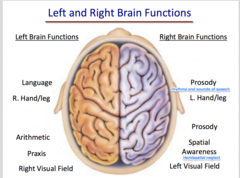
Corpus Callosum
the large band of neural fibers connecting the two brain hemispheres and carrying messages between them
left-handed people have a thicker corpus callosum

Lateralization
specialization of the two cerebral hemispheres for particular operations
Prefrontal Cortex
part of frontal lobe responsible for thinking, planning, and language
Animism
Belief that objects, such as plants and stones, or natural events, like thunderstorms and earthquakes, have a discrete spirit and conscious life.

Centration
The tendency to focus on just one feature of a problem, neglecting other important aspects.

Static Reasoning
A young child thinks that nothing changes. Whatever is now has always been and always will be
Many children cannot imagine that their own parents were once children

Irreversibility
the inability of the young child to mentally reverse an action
fail to recognize that reversing a process might restore whatever existed before
