quantum phenomena
 Call Kai
 Learn
 Practice Test
 Spaced Repetition
 Match
 Flashcards
 Knowt Play
1/34

There's no tags or description
Looks like no tags are added yet.
35 Terms
What is the photoelectric effect?
The phenomenon in which electrons are emitted from the surface of a metal when electromagnetic radiation with a frequency equal to or above the threshold frequency is incident onto it.
What are photoelectrons?
Electrons emitted from the surface of a metal due to the photoelectric effect.
How do electrons absorb photons?
On a one-to-one basis: one electrons absorbs one photon.
What is threshold frequency?
The minimum frequency of electromagnetic radiation an electron must absorb to overcome the work function of the metal and be emitted from its surface.
Why does threshold frequency exist?
The frequency of a photon is directly proportional to its energy, given E = hf.
Each electron absorbs one photon.
Thus, in order for an electron to have enough energy to be emitted from the surface of a metal, the photon it absorbs must have an energy equal to or more than the work function, and therefore a frequency equal to or above the threshold frequency.
What is work function?
The minimum amount of energy an electron must absorb from one photon in order to be emitted from the surface a metal.
Is the threshold frequency and work function of each metal the same?
No, they are characteristic properties of each metal.
What happens to the excess energy gained by a photoelectron when it absorbs a photon with an energy higher than the work function?
It is transferred into the photoelectron’s kinetic energy.
What is the photoelectric equation?
Where:
hf is the energy of the photon absorbed by the electron
Ek(max) is the maximum kinetic energy of the electron
ϕ is the work function of the metal

Why does the kinetic energy of an electron vary up to a maximum value?
Different electrons are located at different depths in the surface of the metal.
Therefore, they lose varying amounts of kinetic energy before they are emitted.
The electrons at the very surface of the metal don’t lose any kinetic energy, as they only need the work function to escape, and thus are emitted with maximum kinetic energy.
However, electrons deeper in the surface have to travel a greater distance to escape, and thus lose more kinetic energy before being emitted.
What is stopping potential?
The minimum potential difference needed to stop photoelectron emission from occurring.
Why is the stopping potential always a retarding (negative) potential difference?
The stopping potential opposes photoelectric current in order to reduce it to 0 - stop photoelectron emission.
What is a vacuum photocell?
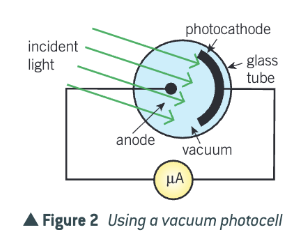
What happens in a vacuum photocell?
The photocathode absorbs the incident light, causing photoelectron emission.
These photoelectrons are attracted to the anode, and move towards it, causing a photoelectric current to flow
What happens as the potential difference across a photocell is increased?
The photocathode becomes more positively charged, attracting the photoelectrons that escape its surface back towards it.
Only electrons with enough KE can overcome this electrostatic force of attraction to reach the anode.
Thus, the photoelectric current decreases as not all electrons manage to reach the anode from the photocathode.
The p.d. at which no more electrons are able to flow from the photocathode to the anode is the stopping potential.
What is the maximum kinetic energy of a photoelectron equal to at the stopping potential?
It is equal to the work done to overcome the force of electrostatic attraction between the photoelectron and photocathode.
Thus, Ek(max) = eVs where:
Ek(max) is the maximum kinetic energy of the photoelectron
e is the charge of an electron (1.6 × 10⁻¹⁹C)
Vs is the stopping potential
What equation is Ek(max) = eVs derived from?
E = QV where:
E is work done
Q is charge
V is potential difference
What is the intensity of a wave?
The power transferred by a wave per unit area, at right angles to wave propagation.
How is the intensity of the incident light related to the photoelectric current?
The intensity of the incident light is directly proportional to the photoelectric current in a photocell.
As the intensity increases, more photons are incident to the photocathode per second given that more power is transferred per unit area.
Thus, more electrons absorb a photon each, causing more photoelectrons to be emitted and travel to the anode per second.
Why doesn’t the intensity of the incident light affect the maximum kinetic energy of a photoelectron?
Increasing the intensity of a light source increases the number of photons emitted per second, and doesn’t increase their frequency if it’s kept constant.
Thus, the energy of each photon remains the same.
And, given that the energy gained by an electron is due to the absorption of one photon only, the energy absorbed by each photoelectron remains the same.
What is excitation?
The process in which an electron moves to a higher energy level after absorbing a photon with a specific energy (equal to the transition between those energy levels).
How is an atom described when excitation occurs?
The atom is said to be in an ‘excited’ state.
What does excitation cause?
It causes a temporary vacancy in an energy level which cane be filled by the same or a different electron.
When does excitation occur?
When an atom absorbs the exact amount of energy equal to the difference in energy between two energy levels.
What is de-excitation?
The process in which an electron moves to a lower energy level after emitting a photon (with an energy equal to the difference in energy between the two energy levels).
What are the two ways in which an atom can be excited?
Electron collision
Photon absorption
How can an atom be excited from a collision with a free electron with sufficient kinetic energy?
The KE of the free electron is partially transferred to one of the atom’s electrons (unless its KE is equal to the difference in two energy levels), causing it to gain the exact amount of energy it needs to move to a higher energy level.
What happens if the free electron doesn’t have enough kinetic energy to cause any form of excitation in an atom?
The free electron is deflected by the atom with no overall loss of KE.
What is ionisation?
The process in which an atom gains/loses an electron, causing it to become an ion.
What does a fluorescent tube contain?
Mercury gas at a low pressure → ensures electrons do not lose too much KE in collisions so that they can still ionise mercury atoms
Fluorescent coating
Evacuated tube → ensures that the free electrons are absorbed by the mercury atoms
Power supply → source of potential difference

How do ionisation and excitation occur in a fluorescent tube?
A potential difference is applied across the tube, causing electrons emitted from the cathode to be accelerate towards the anode (as the electrodes become more greatly charged) and a current to flow.
The free electrons collide with mercury atoms, causing them to become excited or ionised - those that are ionised emit additional free electrons which collide with other mercury atoms.
Eventually, the excited mercury atoms de-excite and emit UV (and visible light) photons.
The phosphor atoms in the fluorescent coating absorb these UV photons and are excited as a result.
When the phosphor atoms de-excite, they emit photons in the visible light spectrum, causing the tube to glow.
What are fluorescent tubes used for?
More energy efficient lighting.
What is an electron volt?
The work done when an electron is moved through a p.d. of 1V.
For a charge Q moved though a p.d. of V, work done = QV.
Thus, 1eV = 1.6 × 10⁻¹⁹J
Why are electron volts used?
They’re used to describe small energy values, e.g. the energy difference between energy levels and ionisation energies.