Unit 1- Lipids
 Call Kai
 Learn
 Practice Test
 Spaced Repetition
 Match
 Flashcards
 Knowt Play
1/48

There's no tags or description
Looks like no tags are added yet.
49 Terms
Common property of all lipids
insoluble in H20
Lipids consist of .. and are …
HC chains and fused rings
Hydrophobic/ampipathic molecules
soluble in organic solvents
benzene, chloroform, alcohol, etc
Saturated FAs have how many double bonds
0
Basic formula→ CH3-(CH2)N-COOH
CH2= methylene
COOH= carboxylic acid group
Normally 4-36 Cs long
most biol. relevant forms 12-24 Cs
FAs are weakly
acidic
pKA→ 4.5-5
Are FAs found in cells? Where
Yes trace amounts are found in cells
Normally bound to lipid molecules/complexed to carrier like albumin in bloodstream
Nomenclature for saturated FAs
Nomenclature only applies to UNBRANCHED FAs
Cn:0
Nomenclature for unsaturated FAs
Nomenclature only applies to UNBRANCHED FAs
Cn:X (cis/trans)-△^y
y= position of double bond(s)
x> or equal to 1 (double bonds)
Know how to draw FAs from the nomenclature at certain pH’s
ph> pka then COO- (deprotonated)
ph<pka COOH (bc lots of H+ floating around)
Most unsaturated CIS FAs are isolated from..
Biological sources
FAs with trans double bonds can be produced by
Ruminants (cows, sheep, etc)→ possess bacteria that can produce trans unsaturated FAs via fermentation
Industrial hydrogenation of unsaturated FAS
Hydrogenation involves adding H2 across double bond
ex) making margarine
How to number the omega in unsaturated FAs
From the terminal carbon
so COOH takes priority in chain =1 then keep counting down chain
Omega-# (where the number is the 1st double bond position from that end tail)
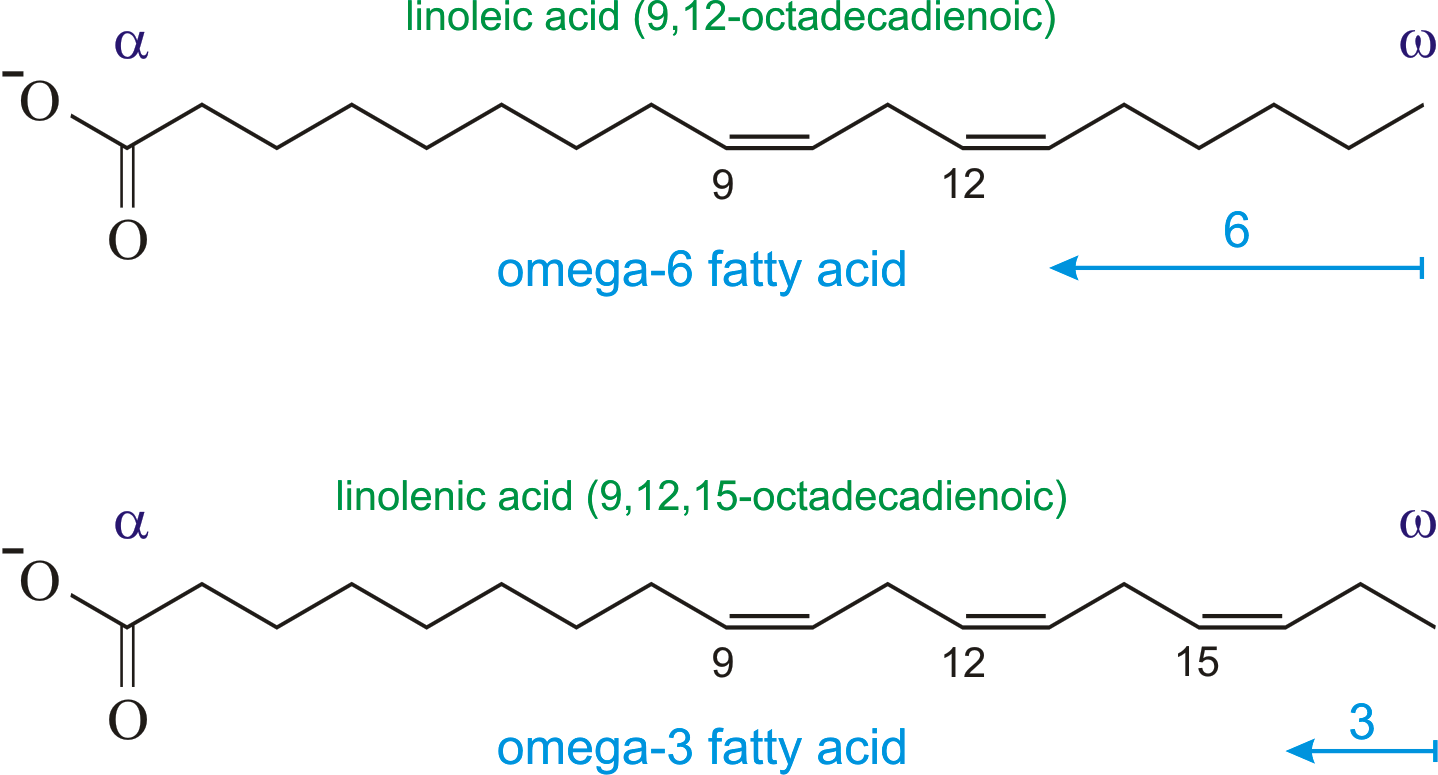
An imbalane of omega__ and omega __ PUFAs is correlated with
Omega-6 and omega-3
correlated with increased risk of cardiovascular disease
Optimal dietary ratio (omega 6-3)
1:1-4:1
in NA it’s 10:1-30:1
get omega-3 FAs from
leafy veggies, flax seeds, veg oils
Fish like salmon cod and tuna
As number of Cs increases what happens to Tm (melting temp) and why?
Tm increases as C # increases because VDWs increases as there’s tighter packing so more forces holding them together
so Tm increases
As double bonds incorporated what happens to Tm and why?
Tm decreases when double bonds added bc this puts kinks in the chain and leads to less tight packing, decreases VDW, decreases Tm (easier to break apart)
Overall Tm trend
Saturated FAs> Unsat Trans FA> Unsat Cis FA
Phytol= long chain alcohol that when consumed→ phytanic acid. Refsum’s disease= neuro disorder related to phytanic acid accumulating in nerve cell membranes.
What general effects of phytanic acid on these membranes would be observed?
When phytanic acid incorporated into membranes Tm decreases bc less packing(as its branched) and this decreases VDW
Phytanic acid liquifies myelin sheath due to decreased VDW so poor communication
How are micelles formed?
when free FAs enter aq soln they can form micelles
If the cross sectional area of A (ball)> B (tail) then free FA takes on a cone-shaped structure→ micelles formed
FA with 1 tail basically
ex) C20:0, lyso___
TAGs (triaglycerols)- neutral fats are derived from?
glycerol backbone
Very reduced
Have 3 FAs attached to 1 glycerol with ester linkage
be able to draw and recognize structure
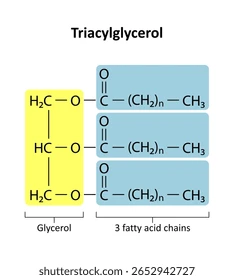
Functions of TAGs
Used mainly for energy storage (fuel)
TAGs stored in special fat cells called adipocytes→ TAGs in adipose tissues can be used for insulation @ cold temps
C’s most reduced compared to carbs + proteins
when oxidized TAGs yield MORE energy (FA’s- 9kcal/g, carbs/proteins= 4kcal/g)
(the glycerol can enter GNG→ DHAP→ glucose)
How do TAGs reduce water weight?
TAGs very hydrophobic + carry less H20 weight than polysaccharides
TAGs come together into dense droplets
Based on structure of TAGs why can this structure NOT form micelles even though FAs are a major component of TAGs? Why are TAGs not a major component of cell mebranes?
The cross sectional areas of A + B are similar so won’t form a micelle
like a cylinder
Not part of membrane bc lack a polar head (not ampihpathic) needed to form lipid bilayer
Biological waxes structure
consist of long chain alcohol + FA that are linked together via ester bond (C=O-O)
Have high Tm
ex) candies, car wax etc

recognize structure of wax


Generalized phospholipid structure be able to draw and recognize
NEXT moving on from storage lipids to STRUCTURAL LIPIDS
→Glycerophospholipids basic structure
Head group(charged)-glycerol backbone- 2 fatty acyl chains
FA-C1 (ester linkage)
FA-C2 (ester linkage)
. -C3-P-alcohol (polar head group)
Phosphoester linkages
ABUNDANT in membranes

Glycerophospholipids are amphipathic meaning?
the molecule has a distinct polar end and np end
If head group (X)= H then what is it?
phosphatidic acid
net charge=-1 (-1 from the phosphate)
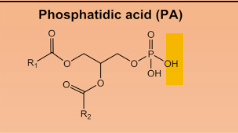

Recognize head group
Ethanolamine
Full lipid name→ phosphatidylethanolamine (PE)
Net charge-0
zwitterionic (neutral molecule with positive and negative charge)

Phosphatidylglycerol (PG)
net charge:-1
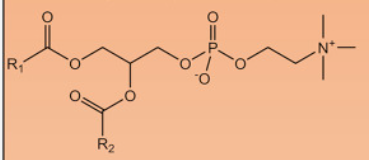
choline (phospatidylcholine PC)
net charge:0
zwitterionic (neutral molecule with positive and negative charge)
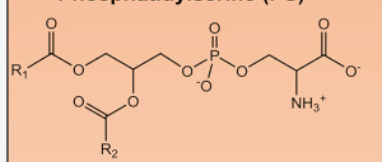
Phosphatidylserine (serine)
Net charge: -1

phosphatidylinositol (inositol)
net charge: -1
PL (phosphilip) aggregates form a BILAYER structure to..
minimize interactions of FA chains (NP) with H20 (polar)
If cross sectional area of A (ball head)=B (NP FA chains) then glycerophospolipid will form bilayer structures
Phospholipases are
hydrolytic enzymes
cut (hydrolyze) glycerophospholipids
Phospholipase A (1 or 2 ) cut 1 of the FA chains→ lysophospholipid + free FA
PL C and D are phosphodiesterases
PLC→ DAG + phospho__(head group)
PLD→ phosphaditic acid + head group X

Why do lysoPL form micelles instead of bilayer structures?
Because lysoPL have 1 FA cut off the chain→ this forms a micelle bc A cross section > B (forms cone in aq envt→ micelles)
thus, lyses cells (no cell membrane intact bc no bilayer formed)
PC + H20→ Lyso-PC + free FA
. A2
Friend bitten by snake almost dying from hemolysis (rbc breaking). Why is phospholipase A1 in the venom responsible for rbc hemolysis?
Phospholipids + H20→ lysoPL + Free FA
. A1
Problem because rbcs burst as micelles form instead of bilayer (lyses cells)
Sphingosine backbone
look for ONO
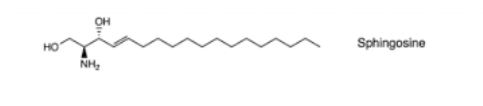
Ceramide
When X=H on O of C1
FA attached in AMIDE LINKAGE w/ NH2

Sphingomyelin
When X= phosphocholine/ phosphoethanolamine on C1’s oxygen
Part of myelin sheath that surr and isnulates axons of some neurons
ONLY cell membrane PL in humans not derived from glycerol


Glycosphingolipids
Cerebrosides
1 sugar (galactose/glucose) linked to C1’s oxygen in ceramide
GALACTOSE attached
found in membranes of cells in neural tissues
GLUCOSE
found in membranes of cells in non-neural tissues
(neutral no charge at ph 7)

Glycosphingolipids
globosides
X=2 or more sugar monomers on C1 oxygen in ceramide

Glycosphingolipids
Gangliosides
X= 3 or more sugar monomers on C1’s oxygen in ceramide
1 of the sugar monomers MUST BE N-acetylneuraminic acid (Neu5Ac/sialic acid)
each of this monomer gives the ganglisode a -1 charge at neutral pH

Neu5Ac structure in ganglioside

Cholestrol structure
4 fused rings
3 with 6 C’s: 1 w/ 5C’s
Planar and rigid
Amphipathic
Precursor for steroid hormones
bile acids= polar derivates of cholestrol

Eicosanoids are ___ and derived from___
signaling lipids derived from arachidonic acid (FA is c20:4 cis-triangle(5,8,11,14)
Act as paracrine hormones (= short range acting hormone)
Arachidonate then leads to formation of..
Prostaglandins → in response to tissue injury, cause pain response
Thromboxane→ produced by platelets, induce formation of blood clots
NSAIDS work on them
Leukotriene→ causes contraction of smooth muscle lining lung airways, overproduction= asthma attack
Why are Aspirin/Ibuprofen (NSAIDS) “non steroidal”
they lack 4 fused rings and arent steroids
Steroid hormones exs
Estrogen and testosterone
Steroid hormones are derived from cholestrol
carry messages bw tissues
Lipid soluble vitamins exs
Vitamin K and E
important for blood clotting
aids in producing prothrombin which is used to make fibrin (a insoluble fibrous protein)
need to get from diet
Fibrin is a protein that
holds blood clots together
acts as biological antioxidants
helps in preventing oxidative damage to membrane lipids
When drawing a FA at different pH’s when to put a COO- or COOH
ph> pka then COO- (deprotanated)
ph<pka then COOH (bc have lots of H+, fx group picks up and we get the protonated form)
pka~4.5