Research skills A- Quant
 Call Kai
 Learn
 Practice Test
 Spaced Repetition
 Match
 Flashcards
 Knowt Play
1/32

There's no tags or description
Looks like no tags are added yet.
33 Terms
Rene descartes
Beginning of modern philosophy:
French- desire to answer life's significant questions
Rationalism- the use of reason and logic to derive the truth- can't rely on the sense because they can deceive.
Mind-Body dualism- the mind and the body are conceptually separate
John Locke
British- disagreed with Descartes
Empiricism: Our knowledge of the world is constructed through experiences- Black slate 'tabula rasa'
Environment directly shaped the mind and behaviour was adopted later by the behaviourism movement- Pavlov's dogs
Gustav Fechner
Physician with interests in physiology and psychology- Leipzig
Interested in the relations between sensations and the physical stimuli producing them
Developed Psychophysics
Fechner's psychophysics:
Uniting the mind and body mathematically
Converting human behaviour into numbers using experimental methods- quantitively
Led to developments of psychometrics and experimental psychology
Fechner and Wundt
Arguably, Fechner's work on psychophysics entitles him to the claim of the first experimental psychologist
Fechner himself didn't appreciate that his work showed that psychological phenomena could be subjected to scientific methodology
Paved the way for Wilhelm Wundt
Founding father of Psychology
Worked with Fechner in Germany but Fechner was old and eventually died
First psy lab at uni of Leipzig in 1879
Physiological psychology
Believed that some phenomena couldn't be studied experimentally- Volkerpsychologie
Wundt’s experimental methods
Structuralism- Breaking down mental processes into their basic elements
Use of introspection- Introspection means looking inward and examining your own thoughts, feelings, and mental experiences- Griffiths (1994)- gamblers
Developed the first journal of Experimental psychology "philosophical studies"
Darwin and psychology
In 1859 CD published The origin of Species
'Human nature' in the broader context of evolutionary change
Arguments are evidence-based; phenomena are rigorously observed (scientific)
Darwin and Psych:
Functionalism- how human behaviour and mental processes serve to adapt an individual to an ever-changing environment
Led to the systematic study of individual differences- intelligence and personality tests
Studied emotions for first time
Francis Galton- his legacy
Darwin's cousin, influenced by Darwin's work
Intelligence in inherent
Argued for eugenics- selective reproduction of the fittest in society
Should get the people with the highest intelligence to reproduce to get highest level of human ability
Galton's Legacy:
Questionnaire design used for first time by him- he took a long time to develop the questions
The normal distribution- average IQ- 100
Intelligence tests- used for a long time
Correlation- found between head size and intelligence
Twin study methodology
William James
Exploration of why the mind works in the way it does
Father of American psychology
Wrote 'the principles of psychology'
He worked with more women- not usual for psychology
Psychology as a science
Psychology- the scientific study of the mind and behaviour
Should be empirical- verifiable by observation, measurement or experimentation, rather than just reason and logic
Quantifiable versus intuition
Systematic
Objective
Allows us to establish laws or theories
Two types of reasoning
Deductive- reasoning from general statements or premises to a logical and certain conclusion
Inductive- reasoning from general statements or premises to the probable validity of a conclusion
Inductive and Deductive reasoning
Video on this
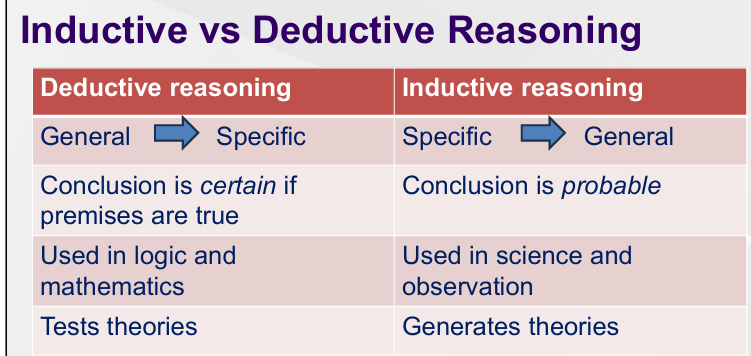
Science and induction reasoning
Science and induction reasoning
Induction offers a powerful intellectual tool in science
Enables the development of general laws and theories
Combined with systematic observation, induction seems to offer a method for generating scientific laws.
Problem with induction:
No amount of experiments showing that water has always boiled at 100 degrees in the past can prove that water will boil at 100 degrees tomorrow
David Hume problem of induction: how can we justify the assumption that what will happen in the past will happen in the future.
We should go out to look to prove something wrong rather than trying to prove something right
Verification and falsification
No amount of observations can prove that water always boils at 100 degrees but only 1 contrary observation would prove that water does NOT always boil at 100 degrees.
Empirical generalisations are falsifiable even if they are not verifiable.
'An empirical generalisation is a statement based on observations or evidence that makes a claim about a wider group or situation.
This is falsifiable because you could collect evidence that shows the statement is wrong—for example, research could consistently find that exercise does not improve mood under the conditions being studied.
But it is not completely verifiable because you can never test every single person who exercises.'
If it isn't falsifiable, it isn't science
Why did psychology not develop before 1850
Religion played an important role.
In the 1600s, the study of the soul was called Pneumatology.
Religious authorities wanted to maintain control over knowledge about the soul.
They resisted scientific approaches that challenged religious beliefs.
The three philosophical traditions before psychology
Associationism
Scottish common-sense realism
Rationalism
Associationism
Began with John Locke (1689).
Believed all knowledge comes from basic sensations and experiences.
Simple sensations combine to form complex ideas through laws of association.
Influenced later psychologists and philosophers.
Key idea: Knowledge develops through experience and associations.
Scottish common-sense realism
Developed by Thomas Reid (1764).
Reaction against associationism.
Believed humans have innate mental abilities (faculties), but these should be studied through experience.
Combined rationalism and empiricism.
Influenced early American Psychology.
Key idea: The mind has natural abilities, which can be studied through experience.
Rationalism
Believed knowledge can be gained through reason and logical thinking.
Emphasised innate knowledge rather than relying only on experience.
Differences between countries in psychology
France: Associationism suited philosophers who wanted to challenge religious beliefs.
Scotland: Common-sense realism aimed to combine philosophy with Protestantism and understand society.
Germany: Philosophers focused more on abstract intellectual ideas, with little influence from industrialisation.
England: Preferred associationism because it fitted with Newtonian science and avoided abstract speculation.
Phrenology
Franz Gall
Suggested different brain areas controlled different mental functions.
Claimed skull shape could reveal personality and character.
Popular from 1810s–1850s.
Influenced early psychologists, including Herbert Spencer and Alexander Bain.
Later discredited, but helped popularise the idea of a scientific study of the mind.
Wood, Kemp, Waldron study
Parents and teachers- children using text abbreviations negatively impact children's use of standard English.
Ppts:
Children aged 8-12 in primary and secondary schools
Methodology:
Children assessed on measures of intelligence, grammar, processing ability and spelling
Also asked to provide a sample of text messages sent over a 2-day period to be analysed for grammatical errors
Findings:
No link between children using 'text-talk' and grammatical skills
The importance of research
To develop objective, empirical evidence to inform knowledge
Research in Psychology has informed, for example:
Drugs used to treat psychological conditions
The development of IAPT
Policies and guidelines to protect children: physical activity, nutrition, screen use
Always need to look at evidence that falsifies evidence- contradicts what we know- disproves something
Science and ‘proof’
Research studies don't prove theories with certainty
- suggests, supports
Are all swans white….- haven't witnessed ALL swans, so can't prove it
But we do combine a deductive and inductive approach
What was the traditional scientific method in psychology known as
Hypothetico-deductive
Types of research/ alternative hypothesis- causal
Causal: suggests a particular casual influence
Only appropriate if you are using an experimental design
Consuming caffeine causes driving impairment
Types of research/ alternative hypothesis- non-causal
Non-causal/ associative: suggests particular characteristics of behaviour without reference to causation.
Consuming caffeine is associated with driving impairment
The hypothetic- deductive method
Observation/ identification of a problem
Exploratory theory
Deduce hypothesis/es to test the theory
Test hypothesis/es
Interpretation of the results and refinement of theory/application
Generalisability
In quan research we develop theories to generalise to wide population
Generalisability- the extent to which findings can be generalised across a sample or population
By using stats we are able to generalise from the sample of people who have completed our research, to the wider population
Importance of a 'representative sample'
Replication
Repeating a research study in the same way as it was originally conducted
To be sure that the generalisations we make from our research samples hold true for the population
Theories aren't based on one study alone- the importance of replication
Why should we replicate
To avoid 'flukes'
To increase confidence in results
Independent replications- not same researcher
Can involved minor modifications (different ppts/ situations)