Acute Coronary Syndrome
 Call Kai
 Learn
 Practice Test
 Spaced Repetition
 Match
 Flashcards
 Knowt Play
1/56

There's no tags or description
Looks like no tags are added yet.
57 Terms
ACS diagnostic labs
ECG
Cardiac biomarkers
(+) → STEMI & NSTEMI ; (-) → UA
Cardiac troponin (cTn)
High-sensitivity (hs-cTn) → elevated within 1-2hr
ECG for STEMI
ST segment elevation
ECG for NSTEMI
ST segment depression
T-wave inversion
No change
ACS diagnostic labs frequency
ECG
Within 10mins of presentation (12-lead ECG)
Q15-30min during 1st hour if high suspicion for ACS
hs-cTn
Cardiac Biomarkers test frequency
hs-cTn q1-2 in ED after Sx onset
Goals of therapy for ACS
Early restoration of blood flow to infarct-related artery
Prevent infarct expansion & prevent complete occlusion
Resolution of ST or T changes in ECK
Relief ischemic chest discomfort
Prevent death, coronary artery reocclusion, and complications
General Tx for admitted patients
Bed rest
continuous rhythm monitoring
O2 if sat <90%
Frequent vitals
ECHO
Eval LVEF, valvular abnormalities,c complications
Initial Tx for admission
Oxygen
Analgesics
1st line →Nitroglycerin
IV for continuous ischemic discomfort, HTN, HF
SL for ischemic discomfort
Opioids (morphine / fentanyl)
Antiplatatelet (ASA0
Betablocker → within first 24hr
Nitroglycerin SL dosing
0.3 - 0.4mg SL q5min x 3 doses
Nitroglycerin IV dosing
10mcg/min IV infusion → titrate 75-100mcg/min until relieved Sx or SBP <90 or decreased >30mmHg below baseline
Continue for 1-2d or until PCI
Nitroglycerin alternatives for discontinued or refractory symptoms
Patches or oral
Nitroglycerin contraindications
HoTN
PDE-5i (Avanafil, Sildenafil, Vardenafil, Tadalafil)
Opioids indication
Continued ischemic chest pain despite nitroglycerin Tx
Opioids contraindications
Respiratory depression
Confusion
Obtundation
ASA indication
All patients to reduce death and Major adverse cardiovascular events (MACE) — Nonfatal MI/Stroke etc
ASA dosing
162-325mg PO once on hospital day 1
8mg PO daily on hospital day 2, cont indefinitely
All patients to reduce death and MACE
ASA contraindication
Hypersensitivity
Active bleed / severe risk
BB indication
initiate PO in all patients within first 24hr (without CI)
BB contraindications
PR interval >240 msec
2nd / 3rd degree heart block (no pacemaker)
HR < 60
SBP <90
Acute HF
Active bronchospasm
BB dosing
Metoprolol tartrate 12.5 - 25mg PO q6
Switch to BID or SID (succ) prior to discharge
CCB indications and contraindications
Non-DHP (Diltiazem / Verapamil) can be used with continuing ischemia and CI to BB
AVOID
HFrEF
Cardiogenic shock risk factors (>75, Hx MI)
PR interval >240 msec
2nd/3rd heart block w/o pacemaker
Pre-hospital meds that can be given at home or in ambulance
ASA + NTG
Routine invasive strategies for NSTE-ACS
Cardiac catheterization
Usually within 24-72h of Sx onset
Primary percutaneous coronary intervention
Invasive Strategy management in NSTE-ACS
Unstable / V high risk → Immediate < 2hr
Cardiogenic sock, HF, Refractory angina
High risk → Routine invasive
Rising troponin values despite therapy
Ongoing ST changes
Intermediate → routine
No ischemic Sx, stable troponin
Low risk → selective invasive
No ischemic Sx, no ST change
Selective invasive strategies for NSTE-ACS
Not immediate cardiac catheterization = lower risk
Initial medical therapy before revascularization
Contraindication for Routine Invasive approach in ACS
High risk for bleeding in dual antiplatelet therapy (DAPT)
Severe thrombocytopenia (plt <50 × 10^9/L)
Advanced kidney disease (not on dialysis)
Acute renal failure
1-2y life expectancy
Advanced dementia
Known coronary anatomy that precludes PCI / CABG surgery
Patient preference
3 timeframes for ACS Tx
Prior, during, and after coronary angiography or PPCI
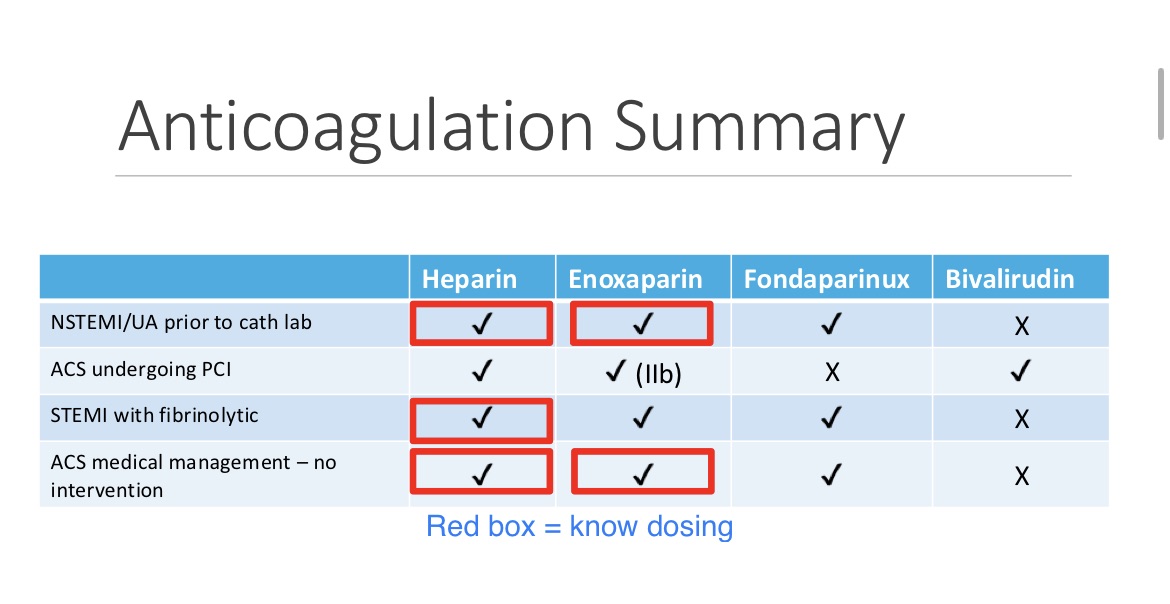
Anticoag Indications
NSTE-ACS upstream → BEFORE angiography
Heparin infusion (routine invasive) or Enoxaparin
Continued until revascularization (PCI/CABG)
PPCI
Heparin or Bivalirudin
STEMI with fibrinolytics
Heparin or Enoxaparin
ACS medical management
Heparin or Enoxabarin
UFH dosing
60 units/kg IV bolus (max 4000)
Then 12 units/kg/hr IV infusion (max 1000 units/hr initial infusion rate)
D/C after PCI / revascularization
UFH monitoring
Activated thromboplastin time (aPTT) q6 until therapeutic → q24
Goal 1.5 - 2.5 x normal (50-80s)
Activated coagulation test (ACT)
During angiography
UFH contraindication
active bleed or severe risk
Hx HIT
recent stroke
AEs → bleeding (reversal protamine) and HIT
Enoxaparin dosing for NSE-ACS prior to LHC (left heart catheterization)
1mg/kg SQ q12
q24 for CrCl <30
D/C after PCI or revascularization
Enoxaparin contraindications
Active bleed / severe risk
Hx of HIT
Recent stroke
Planned CABG surgery
Enoxaparin monitoring
Anti-Xa levels
Pregnancy, renal insufficiency, obesity
AEs
Bleeding (SCr)
HIT
Bivalirudin indication
only during coronary angiography and PCI
Anticoag of choice Hx HIT
CI → active bleed or severe risk
Continue until end of PCI or 2-4hr after
Monitor
ACT, aPTT, SCr
Antiplatelet indication
Additional P2Y12i to ASA for all patients
Ticagrelor > Prasugrel > Clopidogrel ± PCI

Clopidogrel indication & dosing & AEs
STEMI undergoing PCI / NSTE-ACS w routine invasive strategy
600mg PO loading dose asap before or during PCI
Then 75mg PO daily starting hospital day 2
For 12 months
Bleeding, Diarrhea, Rash
Prasurgrel indication & dosing & AEs
Given after coronary angiography (PCI); NO CABG
>60kg → 60mg PO loading dose → 10mg PO SID
<60kg → same LD → 5mg PO SID
Avoid in >75yo unless DM or Hx MI → lower dose
For 12 months
Bleeding, Diarrhea, Rash
Ticagrelor indication & dosing
STEMI undergoing PCI & NSTE-ACS
180mg PO loading → 90mg PO BID
For 12 months
Ticagrelor AEs
SOB, bleeding, ventricular pause
CI → severe hepatic impairment, active bleed
Dual antiplatelet therapy (DAPT) post discharge
12 months
Ticagrelor or Prasugrelor preferred post PCI
Cangrelor indication
STE-ACS and high risk NSTE-ACS undergoing PCI that have NOT been loaded with P2Y12 inhib
combo with anticoag during PCI (UFH or Bivalirudin)
GP IIb/IIIa inhibitor is NOT planned
Ticagrelor DDIs
AVOID strong 3A4, Simvastatin/Lovastatin
Use lower dose for concomitant ASA (81mg)
Increase Digoxin levels
Cangrelor dosing
Start of PCI
30mcg/kg IV bolus <1min → 4mcg/kg/min IV infusion
continue infusion for at least 2 hrs or duration of PCI (whichever is longer)
After PCI + oral P2Y12i started
After cangrelor d/c → clopidogrel 600mg / prasugrel 60g
GP IIb/IIIa inhibitors indication (Eptifibatide, Tirofiban)
Used during PCI to reduce infarct size
Large thrombus burden
No reflow / slow flow
Not used with cangrelor
Eptifibatide contraindication & duration
Active bleed, Thrombocytopenia, Renal failure
Renal adjustment for CrCl <50
18-24hr after PCI
Tirofiban contraindication & duration
active bleed, thrombocytopenia
Renal adjustment for CrCl <60
18-24hr after PCI
Gp IIb/IIIa inhibitor AEs & monitoring
Thrombocytopenia, bleeding
Hgb/Hct
Platelets
Check baseline → 4hr
Concomitant UFH
SCr
No reversal agent
Lipid management & dosing for ACS secondary prevention
High intensity statin should be initiated/cont in all patients with NSTE-ACS to reduce MACE risk
Atorvastatin 40-80mg PO SID
Rosuvastatin 20-40mg PO SID
Statin intolerance → non-statin lipid lowering agent
Already on statin + LCL-C >70 → add on ezetimibe
continued indefinitely
BB indication for secondary prevention
All patients with ACS → HR target 50-60 & reduce reinfarction and ventricular arrhythmias
At least 3 yrs → indefinitely for other indications (HFrEF, afib)
CCB indication for secondary prevention
Intolerant / CI to BB → Diltiazm or Verapamil
Already on BB and Nitrates
Nitrates secondary prevention
All post-MI discharged with SL or Spray NTG for acute angina attacks
Long-acting reserved
NO/unsuccessful revascularization
Recurrent Sx AFTER revascularization
RAASi indication for ACS secondary prevention
high risk with ACS (HFrEF, HTN, DM, STEMI with anterior location)
ACEi or ARB
ACS + HFrEF (LVEF <40%) and with HF Sx ± DM
MRA
Discharge meds
ASA
P2Y12 (-grel / -grelor)
High-intensity statin
BB
SL NTG
RAASi
Non-pharmacological recommendations
Influenza vaccine annually
Smoking cessation
Diet And Exercise
Avoid NSAIDs
Reperfusion Tx indication
All eligible pts with STEMI within 12hrs of Sx onset
Primary PCI
Fibrinolysis
PCI within 90 mins of first medical contact (door to balloon time)
Unable to undergo PCI within 120min of first medical contact → evaluate & receive fibrinolytic within 30 mins of hospital presentation (door to lysis time)
ACS + cardiogenic shock or hemodynamic instability
Emergency revascularization via PCI or CABG
Fibrinolytic indication
patients with STEMI and symptom onset of <12 hours and anticipated delay to PPCI >120 minutes from FMC, fibrinolytic therapy should be administered in patients without contraindication to reduce MACE
These drugs are NOT used for NSTE-ACS!!