Stages of mitosis
 Call Kai
 Learn
 Practice Test
 Spaced Repetition
 Match
 Flashcards
 Knowt Play
1/10

There's no tags or description
Looks like no tags are added yet.
11 Terms
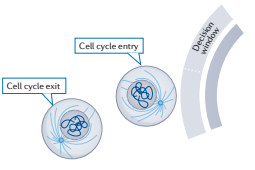
G1 phase
• Enter cell cycle or exit cell cycle (G0/quiescence)
• Depends on intrinsic signals (cell size)
• Depends on extrinsic signals (nutrients/ mitogens)
• Requires CycD/CDK4 or CDK6
• Most cells in your body have exited the cell cycle!

S phase
• Genome duplication
✴Once and only once per cell cycle
✴All or nothing •Requires S-CDK activity (CycE/CycA-CDK2)
• Centrioles are duplicated (centrosomes)

G2 Phase
• Ensure that DNA replication is complete
• Repair/resolve any DNA damage prior to mitosis

M Phase
• Chromosome segregation
• Requires M-CDK - CycB/CDK1

Prophase
• Duplicated chromosomes condense
• Mitotic spindle assembles
• Centrosomes move apart
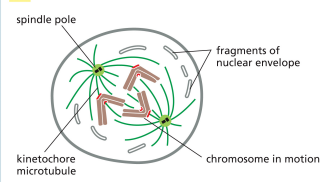
Prometaphase
• Breakdown of the nuclear envelope
• Chromosomes attach to the mitotic spindle through the kinetochore
• Active movement of chromosomes

Metaphase
• Chromosomes align a the equator of the spindle
• Each sister chromatid is attached to opposite poles of the spindle
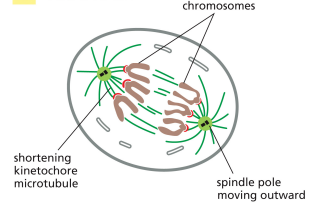
Anaphase
• Sister chromatids are pulled toward the spindle pole
• Kinetochore microtubules get shorter
• Spindles move outward

Telophase
• Chromosomes arrive at the spindle poles
• New nuclear envelope reassembles around each set of chromosomes
• Chromosomes begin to decondense

Cytokinesis
• Cytoplasm is divided in two by a contractile ring
• Two daughter cells are formed, each with one nucleus
Phases w/in interphase
G1, S, G2 (everything except M phase)