Inorganic chem
 Call Kai
 Learn
 Practice Test
 Spaced Repetition
 Match
 Flashcards
 Knowt Play
1/96

There's no tags or description
Looks like no tags are added yet.
97 Terms
Three things metallic bond strength depends on
size of the cation( smaller = stronger)
charge( higher = stronger)
Amount of delocalised electrons for one atom ( the more = stronger)
Si
Semi metal and
giant covalent structure ( highest melting point in period 3)
phosphorus, sulfur, chlorine, Ar
name their formulas
P4
S8
Cl2
Ar
Solid oxides
Alays white colour
Reaction of solid sodium with oxygen
Product- white solid (Na2O)
Flame- Bright yellow
Reaction- vigorous
conditions-heat
Oxygen- not in excess
Reaction of solid magnesium with oxygen
Product- white solid (MgO)
Flame- Bright white
Reaction- vigorous
conditions-heat
Oxygen- not in excess
Reaction of solid aluminium with oxygen
Product-White solid (Al2O3)
Flame-bright white
Reaction- fast
conditions- powdered Al , heat
Oxygen-not in excess
Reaction of solid phosphorus with oxygen
Product-White clouds(P4O10)
P—+5
Flame-bright white or yellow
Reaction- vigorous
conditions- heat
Oxygen-must be in excess
Reactions of sulfur (solid) with oxygen
Product- Yellow solid melt , toxic fumes (SO2 gas, not SO3)
Flame- Blue flame
Reaction-Gentle
Conditions- heat , powdered
Reaction of sodium with water
(NaOH (aq)) produced.
Vigorous reaction
floats/ moves on surface
dissolves / disappears
Effervescence
Reaction of magnesium with water(cold)
Mg(OH)2
Very slow reaction as it loses its electron less readily
Less soluble so forms clouds
Reaction of magnesium with steam( at higher temperature of water)
MgO formed
Vigorous
Colour of chlorine gas
Yellow green
Period 3 chlorides solid colour
White
Sodium reaction with chlorine
White solid (NaCl)
Chlorine colour disappears
Bright orange flame
How to do- pass the chlorine gas over the metal
Magnesium reaction with chlorine
White flame
White solid is formed (MgCl2)
Chlorine colour disappears
How to do- pass the chlorine gas over the metal
Aluminium reaction with chlorine
White solid (AlCl3 or Al2Cl6)
Chlorine colour disappears
How to do- pass the chlorine gas over the metal
Silicon reacts with chlorine
Colourless liquid (SiCl4)
Color of chlorine disappears.
How to do- pass the chlorine gas over the powdered silicon
Phosphorus reacts with chlorine
PCl5 (white solid formed)
Colour of chlorine decreases
sodium oxide and metal oxide are basic in nature why?
Because it contains oxide ion (O2-) which is a very strong base and accepts the proton
producing alkaline solution
O2- + H20 ——- 2OH-
Na2O with water(cold)
Highly exothermic (vigorous)
Solid dissolves
NaOH(aq) formed
ph of solution - 12-14
MgO with water
Mg(OH)2
slightly soluble only so ph of solution is 8-10, a weak alkaline solution formed
Only slightly exothermic(slow reaction)
Aluminium oxide nature and why?
Ampotheric
Ionic compound with covalent character
When placed in water what happens?
It is insoluble it does not react
Aluminium oxide + sodium hydroxide (special reaction)
Not necessarily need to know second one
hot and concentrated please

SiO2 and its reaction with water
Insoluble in water as it is a giant covalent structure.
so no reaction
Silicon oxide + sodium hydroxide
Hot concentrated
SiO3 (-2)
silicate ion

reaction of P4O10 with water
Phosphoric acid produced. (H3PO4)
PO4 (-3)
Vigorous reaction
pH 2
Hydrolysis
reaction of SO2 and SO3 with water
ph of solution 1

Sodium chloride in water
White solid dissolves to form colourless solution

Magnesium chloride in water
White solid dissolves to form colourless solution
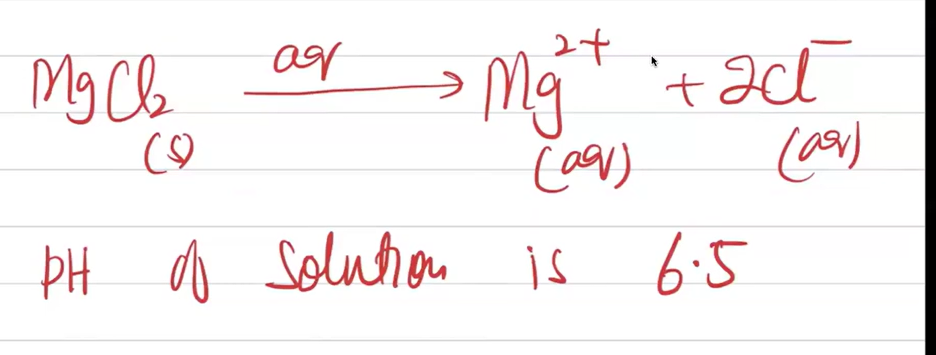
At high temperatures AlCl3 is converted to
Al2Cl6
Both of them are mostly simple molecular but when added in water they behave as ions
Most of ionic compounds do not
react chemically with water they only dissociate into ions
When AlCl3 or Al2Cl6 reacts with water
pH 3
Steamy fumes of HCL gas
This is hydrolysis reaction
Look at explaination in book

SiCl4 reaction with water
White Solid SiO2 forms
pH is 2
Steamy fumes of HCl gas produced
Still hydrolysis
PCl5 reaction with water
H3PO4 formed
White steamy fumes of HCL has formed
Hydrolysis
Vigorous
Important
Going across Period 3, their chlorides and oxides become more covalent and their structure shifts from a giant ionic to a simple molecular structure
Their reactions with water become more vigorous as a result of this, as it becomes easier to hydrolyse the chlorides and oxides
Magnesium reaction with oxygen
MgO produced (solid)
Bright white flame
white solid produced
Burns easiest
Calcium reaction with oxygen
white CaO (solid)
Brick red flame
Difficult to ignite
Sr reaction with oxygen
white solid of SrO formed
red flame
Difficult to ignite
Barium with oxygen
White solid formed
Apple-green flame
Difficult to ignite
Magnesium with water
Mg(OH)2
It is only slightly soluble so weak alkaline solution
Slightly soluble - Cloudy white suspension
Slow reaction
Gas bubbles
Magnesium with steam
white solid Magnesium oxide formed
Magnesium glows
Vigorous
Calcium with water
Ca(OH)2
Reacts and dissolves more readily than magnesium
Slightly soluble — cloudy white suspension
Still weak alkaline solution formed
bubbles
Trend continues (Sr, Ba)
Do not write cloudy suspension for them though
Metal + dilute hydrochloric acid =?
Metal + dilute sulfuric acid=?
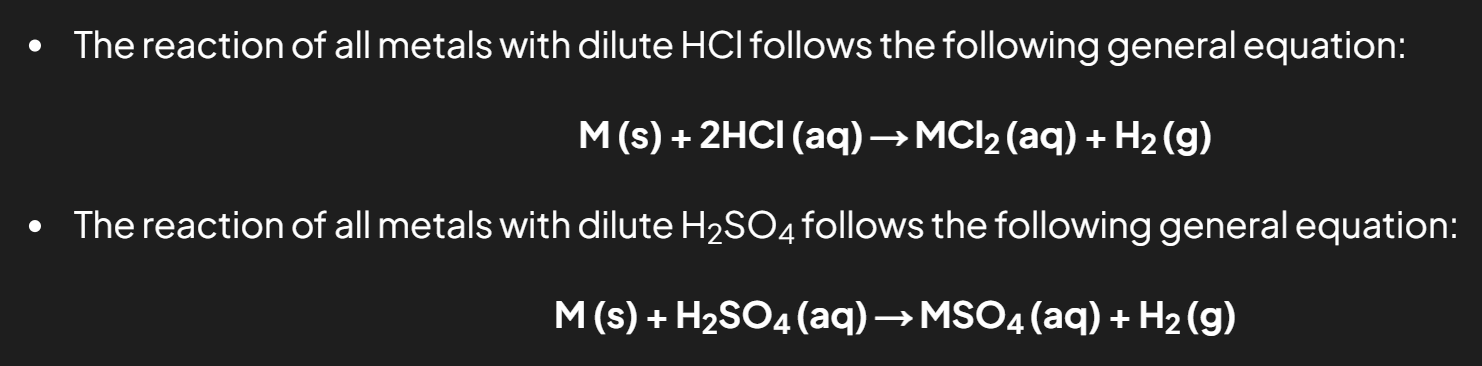
Reaction of group 2 elements with hydrochloric acid

Reaction of group 2 elements with dilute sulfuric acid

What is insoluble amongst the sulfates
Remember that for sulfates solubility decreases down the group

Solubility of group 2 oxides and hydroxides
Increases down group
When group 2 oxides are placed in water what happens to reaction as we go down group
Becomes vigorous
no fizzing
As calcium hydroxide and magnesium hydroxide are very slightly soluble in water they are written as solids and they also
form white cloud suspension
Reaction of group 2 oxides with sulfuric acid and hydrochloric acid
no trend with HCl

What happens when group 2 hydroxides are placed in water.
They dissolve in water

All group 2 carbonates
Are insoluble
Group 2 carbonates reaction with water
No reaction
Group 2 carbonates reaction with acids
For HCL no trend
all reactions produce fizzing
For H2SO4
fizzing stops or slows down when insoluble layer forms
and remember the solid salt is formed in Ca,Sr, Ba

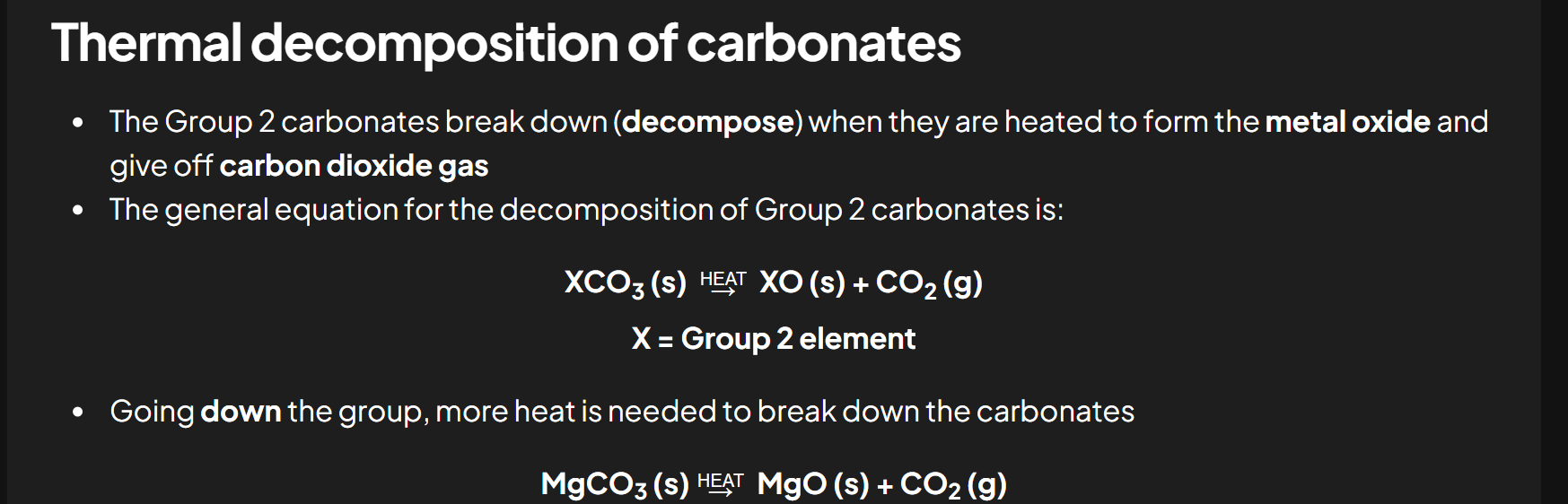
Thermal decomposition of group 2 carbonates
Thermal stability is the ability of a substance is the ability to resist decomposition
IN this case thermal stability increases down the group as they require more heat to decompose down the group
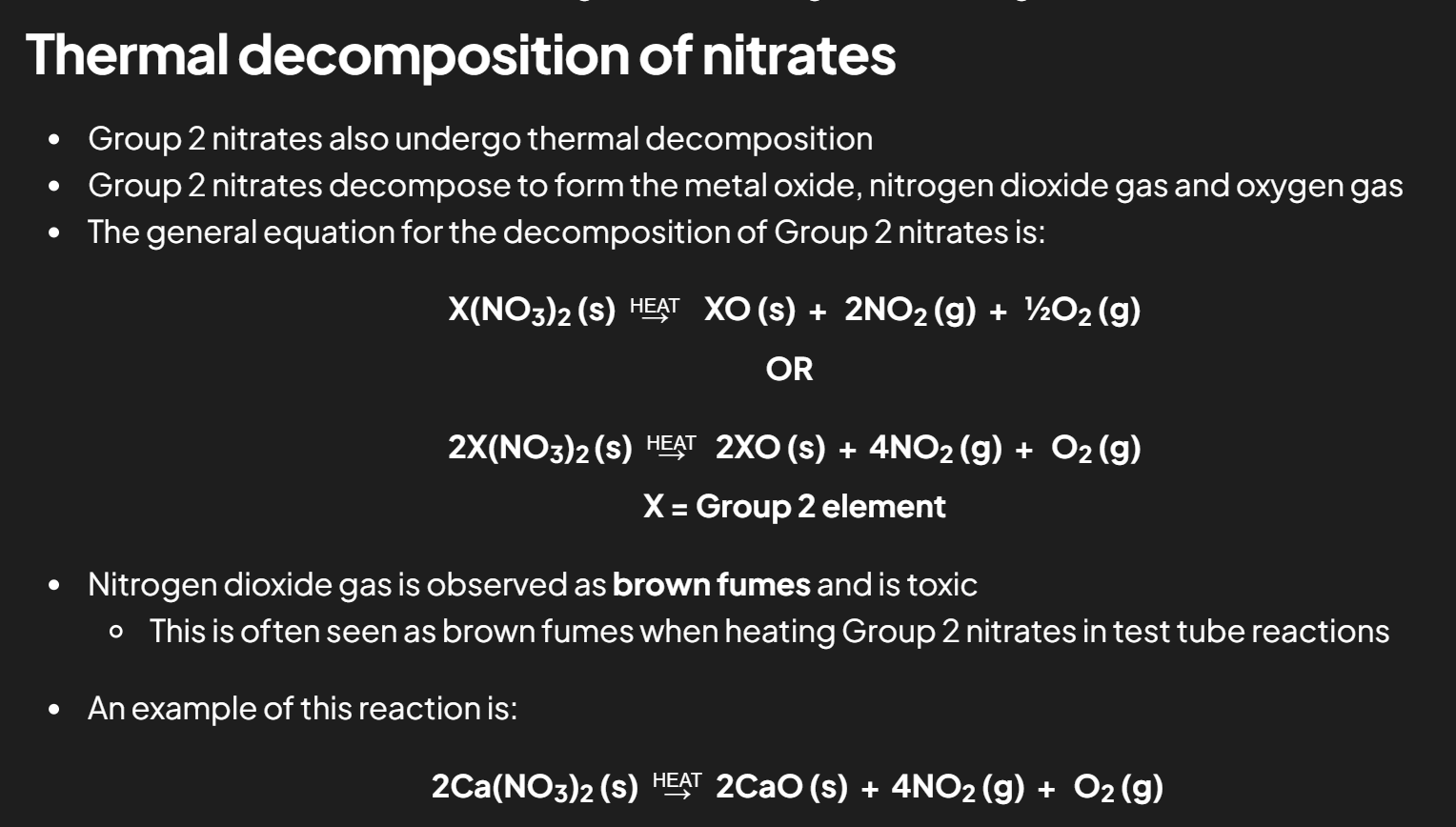
What do metal nitrates decompose to

Thermal decomposition of group 2 nitrates
Same trend for thermal stability it increases down the group
brown fumes
Colour of fluorine gas
Pale yellow
Colour of chlorine gas
yellow-green
Colour of bromine liquid
orange/ brown
Colour and state of iodine at room temp
Grey-black solid
Colour of iodine vapour
purple
colour of iodine solution
Brown
What is Volatility explain trend down
Volatility is how easily an object evaporates
The lower the boiling point the easily it evaporates so higher the volatility
Down the group electrons are more so stronger Id-Id forces and hence IMF is stronger so BP higher and volatility decreases down group
Describe and explain bond strength of halogen molecules down the group
Bond strength generally decreases down the group
as atomic radius increases down the group.
The bonding electrons are further from the nuclei.
The attraction between the nuclei and the shared pair of electrons becomes weaker.
Therefore, the covalent bond becomes weaker

Oxidising agents:gain e-
Why and what happens to oxidising power of halogens down the group?
Down the group atomic size increases, shielding increases, nuclear pull decreases on outer electrons, the ability to gain electrons easily decreases
Oxidising power decreases down group
F2>Cl2>Br2
Reaction of fluorine gas with hydrogen

Reaction of chlorine gas with hydrogen

Reaction of bromine gas with hydrogen

Reaction of iodine gas with hydrogen
Forms an equilibrium as reaction is too slow.

Why do this reactions become less vigorous down the group?
As the halogens have less oxidising power down the group.
Thermal stability(resistance to decomposition when heated) of hydrogen halides
Thermal stability decreases down the group
This is because H-F bond is strongest as the halogen is the smallest so bond length is smallest and hence bond strength is the highest
Bond length is inversely proportional to bond strength
Remember that hydrogen halides form polar covalent bond(slight ionic character)
Rule for halogen displacement reaction
It only happens if the halogen is a stronger oxidising agent than the halide ion
Cyclohexane can be used to do this displacement reactions
Trend of halide ions as reducing agents down the group
reducing power increases down the group
F^- is poorest reducing agent as it is the smallest so less shielding and hence stronger nuclear attraction on outer shell electrons
Chloride ions in a solution with aqueous silver ions
White ppt of AgCl
AgCl in dilute aq ammonia
and in concentrated aq ammonia
PPt dissolves
Bromide ions in a solution with aqueous silver ions
Cream ppt of AgBr (s)
AgBr in dilute aq ammonia
and in concentrated aq ammonia
dilute- does not dissolve
concentrated- dissolves
iodide ions in a solution with aqueous silver ions
Yellow ppt of AgI
AgI in dilute aq ammonia
and in concentrated aq ammonia
PPt does not dissolve
All halide solutions
are colourless
What is the reaction of chloride ions with
concentrated sulfuric acid
White fumes of HCl gas

What three things can H2SO4 can be transformed to
SO2 4+ ———— Colourless gas
S———- yellow solid
H2S——-rotten egg smell
Reaction of bromide ion with concentrated H2SO4
HBr is not the final product
This is because Br- is a good reducing agent so it reduces H2SO4 into SO2
and H2SO4 is a good oxidising agent so it oxidises HBr to Br2

Reaction of iodide ion with concentrated H2SO4
Iodide ion is a very powerful reducing agent

Reaction of chlorine in cold dilute aqueous sodium hydroxide
Bleach is made of NaCl and NaClO
15*C
0 — -1 and +1

Reaction of chlorine in hot concentrated aqueous sodium hydroxide
70*C
0—— -1 and +5

What happens when chlorine is added into water
HOCl and ClO- are responsible for killing bacteria

Why is nitrogen least reactive
Triple bond
Non polar bond b/w two nitrogen at
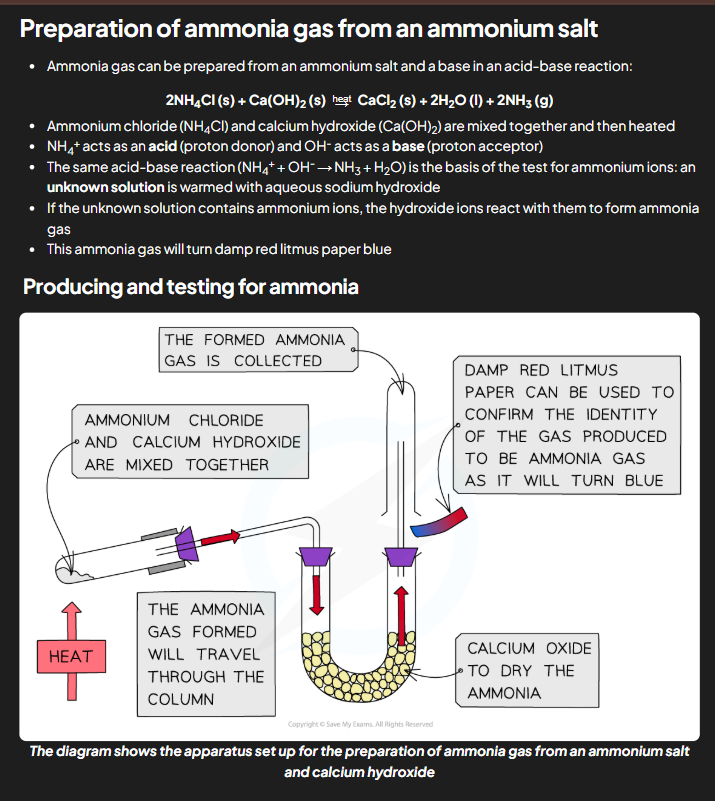
How to prepare ammonia gas from ammonium salt
How can nitrogen oxides form naturally ?
It is when N2 molecule reacts with atmospheric oxygen, where the reaction can be triggered by lightning

How can nitrogen be man made?
High temperature and high pressure inside engines cause nitrogen and oxygen from the air to react and form nitrogen oxides.
What is the catalyst used and its role.
Hot solid platinum
Nitrogen oxides and CO from incomplete combustion of engine react together to from CO2 and N2 which are
removed from exhaust of internal combustion engines
What can atmospheric nitrogen oxides form when they react with
unburned hydrocarbons ?
PAN
Peroxyacetyl nitrate
It is a component of photochemical smog
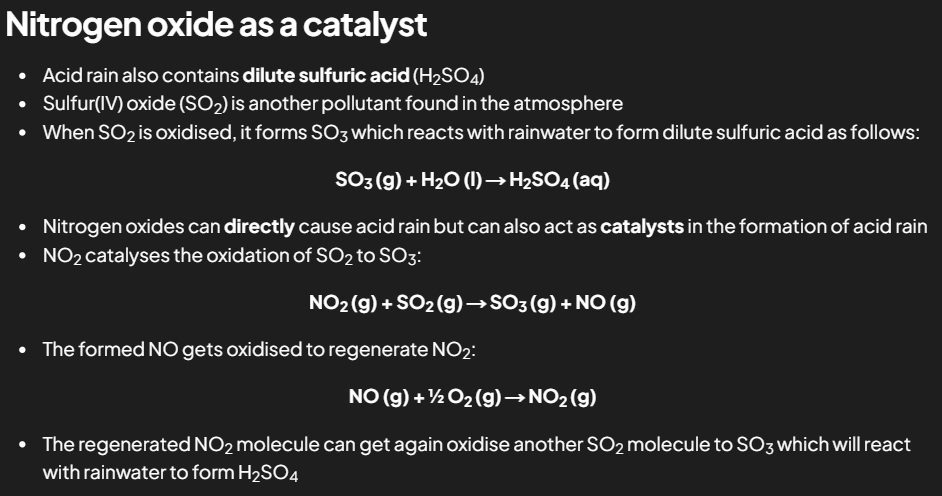
How doe nitrogen oxides form acid rain component HNO3?

How doe nitrogen oxides form acid rain component H2SO4?
NO2 is the homogeneous catalyst
