Reproduction in Flowering Plants (chpt 37)
 Call Kai
 Learn
 Practice Test
 Spaced Repetition
 Match
 Flashcards
 Knowt Play
1/27

There's no tags or description
Looks like no tags are added yet.
28 Terms
Sexual reproduction
Reproduction involving the fertilisation of gametes
Asexual reproduction
Reproduction not involving gametes
Functions of flower parts
Sepals: Enclose and protect flower before opens and will sometimes close over flower at night. Usually green, but can be brightly coloured and form part of flower, eg. daffodil
Petals: Brightly coloured to attract insects for pollination. Some have lines that reflect UV wavelengths so bees can see them. Produce scents to attract insects. In wind, dull and very small/absent
Stamens: Male part of flower, consists of two parts
Anther: Produces pollen which forms male gametes. Four sausage-shaped tubes, usually yellow in colour, but can be others
Filament: Long, thin tube that holds anther iin place where it can most effectively carry out its job. Also carries food and water to anther
Carpel: Female part of flower. Only one, consists of 3 parts
Stigma: Catches pollen. In insect, tends to be small and sticky, wind, tends to be large and feathered
Style: Connects stigma to ovary and hols in suitable position to collect pollen. Acts as guide to allow pollen tube to grow through it to reach ovary
Ovary: Has one or many ovules, which contains embryo sac. Inside embryo sac is egg cell and two polar nuclei that will form endosperm. After fertilisation, holds seed and usually develops into fruit
Receptacle: Thickened part of pedicel from which flower parts grow. Forms edible part of fruit, white cone-shaped piece in raspberries
Nectary: Inside flower at base of petals, produces nectar, provides rich source of energy. Bees concentrate this to produce honey and add compounds to stop fungi and bacteria growth
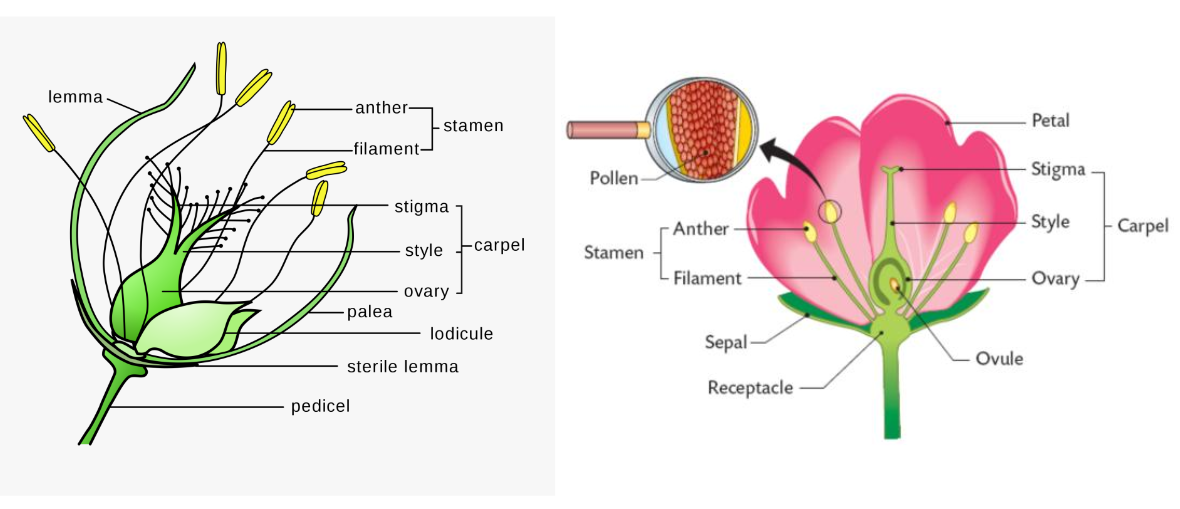
Female gamete (embryo sac) development
Female gamete formed in ovule from diploid megaspore mother cell when divides by meiosis to form four haploid megaspores (much larger than pollen grain)
Three megaspore cells degenerate leaving one. Surviving megaspore divides by mitosis three times, forming 8 nuclei. Sample of three → two polar nuclei in centre and middle of three at bottom: egg cell
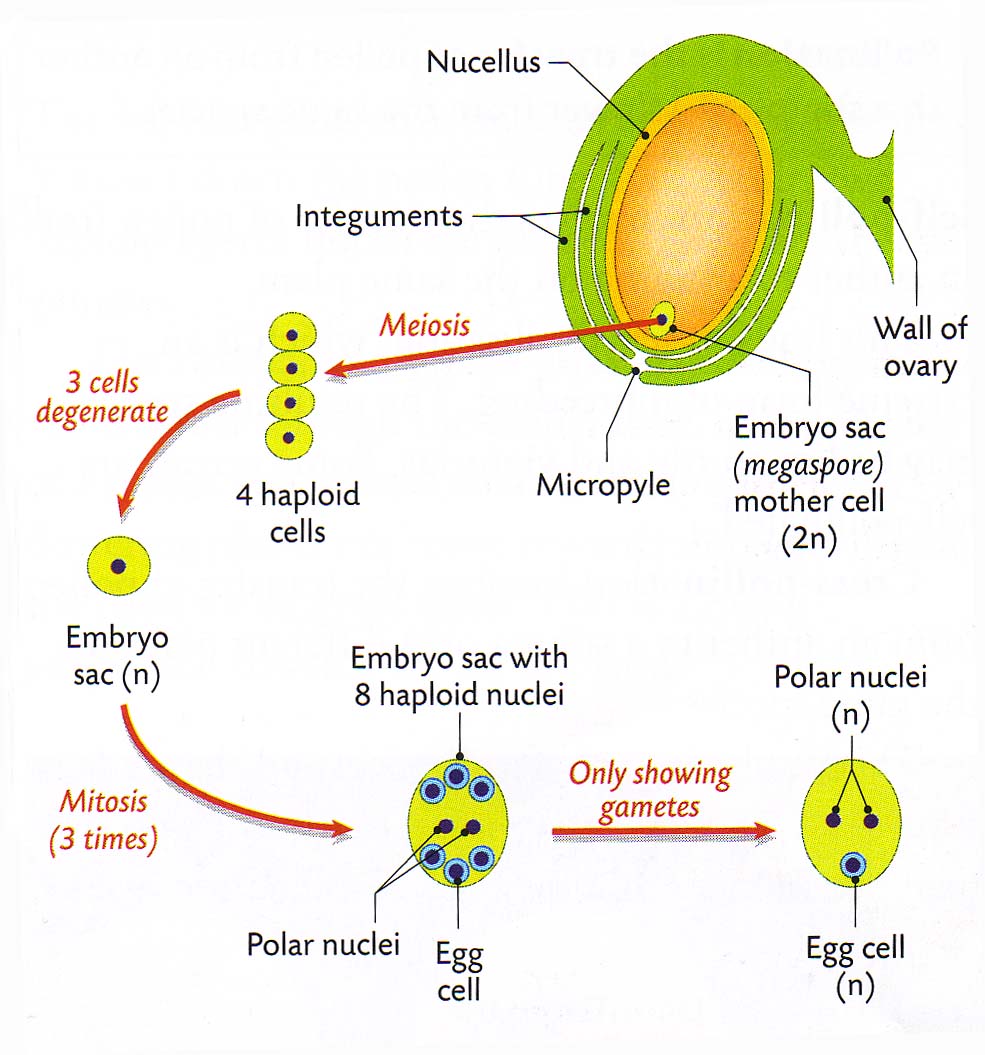
Pollen grain development
Male gamete not formed until after pollination occurs. Inside anther, hollow tubes lined with diploid microspore mother cells. Each divides by meiosis making four haploid microspores. Each divides by mitosis to produce two nuclei which appear identical
One of these is tube nucleus and controls growth of pollen tube from stigma through style of ovary and then to micropyle of ovule. Other nucleus is generative nucleus and divide by mitosis and passes down pollen tube to form male gametes
Pollen grain matures forming almost indestructible layer on outside, exine (unique to plants)
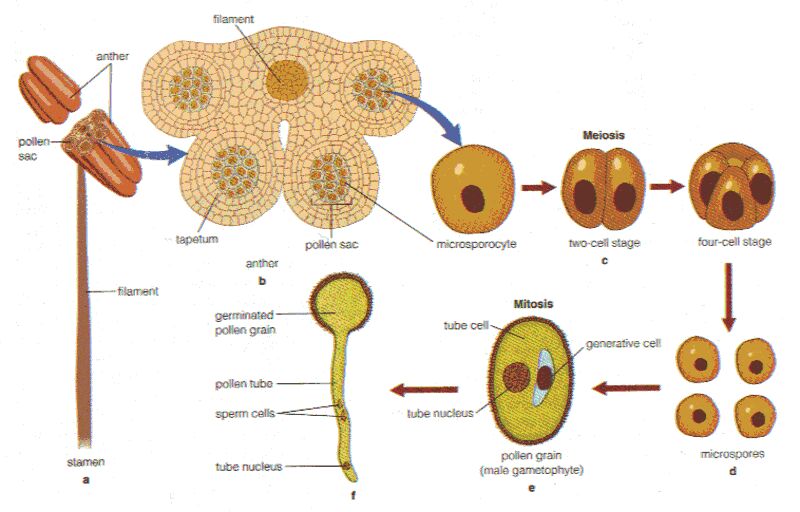
Pollination
The transfer of pollen from an anther to another stigma, two types: self and cross
Self-pollination
Occurs when anther and stigma are on same plant
Not ideal as less variation and greater chance of deleterious (harmful) variants occurring more often (better than nothing)
Flowers reduce chances of this by carpel maturing first so pollination probably have occurred before own pollen released
Cross-pollination
Occurs when anthers and stigma are on different plants
Most desirable situation as leads to greater variation and hence ability to evolve
Various methods: insect (animal) and wind pollination
Insect (animal) pollination
Preferred method of pollination. Eg. butterflies, hover flies, beetles, bees
Bees collect nectar and pollen to feed young and become covered in pollen, spreading pollen from flower to flower (tend to feed on one species of plant for several hours during the day before moving to another)
Flowers may also have scent released at certain times of day to attract a particular insect
Wind pollination
12% of all flowering plants, majority of conifers, eg. grasses, cereal crops, trees
Floral parts designed this way. Petals and sepals are small or non-existent while stigmas and anthers hang out for max wind exposure
Stigmas often feathered to increase surface area to catch pollen
Fertilisation
Fusion of male and female gametes
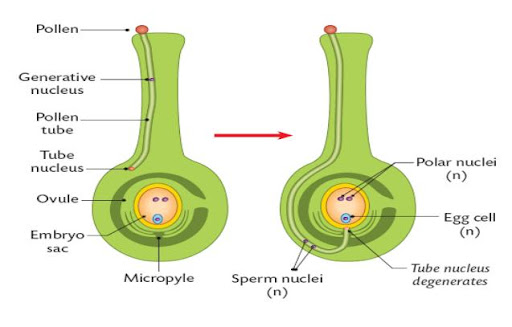
Pollen grain lands on stigma, germinates and produces tube: pollen tube. Grows down through style
Tube nucleus enters pollen tube and directs where to grow. If pollen is of other species, tube may grow, but in wrong direction inhibiting fertilisation
Generative nucleus follows tube nucleus down pollen tube. As it moves down, divides by mitosis to form 2 male gametes
When pollen tube reaches micropyle, tube nucleus degenerates, leaving way clear for male gametes to enter embryo sac
One male gamete fuses w egg cell to form diploid zygote, other male gamete fuses w 2 polar nuclei to form triploid endosperm nucleus → double fertilisation (two sets of fusion)
Seed Structure and Function
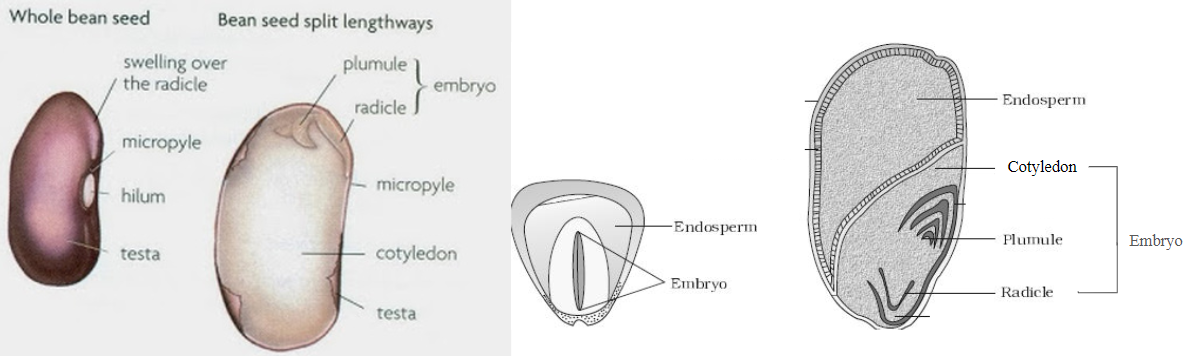
Testa: Thick protective outer coat formed from integuments
Embryo: Part of seed that develops into new plant. Made up of plumule, hypocotyl, epicotyl, radicle, cotyledons
Radicle: First part of new plant to emerge from seed. Grows downward under gravity and develops root
Plumule: Emerges soon after radicle and grows up to form shoot
Cotyledons: Seed leaves (have either one or two → monocot/dicot), in dicots, cotyledons act as main food storage organs
Endosperm: Stor of food mainly in form of starch, but can also contain oils/proteins, in monocots, main food storage area
Hypocotyl: Part of embryo found below cotyledons and above radicle
Epicotyl: Part of embryo that forms stem above cotyledons
Micropyle: Small hole in surface of ovule through which gametes enter. In mature seed, allows entry of water and oxygen
Seed formation
Zygote forms seed embryo
Triploid endosperm nucleus divides rapidly in some plants to form food storage tissue
Ovule develops into seed
Integuments (outer wall of ovule) thicken and toughen to form testa/seed coat
When seed fully formed, dries out and becomes dormant
Endospermic and non-endospermic seeds
Food stored in two places: endosperm in monocots and cotyledons in dicots
Monocot seeds are endospermic as endosperm is present and used for food storage
Dicot seeds are non-endospermic as endosperm is either small or absent
Seed Dispersal Functions
Reduce competition between offspring when seeds germinate and reduces competition between offspring and parent plant
Allow species to colonise new areas, enabling spread and exploit new habitats
Types of seed dispersal methods
Animal dispersal:
Fruit with seed eaten by animal and pass through digestive system
Attacked by digestive enzymes which is need for them to germinate, eg. tomato seeds (commercial suppliers soak them in acid to mimic effect). Seed also surrounded by fertilisers in this process
Some attach to to coats/other parts of animal, eg. mistletoe sticks to beaks of bird and falls as bird flies off
Wind dispersal:
Need to be light and have large surface area to catch wind
Eg. sycamore helicopters (rotate as fall), dandelions (parachutes and can be carried for miles in gentle breeze when completely dry)
Self-dispersal:
Explosive self-dispersal, eg. pea pod dries in sun, lines of weakness appear and pod curls back and splits
Water dispersal:
eg. coconuts, air keeps them afloat and allow for dispersal over large distances by currents
Dormancy and its advantages
Period of greatly reduced growth or metabolism even when conditions are suitable for germination
Advantages:
Allows plant to avoid adverse conditions eg. winter
Gives seeds more time to disperse and so reduces competition
Many embryos are not mature when dispersed, gives time to mature before conditions improve
Dormancy in agriculture and horticulture
Breaking dormancy
Many plants maintain dormancy by having waterproof testa, as water needed to dissolve and transport digestive enzymes and products around plant. Seeds are soaked or broken by abrasion to introduce water
Soakingseeds can wash out chemicals that prevent germination → inhibitors. Happens mainly in seeds from arid regions, takes a lot of water to wash out inhibitors and ensures seed has enough water in ground to see plant through own growth cycle
Some seeds (eg. apples) need to be stored in cold conditions for number of weeks before germination → stratification/vernalisation
Dormancy can also be broken chemically by applying certain plant hormones, eg. gibberellins, to seeds
Utilisation
Knowing about dormancy means seeds can be kept in optimum storage conditions to allow larger percentage of seeds to survive/germinate
Optimum time of year to sow is known so fewer seeds lost in adverse weather/eaten by animals, allowing farmers to maximise growing season for crop
Germination
When the embryo or seed begins to grow
Annual: Completes life cycle from seed to seed within one year, eg. poppies, cornflowers
Biennial: Takes two years to complete life cycle from seed to seed, eg. cabbage, lettuce
Perennial: Survives from year to year, producing seeds many times, eg. roses, geraniums
Stages in seedling growth
Radicle emerges: grows downwards, eventually becoming root
Plumule grows upwards: forms shoot. Plant continues to lose weight
Leaves break the surface: Seedling begins to photosynthesise and produce glucose. Surplus often stored as starch
Plant gains weight
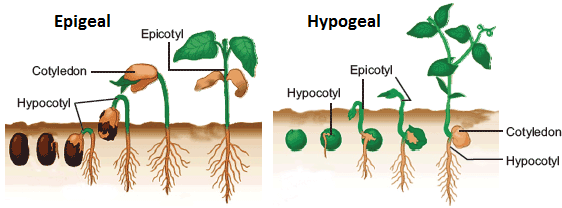
Hypogeal germination: Seed stays below ground
Epigeal germination: Seed is carried above ground
Requirements for germination
Water: needed as solvent to transport materials around plant. Also acts as medium for plant hormones/enzymes produced by embryo to work
Oxygen: Used in aerobic respiration to provide plant w energy to grow and carry out normal life functions
Suitable temperature: Needed for enzymes to work. Most plants in Ire will not germinate or grow if temperature is below 10 degrees
Food reserve in seed must be digested: To provide energy and materials to make new plant tissues. Weight of seed drops as a result. Respiration, which results in release of carbon dioxide, is main cause of weight loss
Seedless fruits
Not usually completely seedless, but have significantly less seeds, eg. watermelons, bananas, tomatoes, grapes
Parthenocarpy: Production of seedless fruit
Produced in two ways:
Genetic selection of plants that produce very few seeds, propagated asexually
Plant hormones, eg. auxins, to induce fruiting without fertilisation
Asexual reproduction
Does not involve gametes, therefore offspring are genetically identical to parents → vegetative propagation
Natural Propagation
Stem tubers
Potato is not part of root, swollen underground stem. Eyes of potato are miniature buds which do not occur on roots
Food, mainly starch, stored near end of underground stems as aerial parts photosynthesise. Near end of year, aerial parts die off and swollen parts lie dormant until following spring
Buds on upper surface use resources in potato to grow new stems above ground. At same time, roots form and grow downwards allowing plant to spread and colonise new ground
Root tubers
Swollen areas of lateral roots that store food and act as perennating organs allowing plant to survive year to year. No buds, but if one tuber is broken off, nearest part to stem produces buds that grow into stem and leaves, eg. dahlias, sweet potatoes
Bulbs
Shortened stem w fleshy leaves, swollen from food stored in them. At centre, unexpanded flowering shoot. Base formed from stem, roots emerge under base. Axillary buds may also develop. Eg. onions, daffodils, tulips → perennial
Plantlets
Miniature plants form along edge of leaf and fall off, eg. mexican hat plant
Others produce modified stem called runners that grow over surface of ground, eg. strawberry. Plantlets at end and when touch ground, roots grow into ground (usually already present)
Artificial Propagation
Cuttings
Non-woody tissue. Healthy stem cut w sharp blade at angle between two nodes, allows less tissue damage and greater surface area in contact w growing medium
To encourage root formation, cutting dipped in rooting powder containing plant hormones. Inserted gently into growing medium and watered, left until roots develop/or leave in water
Layering
Shoot is bent over so comes in contact w/slightly under soil and held in place. New roots develop → adventitious roots (not from radicle)
Once roots formed, connection w parent plant can be cut. eg. forsythia, rhododendron, honeysuckle, bramble
Grafting
Lower part of one plant, rootstock (selected for strength/disease resistance), has stem of another plant inserted, scion (selected for fruit/flowers)
Deep notch cut into rootstock and wedge shape cut in scion. Scion is inserted into notch of rootstock and two are tightly bound
Micropropagation
Small piece of apical meristem removed and divided into many smaller pieces, each is transferred into sterile nutrient medium, eg. agar
Small piece, explant, grows into mass of undifferentiated cells, then placed in different medium containing plant hormones. Cells begin to differentiate into tissues
Then transplanted into normal growth medium. Essential that everything is sterile in process to prevent disease
Comparison of Reproduction by seed and vegetative propagation
Seed
All offspring genetically different, allows variation and thus evolution
Seeds have many mechanisms to ensure widely dispersed, reduces competition and allows new plants to grow stronger
Seeds have limited food reserve, have to be able to produce own food soon after germination
Very large number of seeds produced, but very few will find suitable environment to germinate and grow properly, however many take root in adverse conditions
Outside agents needed to bring about pollination and seed dispersal
Vegetative Propagation
Offspring genetically identical and have exactly same properties as each other
Methods of vegetative reproduction only produce limited dispersal, tend to grow in clumps. Although strong competition, conditions are usually suitable for growth
Have large food reserve, and if connected to parent plant have almost limitless suppply, giving enough time to fully establish
Have better chance of survival, so fewer needed
Often independent of outside agents
Investigate effect of water, oxygen, and temperature on germination
4 test tubes and ten seeds placed in each
All oxygen removed from first tube by wrapping wet iron filings in filter paper and placing in tube, as oxidises, removes oxygen
Water removed from second by putting calcium chloride wrapped in dry filter paper in bottom of tube
Third tube placed in fridge for low temperature
Fourth supplied w water, oxygen, and 20 degrees → control
All placed in dark as fridge for cold tube is in the dark. Ensures only one difference between each tube
Examined after 3/4 days
Results
No oxygen, water or temperature have no germination. Control should have roots and shoots visible → germination occurred
Use starch agar plates to show digestive activity during germination
Remove testa from seeds and boil half to kill embryo and denature enzymes
Split all seeds in half and keep half w embryo attatched
Wash w milton sterilising fluid or alcohol to kill any microorganisms on surface
Place dead seeds inner surface down on starch agar plate
Place living seeds flat surface down on other starch agar plate
Cover and leave at 20 degrees for 2 days
Remove seeds and pour iodine solution over both plates
Results
Germinating/living seeds, agar stays brown, showing starch broken down/digested therefore enzyme action has taken place. Rest of plate goes blue
Under dead seeds (control), agar goes blue, showing starch has not been broken down and there was no enzyme action