Fankle and leg D/D
 Call Kai
 Learn
 Practice Test
 Spaced Repetition
 Match
 Flashcards
 Knowt Play
1/46

There's no tags or description
Looks like no tags are added yet.
47 Terms
According to the west point ankle sprain grading system, where is tenderness in a grade 1 sprain?
ATFL
According to the west point ankle sprain grading system, where is tenderness in a grade 2 sprain?
ATFL, CFL
According to the west point ankle sprain grading system, where is tenderness in a grade 3 sprain?
ATFL, CFL and PTFL
Slight and local edema and ecchymosis is indicative of what ankle sprain grade?
Grade 1
Moderate and local edema and ecchymosis is indicative of what ankle sprain grade?
Grade 2
Significant and diffuse edema and ecchymosis is indicative of what ankle sprain grade?
Grade 3
WB ability of a grade 1 ankle sprain?
Full or partial WB
WB ability of a grade 2 ankle sprain?
Difficult without crutches
WB ability of a grade 3 ankle sprain?
Impossible without significant pain
Ligament damage of a grade 1 ankle sprain?
Stretched ligament
Ligament damage of a grade 2 ankle sprain?
Partial tear
Ligament damage of a grade 3 ankle sprain?
Complete tear
Instability of a grade 1 ankle sprain?
None
Instability of a grade 2 ankle sprain?
None or slight
Instability of a grade 3 ankle sprain?
Definite
When does the Ottawa ankle rules warrant an ankle radiograph?
Pain in the malleolar region with any of these:
bone tenderness at post ed of distal 6cm or tip of either malleoli
Instability to WB for at least 4 steps immediately after injury at the time of eval
When does the Ottawa ankle rules warrant a foot radiograph?
If there is pain in the midfoot region with any of these:
tender navicular bone
tender at base of the fifth metatarsal
What is Patellofemoral syndrome (Runner’s Knee)?
What would you observe
What special test would be (+)
Generally 20—50yr
MOI: trauma, tight ITB/glute max/TFL
Worse after sitting for long periods (Movie goer sign), end range flexion painful
Clarke test (+)
What is Patellar tendinopathy (Jumper’s Knee)?
What would you observe
What special test would be (+)
Generally 15—30yr, inflammation of patellar tendon
MOI: gradual, repeated eccentric overload during deceleration activities
Pain increases with squatting and jumping, end range knee flexion painful
Single leg hop test (+); high step up test (+)
What is Prepatellar bursitis?
What would you observe
What special test would be (+)
Generally 15—50yr, inflammation of bursa due to recurrent minor trauma of anterior knee
MOI: direct trauma to anterior aspect of knee
Pain increases with kneeling; local, fluctuating swelling
What is Osgood Schlatter disease?
What would you observe
What special test would be (+)
Generally 8—13yr in female; 10—15yr in male
Sudden onset; traction apophysitis of tibial tubercule
Visible lump over site, anterior knee pain with running, jumping, squatting, kneeling, knee impact
Knee extension against resistance increases symptoms
What is an ACL injury?
What would you observe
What special test would be (+)
Generally 15—45yr
MOI: can be from contact or non—contact,
contact: lateral blow → valgus forces to knee resulting in ACL/MCL/medial meniscus injury
non contact: tibia ER on planted foot
Immediate swelling, popping sound, instability, symptoms increase with WB, pain at end ranges
(+) Lachman’s, (+) Pivot Shift, (+) Anterior drawer
What is Sinding—Larsen—Johansson syndrome?
What would you observe
What special test would be (+)
Traction epophysitis at inferior pole of patella (superior to the osgood schlatter site)
Pain with activities like cycling, athletics, resisted knee extension
(+) X ray finding fragmentation or irregular calcification
What is a PCL injury?
What would you observe
What special test would be (+)
Forceful blow to anterior tibia with a flexed knee, dashboard or falling onto flexed knee
hyperflexion
Popping sound, pain in posterior aspect of the knee joint which worsens with kneeling
(+) posterior sag, (+) posterior drawer
What ST would be (+) with MCL or LCL injury?
Collateral ligament instability test
What is ITB friction syndrome?
What would you observe
What special test would be (+)
Generally 25—55yr
MOI: overuse
Pain with repetitive movements, climbing or descending stairs; diffuse lateral knee pain, localized at lateral femoral condyle
(+) Ober’s, (+) Noble compression, (+) Renne
What is Plantar Fasciitis?
What would you observe
What special test would be (+)
20—60yr
MOI: gradual with no known cause
Painful sole of foot under heel in WB; worse in the morning; flattened arches observed
Passive great toe extension painful; plantar aspect of heel tender upon palpation
(+) Windlass
What is Achilles tendinitis?
What would you observe
What special test would be (+)
20—40yr
MOI: overuse
Jumping, running increases symptoms on posterior ankle
Active and passive DF is painful and limited; extended knee limits passive DF
What is gastrocnemius strain?
What would you observe
What special test would be (+)
20—40yr
MOI: sudden overload
Pain in upper calf, increases with heel raises; antalgic gait, painful active/passive DF and resisted PF
What is Posterior tibialis tendinitis?
What would you observe
What special test would be (+)
20—40yr
MOI: overuse with a flat, pronated foot
Pain at medial ankle throughout tendon, swelling over medial ankle, PF and eversion painful, resisted inversion with PF foot painful
What is Anterior tibialis tendinitis?
What would you observe
What special test would be (+)
15—45yr
MOI: overuse
Symptoms increases with repetitive DF, passive PF painful - inversion worsens, resisted DF painful
What is Medial tibial stress syndrome (shin splints)?
What would you observe
What special test would be (+)
15—30yr
MOI: overuse
Pain on anterior or posteromedial lower leg, active PF + inversion painful, resisted PF and eversion painful
What is anterior compartment syndrome?
What would you observe
What special test would be (+)
Ischemic condition of the leg
MOI: trauma, muscle hypertrophy, fx
Severe cramping, diffuse pain, tightness; pain decreases with rest and increases with activity
6Ps: pain + pallor + paresis + paresthesia + pulselessness + palpable tenderness → acute surgery
What is Morton’s Neuroma?
What would you observe
What special test would be (+)
40—60yr
MOI: gradual with unknown cause
WB increases symptoms on sole of foot, pronated foot or flattened arch can be observed, passive toe extension painful
What is tarsal tunnel syndrome?
What would you observe
What special test would be (+)
25—50yr
MOI: post traumatic
What is a metatarsal stress fracture?
What would you observe
What special test would be (+)
15—45yr
MOI: overuse
Tender over site and worsens with WB on forefoot
Palpation, US, tuning fork, bone scan, MRI and CT
What is Midfoot sprain?
What would you observe
What special test would be (+)
15-40yr
MOI: high impact landing with a foot twist when in a fixed position
Toe walking increases symptoms on midfoot, pain in passive midfoot movement
Lateral and anterior—posterior radiographs
What is Sever’s disease (Calcaneal apophysitis)?
What would you observe
What special test would be (+)
8—13yr
Traction apophysitis at the achilles tendon insertion
MOI: foot pronation, tight gastroc—soleus, jumping and landing from a height
Limited DF and stiffness, pain over posteroinferior heel, increases in WB, improves with rest
(+) Squeeze test, Xray

Orientation of forefoot?
Forefoot varus; inversion
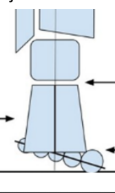
Orientation of forefoot?
Forefoot valgus; eversion
What is osteogenesis imperfecta? (OI)
A congenital disorder of type I collagen synthesis that affects all connective tissues in the body.
osteoporosis
Fxs
bowing of long bones
spinal deformities
mm weakness
ligamentous laxity
blue sclera in the eyes
orthodontal issues
hearing loss
cardiopulmonary abnormalities
What does this describe:
15—50yr pt
Gradual onset of symptoms
Inflamed patellar tendon, tender over site
Pain with passive end range knee flexion
Pain worsens with squatting, jumping
Patellar tendinitis (Jumper’s Knee)
What does this describe:
8—15yr pt
Traction apophysitis of the tibial tubercule
Pain with running, jumping and squatting
Pain worsens with resisted knee extension
Osgood—Schlatter’s Disease
What is piriformis syndrome?
Entrapment of the sciatic N by the piriformis muscle as it passes through the sciatic notch
What causes piriformis syndrome?
Trauma to hip/buttock
Piriformis m hypertrophy
Sitting for prolonged periods
What are symptoms of piriformis syndrome?
Restriction in ROM of hip adduction and IR
Tender with palpation
Pain in buttocks worsened with hip movements
Pain radiating into posterior thigh
How do you treat piriformis syndrome?
short term rest, usage of muscle relaxers and NSAIDs
Stretching of the piriformis muscle, ROM exercises, deep tissue massage