Sedimentary
 Call Kai
 Learn
 Practice Test
 Spaced Repetition
 Match
 Flashcards
 Knowt Play
1/60

There's no tags or description
Looks like no tags are added yet.
61 Terms
sedimentary rocks define
:formed on/near Earth’s surface via geomorphological processes including erosion, deposition, lithification of sediment transported by water, ice, wind or precipitated out of solution by biotic/abiotic processes
importance of sedimentary rocks
aquifers (water)
oil/gas supply (stored in pore space of sedimentary rocks)
lithium (used in batteries - geopolitical tension as mined in China)
geological/biological history of how Earth evolved
pressure + temperature needed for sedimentary rocks to form
1-3kb
0-250C
—> both are less than metamorphic rock conditions
types of weathering and chemical composition (surface processes)
carbonate weathering - CaCO3 + CO2 + H2O —> Ca + 2HCO3
silicate weathering - CaSiO2 + 2CO2 + H2O —> Ca + 2HCO3 + SiO2
James Hutton Siccar Point
60km S of St A
‘deep time’ concept 1780 James Hutton ‘no vestige of a beginning, no prospect of an end’
observed that sediment was placed down vertically even when sediment is deposited horizontally —> realised it would take lots of time for sediment to be deposited horizontally, lithified, tilted vertically, and for more layers to be built horizontally
2 main types of sedimentary rock classification (based on formation and where they are found)
clastic - formed from fragments (clasts) of pre existing minerals/rock
—> mountains, deltas, seas
non clastic - formed from (bio)chemically precipitated minerals , solution can precipitate out salt/gypsum/carbonate —> driven by water/biological processes
—> shallow marine settings
3 ways to classify clastic rocks
grain size
grain shape
grain sorting
grain size
sudden Wentworth grade scale

grain shape
angular —> sub angular —> sub rounded —> rounded
grain sorting
very poorly sorted —> poorly sorted —> moderately sorted —> well sorted —> very well sorted
2 key textures of sedimentary rocks
conglomerate - fragments of rounded rock inside another rock
breccia - fragments of angular rock inside another rock
composition classification of parent rocks from continental, ocean, volcanic arcs

granite rocks
quartz
K + plagioclase feldspar
mafic MINERALS - biotite, amphibole
—> if grains weathers, it can create arkose - distinguish between granite and arkose because granite is crystalline dn arkose has rounded grains
composition proportions of sandstones/arenites
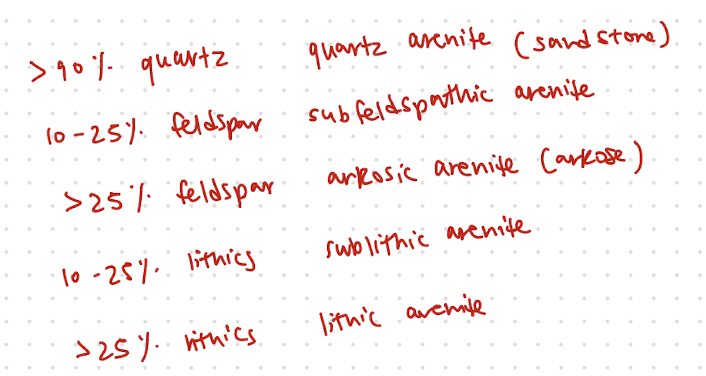
compositional ternary diagram of quartz, feldspar, lithics (clastic)

siliclastic rocks
know as heavy minerals
small, dense grains
in fluvial settings when sorting is based on current, you get concentrations of these heavy minerals
placer deposits
concentrations of heavy minerals (siliciclastic rocks) —> important for titanium, tungsten, diamond mines
maturity define and diagram
:how well sediment has been sorted from weathering

non clastic rocks - what is precipitation influenced by
temperature
salinity
water composition
(low) sediment flux
non clastic rocks - biochemical sediment types
coal (carbon)
carbonates (calcium, carbon)
evaporites (salts, gypsum)
siliceous precipitates
non clastic rocks evaporation order/graph

sulfur cycle draw
delivers material to marine sulphate reservoirs and returned on a geological time scale
areas with lots of sulphate are arid coastal areas (Middle East)

how carbon, silica, calcium cycle are interlinked (chemical equations)

silica cycle inputs, outputs
inputs (H2SiO4)
rivers
sand blown into ocean
hydrothermal vents/mid ocean ridges
outputs (SiO2)
burial
generation of sponges
—> catalysed by organisms that use silicate to make hard shells - diatoms, siliceous sponges - when these small organisms are compacted together, it makes biochemical rock
carbon cycle inputs ad outputs
inputs
weathering of rock (due to carbonic acid)
volcanoes
outputs
marine basin
carbon cycle process (3 steps)
atmospheric CO2 dissolves in sea water
water and CO2 combine to make carbonic acid
carbonic accidentally disassociated to make bicarbonate/carbonate (depends on pH)
3 types of carbonate rock
calcite CaCO3
aragonite CaCO3
dolomite CaMg(CO3)2
corals
made of calcium carbonate
symbiotic relationship with red algae
remains in photic zone for red algae to photosynthesise
biochemical sedimentary rocks - carbonates CO3-
calcite
dolomite
siderite
—> calcite and dolomite fizzes with HCl, can form abiotically/biotically
biochemical sedimentary rocks - sulphates (SO4)2-
gypsum
anhydrite
biochemical sedimentary rocks - others
ironstone/iron oxide
chert (forms abiotically/biotically)
halite
texture of biochemical sedimentary rocks
characterised by allochems (grains) and autochem material
matrix - part between grains/clasts (‘autochems’ when related to carbonate)
ooids - allochems - looks like small carbonate eggs and makes up white sand on beaches
dunhams classification for carbonates draw

carbonate (non clastic) vs siliciclastic (clastic) classification - composition
carbonate - allochem vs autochem proportions
siliciclastic - quartz, feldspar, lithic composition
carbonate vs siliciclastic classification - texture
carbonate - allochem size
siliciclastic - grain size, shape, sorting, maturity
carbonate vs siliciclastic classification - diagenesis
carbonate - CaCO3 precipitates
siliciclastic - feldspar weathering, colour alterations from oxidation (red), reduction (blue/green)
diagenesis define and examples of
:alteration of rock AFTER lithification
weathering
pressure
temperature
fluids migrating between grains
lithification define
:process that turns loose, unconsolidated sediment into sedimentary rock
scale - grain scale
mm-cm
size
shape
sorting
grain to grain/grain to matrix relationship
allochem vs orthochem
scale - bedform scale
cm-m
sedimentary structures (ripples, dunes)
scale - bedding/outcrop scale
meters to 10s of m
bed thickness
thin bedded
medium bedded
thick bedded
bedform scale
fining upwards/normal grading (coarse grains at base to finer grains upward)
deposition due to decreasing flow energy
coarsening upwards/reverse grading (finer grains at base, coarse grains upward)
Bangold Dispersive Forces - clasts bang against each other to get small grains that break up and fall to bottom
bedding scale
<1cm layering - laminated
1-10cm layering - thin bedded
tabular - parallel, planar top and basal surfaces
lenticular - curviplanar, nonparallel top and basal surfaces

sedimentary structures - bedform
morphological feature formed by interaction between a flowing fluid (water, air) and sediment on bed
tells us about flow energy and transport direction
eg. ripples and dunes
sedimentary structures - ripples and dunes
tells us direction of sediment transport
ripples <4cm
dunes >4cm (anything over 4cm is a dune)
ripple/dune movement - planar cross bedding
straight crested ripples/dunes
planar+parallel bounding surfaces
inclined lee surface
low energy
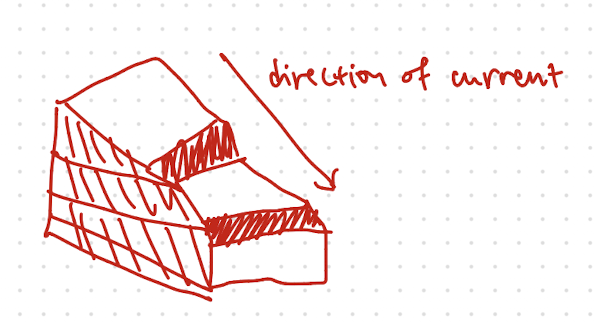
ripple/dune movement - trough cross bedding
sinuous crested ripples/dunes
curve planar/non parallel bounding surfaces
high energy
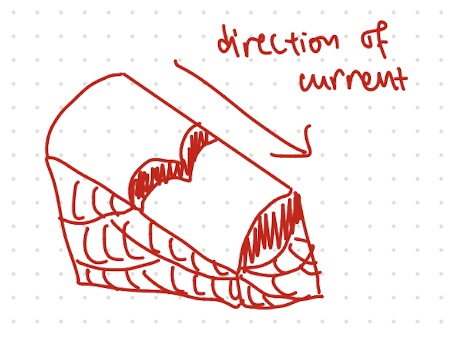
bedform stability diagram

2 types of flow (ripples/dunes)
unidirectional - asymmetric, current ripples
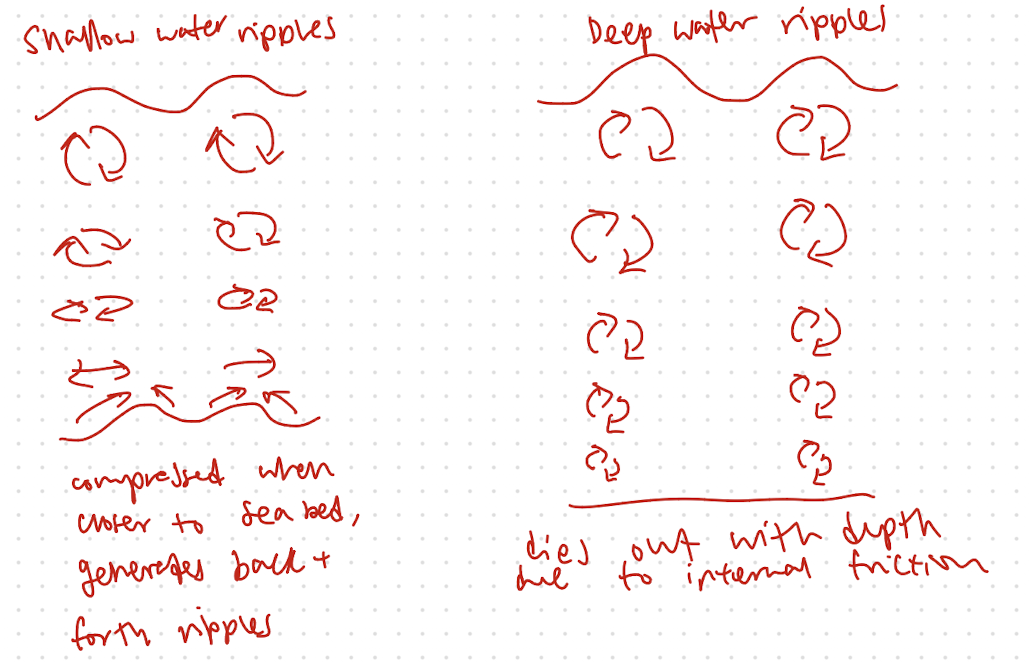
oscillatory - symmetric, wave ripples
formation of wave ripples 3 steps
wind generates waves
waves on surface generates circular motion (orbitals) of water molecules
waves get smaller and smaller when you move down the water column
additional sedimentary structures
imbrication
clasts align/overlap over each other - looks like toppled dominoes
found in fluvial settings with unidirectional flow
soft sediment deformation
forms due to gravitational instabilities from excessive/shear stress
wave/flare looking structure
fossils
2 types - body (fossils embedded in rocks) and trace (imprint of fossils in rocks)
3 main depositional areas
fluvial (river)
shorelines/deltas
marine settings
fluvial deposits
channel migrates laterally
scroll bar patterns due to preferential erosion on active channel + inner deposition
glacier deposits in point bar deposits
mud spills over - makes land agriculturally rich
shorelines + deltas
coastal zones - interface between marine and non marine settings
sink for physical and chemical weathering
mixing of fresh + saline water
deltas - sediment is deposited, nutrient rich area
shorelines - ripples, cm-dm thick sets of low angle laminae, symmetric/flat topped ripples due to erosion, bioturbation (burrowing)
Scotland depositional environment
does not currently have deltas - during carboniferous Scotland was near the equator and had deltas
has firths (estuaries)
—> evidence of sigillaria (moss) stumps and giant millipedes/water scorpions in Crail
marine - what shapes pattern/characteristics of marine deposition
physical properties (waves, storms, tides)
oceanic conditions (bathymetry, salinity, water temp)
tectonic plates
marine - conditions for carbon to be precipitated
photic zone
nutrients
sunlight
clastic flux
:rate at which rock fragments/mineral grains are transported over an area in a given amount of time
Australia - low clastic flux so GBR forms
India - high clastic flux - too high cannot be precipitated to carbon - no reefs
reef zonation diagram

golovinsky-walthers law
:beds occur in conformable vertical strata successions in laterally adjacent environment
back, blobby, fore reef all lateral - deposition occurs
sea level rises - blobby reef is no longer in photic zone so it moves backwards to continue receiving sunlight
sea level falls, reefs move again
overtime lateral environments shift with sea level, previous lateral environments get vertically stacked
clastic vs carbonate sediments
clastic
forms at any latitude
sediments occur in marine + non marine environments
texture + structure shows hydraulic energy - coarse - high energy, fine/mud - low energy
carbonate/biochemical
occurs in tropical/warm environments
sediments in marine environments
sediment texture reflects size of skeletons and grains