hearing phys intro to sound and ear anatomy
 Call Kai
 Learn
 Practice Test
 Spaced Repetition
 Match
 Flashcards
 Knowt Play
1/28

There's no tags or description
Looks like no tags are added yet.
29 Terms
Why is hearing described as "touch for the air"?
Hearing is a mechanical sense: its receptors are mechanoreceptors, just like those in the skin for touch, but they are tuned to vibration
What does it mean that hearing uses "Design B," and how is it similar to vision?
A specialized receptor cell (the hair cell) detects the stimulus, then synapses onto a separate sensory neuron. This is similar to vision, where the receptor cell also doesn't fire action potentials itself
so hair cell doesnt make action potentials it makes a graded potential. The audiory nerve does.

labeled line principle
The brain reads meaning from WHICH fibre fires. What we perceive doesn't really depend on the stimulus itself; it depends on which neurons send the signal. This is the basis of pitch coding.
general chain of events for hearing
A pressure wave travels through the air.
The pressure wave causes mechanical motion in the ear.
The motion bends a hair cell, which leads to nerve impulses in the auditory nerve.
The impulses reach a tonotopic map in the cortex, a map organized by pitch.
What is sound?
A longitudinal wave: a pattern of compressions (high pressure, particles close together) and rarefactions (low pressure, particles spread apart) that travels through a medium (e.g. air).

Do air molecules travel with a sound wave?
No. Each air molecule only oscillates (moves back and forth) locally, in place. What travels through space is the pressure pattern, meaning the wave of compressed and spread-out air molecules.
What is sound, and how is it made? course def
A pressure wave: vibrating objects push air molecules into alternating zones of compression and rarefaction
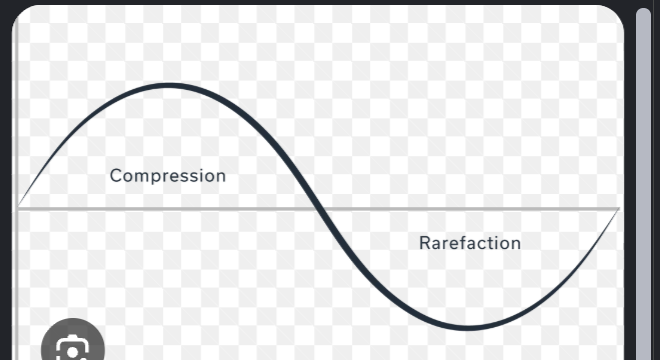
How fast does sound travel,
Around 350 m/s, and it moves faster when the air is warmer (weather dependent).
That's a lot slower than light (about 300,000 km/s), which is why with lightning we see the flash first and hear the thunder a few seconds later
Decibel (dB) scale
Logarithmic scale for loudness; every +10 dB is about 10 times the intensity (breathing about 10, rainfall about 50, hairdryer about 90, jet engine about 130)
For example, normal conversation is about 60 dB and a vacuum cleaner is about 70 dB, so the vacuum is only 10 dB more but 10 times more intense
Amplitude
How big the pressure swings are, which we hear as loudness. The stronger the amplitude, the louder the sound. It's measured in decibels (dB)

Frequency
How many pressure swings (cycles) happen per second, which we hear as pitch. It's measured in hertz (Hz): 1 Hz means one wave per second, and 100 Hz means 100 oscillations per second.
Dont have to know:
Low frequencies (bass): Roughly 20 Hz to 250 Hz
Mid frequencies: Roughly 250 Hz to 4,000 Hz (where 1,000 Hz sits)
High frequencies (treble): Typically above 4,000 Hz, extending up to 20,000 Hz
What frequency can humans hear
About 20 to 20,000 Hz (mice can hear above 100,000 Hz)
How does hearing change as we get older?
The older we get, the more frequencies we lose, starting with the high ones. This hearing loss never comes back, and a hearing aid may be needed
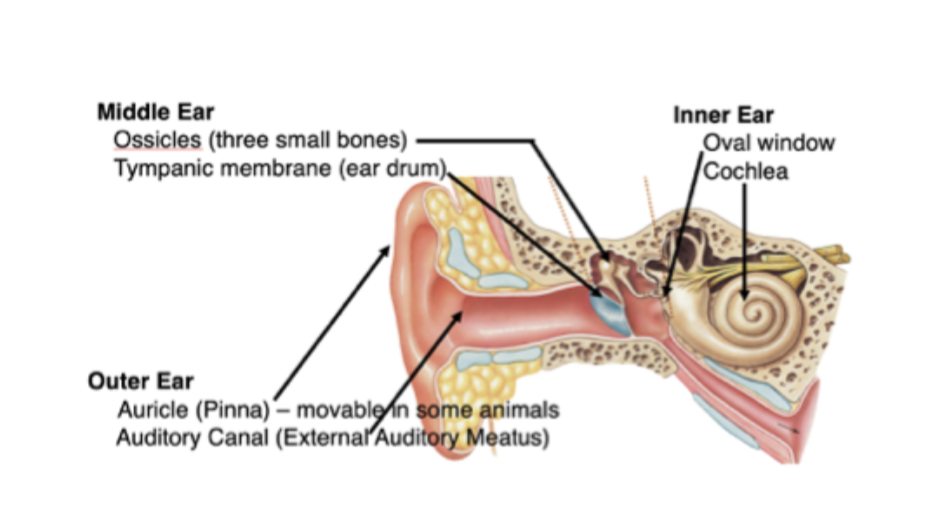
Ear has 3 parts
outer ear
middle ear
inner ear
Outer ear
made up of
The pinna (auricle, the visible part of the ear),
the ear canal ,
the eardrum (tympanic membrane).
Its job is to collect sound from the air and funnel it inward

Pinna function
its folds gather sound, direct it inward, and help tell up from down
it helsp with sound localization
Ear canal
Air-filled (no fluid); funnels and conducts sound to the eardrum; earwax can block it and impair hearing
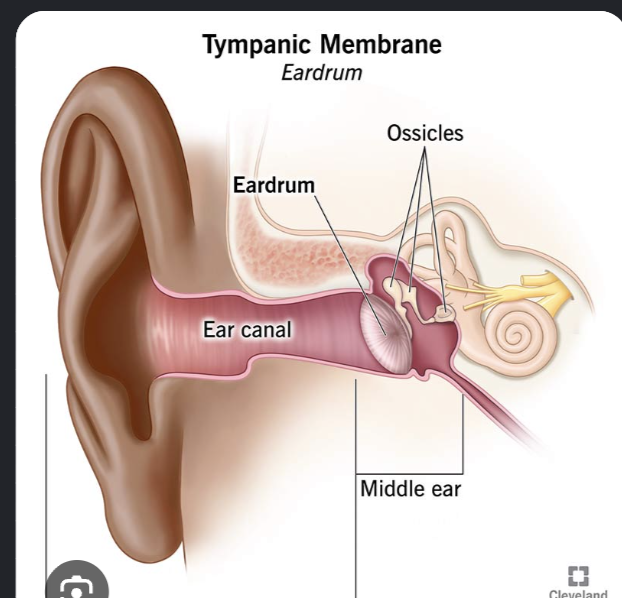
Tympanic membrane (eardrum)
Thin sheet at the end of the ear canal that vibrates with the incoming wave; marks the border with the middle ear
Middle ear
Three tiny bones (ossicles) - malleus, incus, and stapes
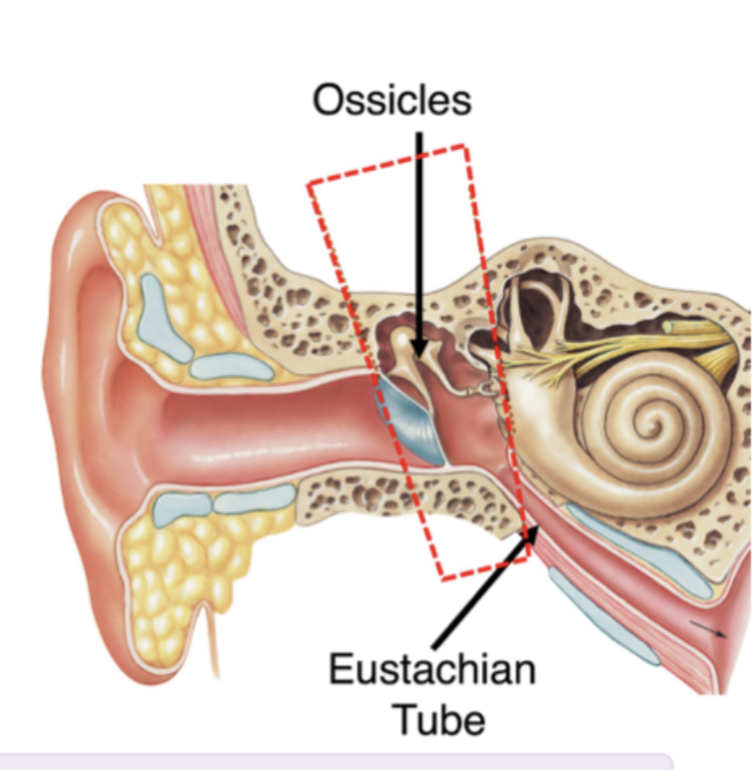
Eustachian tube
Ossicle positions
eardrum - malleus - the incus - stapes - cochlea at the oval window
job: carry the eardrum's vibration to the inner ear
What does the Eustachian tube do?
It connects the middle ear to the throat. It opens to let air in or out, so the air pressure inside the middle ear matches the air pressure outside. When the pressure is the same on both sides, the eardrum is balanced and can vibrate freely.
On a flight, outside pressure changes, and when the tube opens to even it out, your ears "pop"
What happens if the Eustachian tube is plugged?
If it's plugged (e.g. from a cold, allergies, or plane altitude), the pressure can't equalize, so there's a pressure difference across the eardrum. The eardrum doesn't move very well anymore because it has to move against the pressure, and the buildup of pressure is painful

Why does the ear need bones at all? Why isn't the cochlea connected directly to the eardrum?
The cochlea is fluid-filled, and faint air vibrations hitting fluid directly would mostly bounce off. The ossicles act as an amplifier: they carry vibration from the large eardrum to the much smaller oval window and work as a lever. This concentrates the force and boosts the pressure enough to drive waves through the denser cochlear fluid. This is called impedance matching


Impedance matching
The ossicles concentrate force from the large eardrum onto the small oval window and act as a lever, boosting pressure so sound can move the cochlear fluid instead of bouncing off
Inner ear
The cochlea (for hearing), the vestibular apparatus (for balance), and the oval window (where vibrations enter the cochlea). Its job is to turn motion into nerve signals
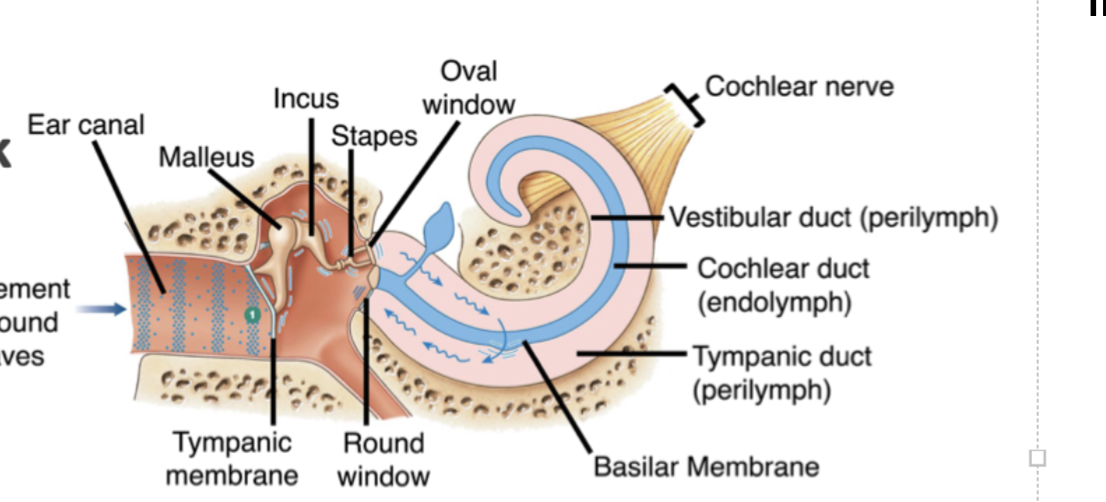
Cochlea
Coiled, snail-shaped, fluid-filled tube; converts sound motion into nerve signals; organ of hearing

What is the vestibular apparatus?
The neighbouring organ of balance in the inner ear, which includes the semicircular canals
What do the oval and round windows do?
membranes between the air-filled middle ear and the fluid-filled cochlea.
The oval window is where the stapes is attached and pushes in; it's the input, where vibrations enter the cochlear fluid.
The round window, just below it, is the release valve: when the stapes pushes the oval window in, it bulges out to release pressure, since fluid can't be compressed
Hair cell (inner ear)
Receptor cell used by both the cochlea and vestibular apparatus, so damage can disturb hearing and balance together
