MM Lecture 12: Price
 Call Kai
 Learn
 Practice Test
 Spaced Repetition
 Match
 Flashcards
 Knowt Play
1/21

Earn XP
Description and Tags
Marketing Mix: Price! (Video: Week 13 + beginning of Week 14)
22 Terms
How can you define “price”?
seller perspective: amount of money charged for a product
buyer perspective: sum of values that the consumers gets in exchange for the benefits of having/using the product (costs) > crucial for consumer’s decision making
What is cost-based pricing?
Company looks at product features → calculates cost of promotion + channels → adds margin to costs = price (costs + margin = price) → convinces customer of benefits
→ from marketer’s point of view (inside of the company)
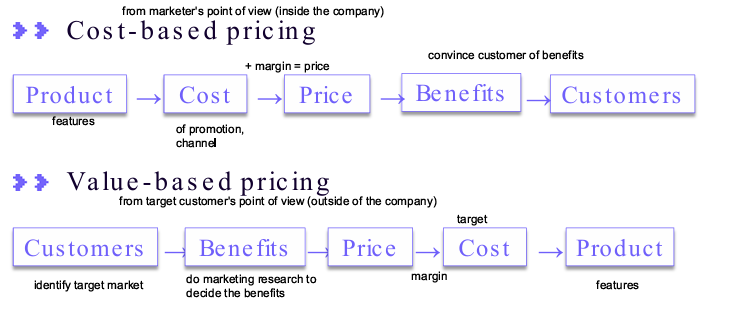
What is value-based pricing?
Company identifies target market → does marketing research to decide the benefits → price → price - margin = target cost → product features
→ from target customer’s point of view (outside of the company)
What do the terms “price floor” and “price ceiling” mean?
price floor: no profits below this price
price ceiling: no demand above this price
What are some internal factors for the pricing?
pricing objective
marketing mix
costs
Explain pricing objectives (internal pricing factors)!
survival (heavy competition or bad economic situations -> set low prices)
profit maximization (optimal price point: supply x demand)
market share/product-quality leadership
Explain marketing mix (internal pricing factors)!
positioning, marketing mix decisions influence price (these costs have to be covered with the price)
target costing = setting a product’s price with target costs first and working back
Explain costs (internal pricing factors)!
price cannot be lower than costs, cost-based pricing:
mark-up (profits that will be added to costs)
margin (% of price representing profits)
break-even pricing: setting number of units to break even on the costs of marketing a product
What are some external factors for the pricing?
industry
economic condition
buyer
Explain industry (external pricing factors)!
=types of competition, group of sellers
pure competition: no single buyer/seller has a big effect on the market price (lots of competitors fighting each other -> if someone drops the price, others will drop the price as well; if someone increases the price, consumers will buy the cheaper products from other competitors)
oligopolistic competition: price is strongly affected by competition (always fluctuating) > most common
pure monopoly: no influence from competition (price is not affected by competition because there’s only one business
Explain economic condition (external pricing factors)!
boom/recession, department stores offer luxury products > when economy is bad people are not willing to buy these expensive products
Explain buyer (external pricing factors)!
setting prices based on consumer’s perception of product benefits
EDLP (every day low price): charging low prices constantly without price discounts > Wallmart
High-low pricing: charging higher prices everyday but offering discounted price below EDLP temporarily (e.g. for Christmas products) -> Department stores
What are the three types of price strategies?
ignorance
optimization
customization
Explain ignorance (price strategies)!
ignore competitor’s prices and stick to your own (ok when you have higher value products than competition > specialty goods)
Explain optimization (price strategies)!
set price based on amount of money consumers are willing to pay
Explain optimization (price strategies)!
offering prices based on customer characteristics
on-linear pricing: price discount for members that pay membership fees
bundled pricing: set price for bundled product (Happy meal McDonalds)
multi-dimensional pricing: considering complementary product + set price of a product (cheap price for printer but high price for the ink you need to buy a lot of the times)
structural pricing: price covers additional benefits (car + assurance > Hyundai)
What are some price adjustment strategies?
discount
allowance
Explain discount (price adjustment strategies)!
price reduction during certain periods (cash: SKONTO, quantity: Mengenrabatt, functional: special discount for retailers who display the product very special, seasonal: retailer gets seasonal discount when buying AC in winter)
Explain allowance (price adjustment strategies)!
money paid to buyers for performing certain functions (trade-in allowance =discount for new batteries when returning old batteries, promotional allowance (=functional discount))
What is segmented pricing?
selling the same product at different prices to different consumer groups (often in service industry)
> dependent on customer, location, time (cheaper prices for children/elderly in zoo/museum; different ticket prices for theater and football stadium; cheaper tickets for shorter movies)
What is psychological pricing?
considers the psychology of prices (399€ instead of 400€)
works for low-involvement products (everyday purchases like toothpaste rather than buying a TV)
What are some price issues?
lost leader pricing: setting prices that don’t generate profits (extremely cheap → students come to the store just for this, buy this product and buy other products on the way out) → to draw people into the store and buy other things (these purchases make up for the loss of product profit)
price fixing (setting prices in consultation with competition > illegal)