CS 453 Midterm 1
 Call Kai
 Learn
 Practice Test
 Spaced Repetition
 Match
 Flashcards
 Knowt Play
1/93

Earn XP
Description and Tags
CH 1-3
Name | Mastery | Learn | Test | Matching | Spaced | Call with Kai | Chat |
|---|
No analytics yet
Send a link to your students to track their progress
94 Terms
internet
collection of hardware and software components executing protocols
internet
network of networks
internet
collection of billions of computing devices and packet switches interconnected by links
protocol
define format and order of messages sent and received among network entities, and actions taken on message transmission and receipt
4G cellular LTE
wireless access network, up to 10’s Mbps per device
802.11 WiFi
wireless access network, 10’s to 100’s of Mbps per device
cable access network
wired access network, up to 10’s to 100’s to Mbps downstream per user
Ethernet
wired access network, up to 100’s Gbps per link
digital subscriber line
wired access network, up to 10’s of Mbps downstream per user
fiber optic cable
the physical layer technology that has the highest transmission rate and lowest bit error rate in practice, but most expensive
forwarding
local action of moving arriving packets from router’s input link to appropriate router output link
routing
global action of determining the source-destination paths taken by packets
network edge
consists of hosts, which are clients and servers; this is the transport layer
network core
this consists of interconnected routers, the data plane (which is what’s inside a router), and the control plane (which consists of routing algorithms)
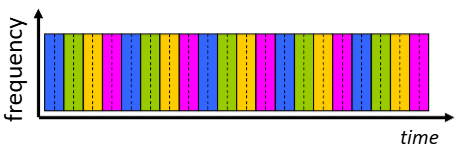
frequency division multiplexing (FDM)
different channels transmitted in different frequency bands
internet service provider (ISP)
connects hosts to Internet
content provider networks
private network that connects its data centers to Internet, often bypassing tier-1 and regional ISPs (e.g. Google, Facebook)
tier-1 commercial ISP
national and international coverage (e.g. Level 3, Sprint, AT&T)
packet-switching
network forwards packets of broken up application-layer messages from one router to the next across links on path from source to destination
packet loss
if arrival rate of packet to link exceeds transmission rate, then the packet will be queues and it can be lost if the memory (buffer) in router fills up
circuit switching
end-end resources allocated to and reserved for call between source and destination during communication; frequency division multiplexing (FDM) and time division multiplexing (TDM) are two approaches for implementation; congestion loss and variable end-end delays are possible because resources are used on demand, not reserved in advance
store-and-forward transmission
entire packet must arrive at router before it can be transmitted on next link
frequency division multiplexing (FDM)
frequencies divided into narrow bands; each call allocated its own band, can transmit at max rate of that narrow band

time division multiplexing (TDM)
time divided into slot; each call allocated periodic slots, can transmit at max rate of wider frequency band only during its time slots
packet delay
delay_nodal = delay_proc + delay_queue + delay_trans + delay_prop
transmission delay
delay_trans = L/R (packet length/link transmission rate)
propagation delay
delay_prop = d/s (length of physical link/propagation speed)
transmission delay
time spent transmitting packets bits into the link
processing delay
time needed to perform an integrity check, lookup packet information in a local table and move the packet from an input link to an output link in a router
queueing delay
time spent waiting in packet buffers for link transmission
propagation delay
time need for bits to physically propagate through the transmission medium from end one of a link to the other
link layer
transfer of data between neighboring network devices (e.g. ethernet, 802.11 (WiFi), PPP); data in frames
application layer
protocols that are part of a distributed network application (e.g. HTTP, IMAP, SMTP, DNS); data in messages
physical layer
transfer of a bit into and out of a transmission media; data in bits
network layer
delivery of datagrams from a source host to a destination host (typically) (e.g. IP, routing protocols); data in datagrams
transport layer
transfer of data between one process and another process (typically on different hosts) (e.g. TCP, UDP); data in segments
encapsulation
taking data from the layer above, adding header fields appropriate for this layer, and then placing the data in the payload field of the “packet” for that layer
encryption
provides confidentiality by encoding contents
access control
limiting use of resources or capabilities to given users
firewall
specialized “middleboxes” filtering or blocking traffic, inspecting packet contents inspections
digital signatures
used to detect tampering/changing of message contents, and to identify the originator of a message
authentication
proving you are who you say you are
1990’s
The WWW starts up (note: the WWW design started at the end of previous decade).
early 1980’s
The Internet Protocol (IP) is standardized in RFC 791
early 1960’s
early studies of packet switching by Baran, Davies, Kleinrock
2010-2020
the number wireless Internet-connected devices surpasses the number of connected wired devices
late 1960’s
first ARPAnet node operational
2000-2010
software-defined networking begins
late 1980’s
congestion control is added to the TCP protocol
1970’s
Internetting: DARPA researchers connect three networks together
packet queueing delay
La/R (packet length * average packet arrival rate / link bandwidth)
traceroute program
a program that provides delay measurement from source to router along end-end Internet path towards destination
throughput
rate at which bits are being sent from sender to receiver
packet sniffer
a passive receiver that records a copy of every packet that flies by, including passwords
IP spoof
injection of packet with false source address
Denial of Service (DoS)
attackers make resources unavailable to legitimate traffic by overwhelming resource with bogus traffic
presentation layer
in OSI/ISO reference model, not in internet protocol stack; allows applications to interpret meaning of data (e.g. encryption, compression, machine-specific conventions)
session layer
in OSI/ISO reference model, not in internet protocol stack; synchronization, checkpointing, recovery of data exchange
client-server paradigm
clients communicate with the always-on server that has a permanent, well-known IP address; often used in data centers due to its ability to handle large amounts of requests; clients communicate with each other through the server
peer-to-peer (P2P) architecture
clients communicate with other clients directly; features self-scalability, meaning new peers can bring new service capacity and demand; P2P applications have client and server processes; peers are intermittently connected and change IP addresses
socket
processes send/receive messages to/from its ____
HTTP Get request message
used by web client to request a web server to send the requested object from the server to the client
HTTP reply
consists of response code and response phrase associated with code
conditional HTTP GET request message
message to allow a server to only send the requested object to the client if this object has changed since the server last sent this object to the client; in other words, if browser doesn’t have up-to-date cached version
enter deep
CDN approach that stores content in access networks, close to clients
DASH
an approach that allows a client to adapt the encoding rate of retrieved video to network congestion conditions
an approach where a server divided a video file into chunks that are stored, each encoded at multiple rates; the client plays the video chunk-by-chunk, with each chunk requested at encoding rate that fits the available bandwidth at the time
chunk
a unit of video, each of which may be encoded at multiple different rates, stored in different files
manifest
a file containing the location and encoding rate of files corresponding to video segments in a video
TCP
internet transport protocol service that had reliable transport between sending and receiving process, flow control, congestion control, is connection-oriented, and does not provide timing, minimum throughput guarantee, security
UDP
internet transport protocol service that had unreliable data transfer between sending and receiving process and does not provide reliability, flow control, congestion control, timing, throughput guarantee, security, or connection setup; used when speed is more important
transport layer security (TLS)
provides encrypted TCP connections, data integrity, and end-point authentication
HTTP is “stateless”
when HTTP server maintains no information about past client requests
non-persistent HTTP
HTTP connection where at most one object is sent over open each TCP connection before it is closed
persistent HTTP
HTTP connection where multiple objects can be sent over a single TCP connection between client and that server before the connection is closed
RTT
time for a small packet to travel from client to server and back
POST method
user input sent from client to server in entity body of HTTP request message
HEAD method
requests headers (only) that would be returned if specified URL were requested with an HTTP GET method
GET method
include user data in URL field of HTTP GET request message
PUT method
uploads object to server and completely replaces file that exists at specified URL with content in entity body of POST HTTP request message
cookies
can be used for authorization, shopping carts, recommendations, user session state; they permit sites to learn about you, and tracking ______ allow common identity to be tracked across multiple web sites; doesn’t mean anything in HTTP GET request
web cache
acts as both client and server; reduces response time for client request, reduces traffic on an institution’s access link, and enables “poor” content providers to more effectively deliver content as servers want to be close to clients