Exam 2, Astro 1220 UVA
 Call Kai
 Learn
 Practice Test
 Spaced Repetition
 Match
 Flashcards
 Knowt Play
1/111

Earn XP
Description and Tags
2026 --> bradely johnson
112 Terms
Chapter 14
learning about our sun and how it was created.
what process causes the sun to shine?
nuclear fusion
how did the sun’s core grow hot enough to allow nuclear fusion to start?
gravitational contraction raised the internal temperature and pressure of sun’s core.
how was the sun formed?
formed by a collapsing cloud of interstellar gas
how long ago was the sun formed
4.5 billion years ago
how does the sun continue to shine steadily?
2 balances:
gravitational equilibrium
energy balance

what is gravitational equilibrium?
it is the inward pull of gravity balances outward push of internal gas pressure at every point within the sun
basically meaning — gravity wants to crush the sun and pull all the gas inward but the gas wants to explode/expand because of its hotness but because both of these forces are equally matched the sun stays stable.
Pressure increases with depth?
true
does pressure make gas hot and dense enough to sustain nuclear fusion?
true
energy released by nuclear fusion in turn heats up gas and maintains the pressure needed for equilibrium
true (this is called energy balance)
what is the rate of energy balance?
rate of energy released in sun’s core is = to rate at which the sun’s surface radiates energy into space
what if fusion did not replace energy radiated from the surface?
the gravitational contraction wouldcause the sun to shrink and its core temp to rise.

what does the sun look like?
has solar flares/sunspots/swirls with radiating gas.
sunspots/flares are caused by loop of hot gas extending into the sun’s corona. — created by magnetic fields
Basic properties of the sun
radius = 696,000
mass = 2 X 1030 kg — about 300,00 times the mass of earth
luminosity = 3.8 X 1026 watts
composition — 70% hydrogen, 28% helium, 2% heavier elements
rotation rate = 25 days equator and 30 days poles
surface temp = 5800K and sunspots = 4000K
core temp = 15 million K
5 seconds of the sun’s luminosity is enough to meet human energy demands for 500,000 years?
false, it is 1 second
what is the sun’s structure?
the sun is made of a ball of plasma that has different temps and densities at different depths.

what is solar wind?
stream of charged particles.
forms a comet tail ( 2 — dust tail and plasma tail )

what is the corona?
the outermost layer of the sun’s atmosphere.
several million km from the surface of the sun.
low density
temperature = 106 K —- hotter than sun’s surface
strong magnetic fields carry energy upward from chromosphere and coronas
emits most of sun’s X-rays

what is the chromosphere
middle layer of solar atmosphere
temperature = 104 K
emits most of sun’s ultra violet light

what is the convection zone?
energy from core transported to surface from hot gas
cool gas moves downward
causes churning/swirls appearance on Sun’s surface.

what is the radiation zone?
1/3 of the way down to the core
hot gas turns into plasma
energy flows outward in the form of photons/x-rays
temperature = 107 K

what is the core?
nuclear fusion transforms hydrogen into helium
density is 100 times of water.
pressure is 200 billion times greater than earth’s surface.
temperature = 1.5 X 10⁷ K

What is nuclear fusion in the sun?
uses quantum tunneling
to proton need to get hot enough to come together — once they come together one proton looses charge and turns into neutron (need 4 protons to give us 1 he+ energy)
The sun uses hydrogen fusion
emits gamma rays and neutrino and positron
nuclear fission vs nuclear fusion
fission = splits a large nucleus into smaller nuclei
fusion = combines smaller nuclei into large nucleus
equation for mass difference
E = mc2
when the core temp rises what happens?
leads to large increase in fusion rate, which raises the core pressure which causes the core to expand and cool down leading to equilibrium stability.
when core temp lowers, what happens?
leads to decrease in fusion rate, lowers pressure in core, causes core to contract and heat up, which then leads to stability.
how long does it take for energy to travel from the core to the photosphere?
hundreds of thousands of years, electrons redirect photons when they travel through suns plasma. — called radiative diffusion
how do we know what is happening inside the sun?
we learn through…
observations of solar vibrations — mainly through Doppler shifts
mathematical models of the sun — helioseismology
observations of solar neutrinos — detected using the Super kamiokande neutrino observatory in Japan.

example problem #1 —
how much hydrogen is converted to helim each second in the sun?
how much helium nuclei are created by fusion each second in the sun?
we need to understand we need to use the equation E = mc2.
we have to understand that E = L x 1 sec — they give us luminosity. so we plug that into L —> will equal , We also have to understand that m = ( 4mp - mhe) N. , c is just the speed of light.
so we do not know m fully (we need to find N) , but we know E, c, and some of m, we just need to find N. so then the equation turns into N = (L x sec 1)/ ( 4mp - mhe)c2
if we plug the stuff we know we get — (3.8 × 1026 w x 1 sec) / (4 × 1.6726 × 10-27kg - 6.643 × 10⁻²⁹kg) c2 ———-if we calculate this it will give use 8.91 ×1037 which is the # of helium nuclei produced
to get total mass of hydrogen we nee to time N to 4mp —→ 4 (1.6726 × 10⁻²⁷kg)(8.91 ×1037) —> this then turns into 5.96 × 10¹¹ kg
to answer the next part we need to use what we learned from question 1.
the M of sun is 2 × 1030 kg — then we divide this by our answer from question 1 and get 3 × 10 -17%

example problem #2
The sun core contains about 1026 particles per cubic centimeter at a temp of 15 million K. Compare the sun’s core pressure to that of earth’s atmosphere at sea level, where the density is about 2.4 X 10¹⁹ particles per cubic centimeter and the temp is about 300 K
we need to use P = nkT —> P = pressure, N = # of density, K = boltzman constant, T = Temp. —- you wouldn’t end with any units. — the answer will get 2.1 × 10¹¹
Unit 15
surveying the stars

IceCube Neutrino Observatory
used to detect neutrinos using thousands of optical sensors in antarctic.
when neutrinos interact with an atom in ice it can produce a charged particle that travels faster than the speed of light in ice, emitting a flash of blue light
particles direction is determined by measuring the timing and intensity of this light at multiple sensors.
how do we measure stellar luminosities?
what does apparent brightness depend on?
luminosity and distance
what is luminosity?
amount of power a star radiates — energy per second = watts (energy/light that comes out of the sun)
passes through each sphere at the same time
can determine this by 4π x (distance)2 x (apparent brightness)

what is apparent brightness?
amount of starlight that reaches Earth (energy per second per square meter)
divide the luminosity by area of sphere(4π(radius)2) to get brightness.
what is the apparent brightness of the sun in our sky?
1,340 W/m2

what is stellar parallax?
parallax is the apparent shift in position of a nearby object against a background of more distant objects
angle depends on distance
apparent positions of nearest stars shift by an arcsecond as earth orbits sun.
measured by comparing snapshots that are taken at different time and then measuring them

what is Gaia spacecraft?
measures the parallax and proper motion between stars.
will survey about 1 billion stars in the milky way
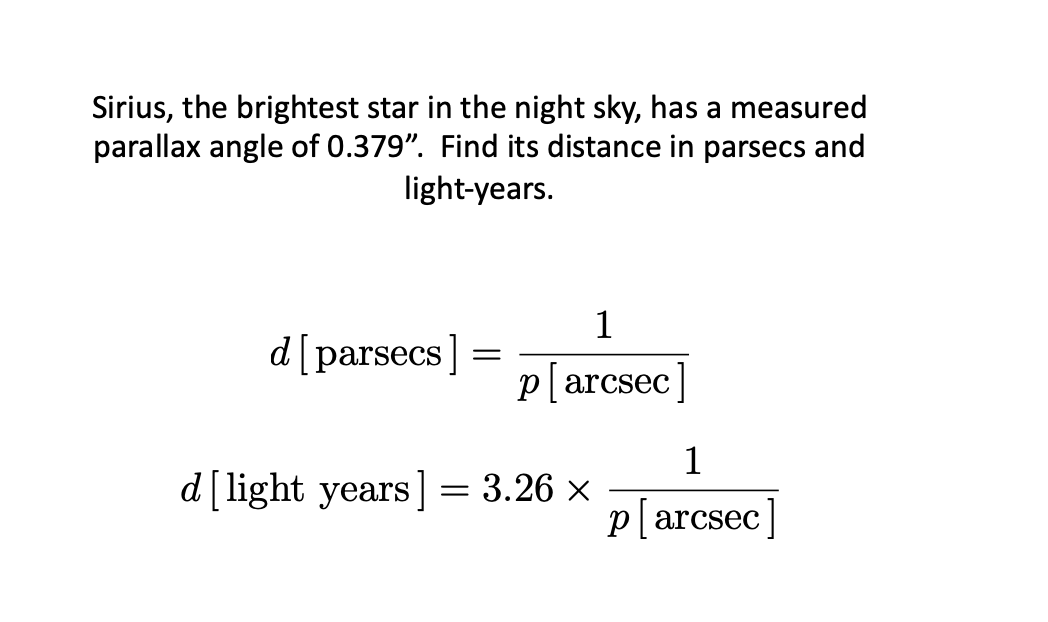
Parallax example
steps to solve
we must first understand the equation and the variables in the equation. — p= parallax angle, in this case it is 0.379, arcsec is the unit it is already in. d = distance. 3.36 is a constant for light-years
if we want to do it the simply way to find parsecs we can just plug in the information into the question. but lets say our professor want meters or something else we must do it the long way.
the long way = 1st change p[arcsec] into sin(1 arcsec), and then change 1 into 1 au. 2nd understand that 1 au = 1.5 × 10¹¹ meters and sin = 0.379 x deg/3600 arcsec x π rad/ 180 deg. 3rd is canceling out the variables that they are 2 of. ex: arcsec, deg. 4th times everything together and use rad as you units giving you (1.837 × 10⁻⁶ rad). 5th then put the answer into the arcsec place in sin and then divide 1.5 × 10¹¹ by your answer (1.837 × 10⁻⁶ rad). ex: 1.5 × 10¹¹m/ sin(1.837 × 10⁻⁶ rad). 6th then you get 8.116 × 10¹⁶m. 7th then we need to multiply this by parsec/ 3.09 × 10¹⁶m. we finally get the answer.
for lightyear we would do the same thing but instead of using parsec/ 3.09 × 10¹⁶m in step 7 we would use lightyear/ 9.46 × 10¹⁵m
what are some stellar temps?
5800K = sun temp
50,000 = hottest star temp
3,000k = coolest star temp
Can stars be different colors?
yes

what is thermal radiation?
every object emits thermal radiation with a spectrum that depends on temp. —- ex’s: planets, you, stars
an object with a fixed size grows more luminous as its temperature rises
depends only on temp
hotter objects emit photons with higher average energy


how do we measure stellar temps?
we use absorption lines in star spectrum to tell us its ionization level
lines in a star’s spectrum corresponds to a spectral type that reveals its temperature.

what are the types of binary star systems?
visual binary —>we can see with a telescope as the star orbit each other.
spectroscopic binary —> used when we cannot determine stare with telescope due to diffraction limit. (we use Doppler shifts in spectral lines to determine this)
eclipsing binary —> pair of stars orbit in the plane of our line of sight. ex: the ellipse
ex: Sirius A and Sirius B
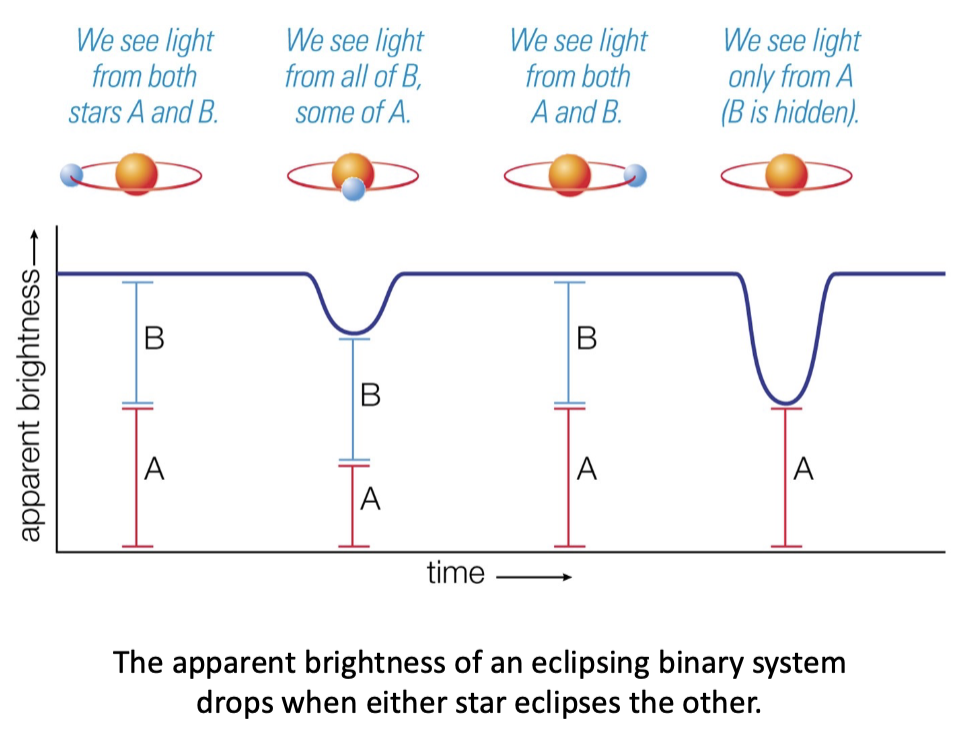
about 3/8 of all stars are in binary systems?
false — ½

what happens to the spectral lines when a n object is away from us?
the lines will shift towards the right/ blueshifted
if close to use it will be redshifted
is Mizar a visual binary or spectroscopic binary?
its both!

how do we measure stellar mass and Radii?
p = period, g(m1+M2) = mass of stars, a3= average separation
direct mass measurements are only porrible for stars in binary star systems.
we need any 2 of these 3 observable:
orbital period
orbital separation (a or r {radius})
orbital velocity (v) — for circular orbits (v = 2πr/p)
center of mass
if 2 stars are equal mass then the center of mass will lie halfway between them
if 2 stars with different masses — the center will be closer to the one with more mass.
if the star has much more mass than the planet the center of mass is in the star.
1 AU = what?
150 million km

measuring stellar mass example
steps:
1st we must understand the question
both stars are traveling at a orbital speed/v of 80,000 m/s or 8.0 ×10 4 m/s.
total time it takes to complete 1 full orbit is 6 months
2nd we must convert our variable P into secs.
p = 6 months x 30/1 × 24/1 × 3600 sec/ 1
gives use 1.555 × 10⁷ sec
3rd - we do not know (m1+m2)/ the distance between the stars
we must first rearrange the equation —- 4π2/ G x a3/p2. — but we still do not know a3. luckily we can change it to (vp/π)3
resulting in 4π2/ G x (vp/π)3/p2 then this turns into — 4π2/ G x v3p3/p2 π3 — but then we can just do — (4 x π2 x v3 x p3)/ (G x π3 x p2)
then cancel out things —> leading to (4 x v3 x p)/ Gπ
then we solve by plugging in v and p and g giving us —> 1.521 × 1032 kg. (total mass of both star)
4th - we must divide our answer by 2
1.521 × 1032 kg / 2 = 0.7605
then we convert into scientific notation — 7.605 × 1031
note we must get rid of 1 space to make up for dividing.
stellar mass range?
sun’s mass= 2.0 × 1030kg
most massive star = 100 Msun
least massive stars = 0.08 Msun
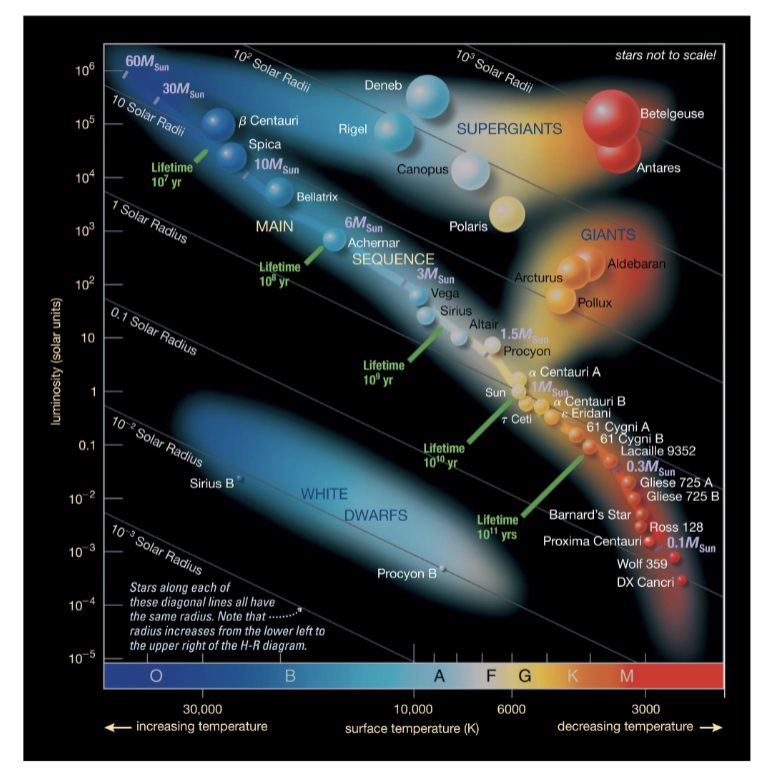
How do we classify stars?
we use the Hertzsprung- Russell (H-R) diagram
Most stars fall somewhere along the main sequence. — our sun is on this
the stars in the upper right are called super-giants — meaning they are very large and very bright
below super giants are giants
stars near the lower left are called white dwarfs— have really high temps
there are 5 classes in the HR sequence, what are they?
super-giant
bright giant
giants
subgiant
main sequence stars
what is each main sequence star fused with?
fuse with hydrogen into helium in their cores
mass increases going down the main sequence (left - right)
false — decreases
what is the most important feature of hydrogen fusing stars?
mass
small increase in mass produces a large increase in luminosity?
true
what must a very luminous star have?
large mass or high surface temp
they could have both.
are stars born with a limited supply of core hydrogen?
yes
more massive stars = lifetime decrease
true
what do stellar properties depend on?
age and mass
all stars become larger and redder when they have exhausted their hydrogen core
true
when fusion ends most stars will end up as what?
white dwarfs
a star that varies significantly in brightness with time is called?
variable star
why do some stars vary in brightness?
because they cannot achieve balance between power from the core and power from the surface
star might expand and contract
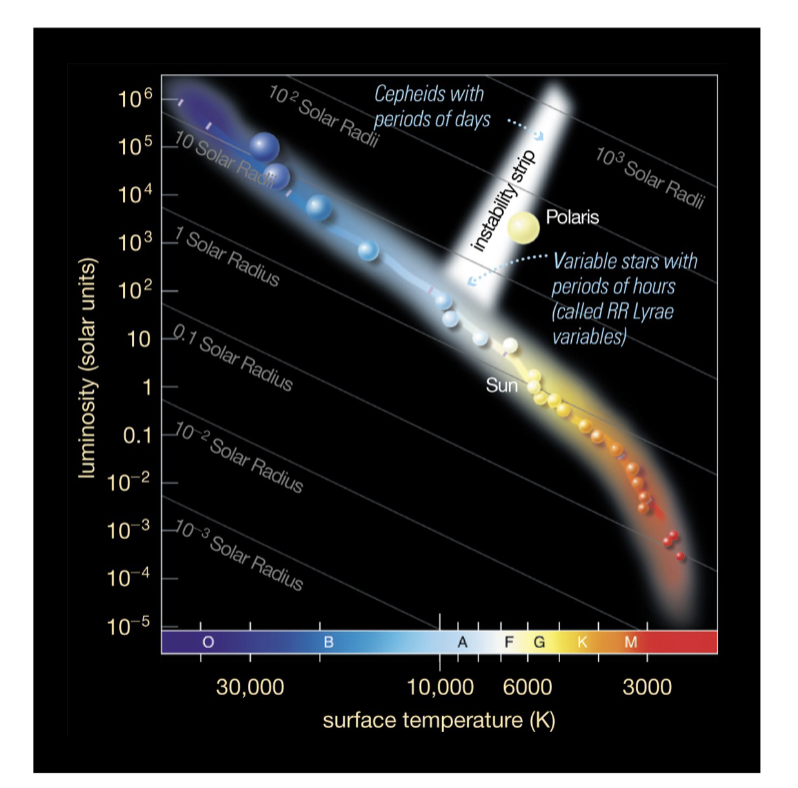
where do they fall on the HR diagram — variable stars?
within the instability strip
called — cepheid variables
pulsation period is closely related to their luminosity
used to determine galaxy distances

what are the 2 types of star clusters?
open cluster —> loosely packed stars, always found in galactic disk, young, 30 light years across.
globular cluster —> up to a million or more stars, dense ball, found in galactic halo, 60-150 light years across, oldest stars —> ex: M4
UNIT 16
star formation
is the space between stars empty
no - it contains small amounts of Hydrogen, helium, and other heavy elements
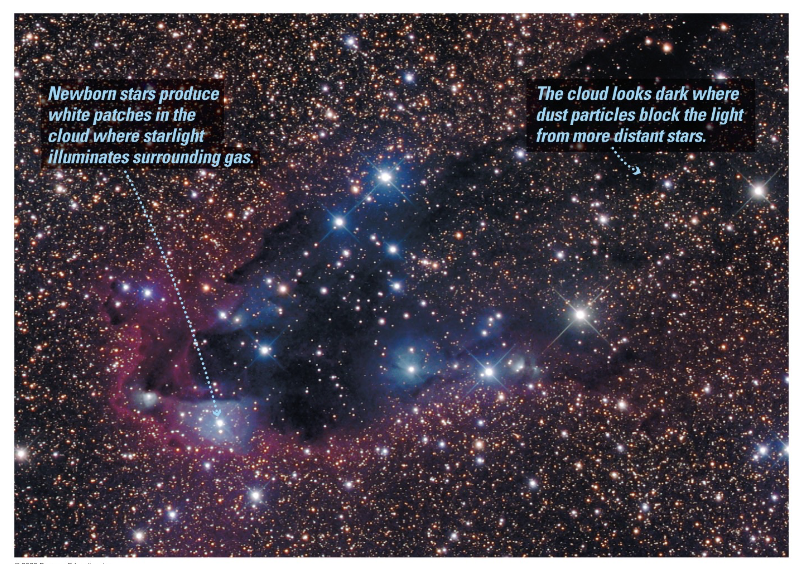
what is the gas between stars called
interstellar medium (ISM) — also can have huge temp and density differences.
what type of area does new stars from?
cold and dense regions of dusty gas. —> this is called molecular clouds

what are molecular clouds?
cold
dense —→ 300 molecules per cubic centimeter
allows atoms to form into molecules
have a temp of 10-30K
composition of star-forming clouds
we can observe composition of forming stars through absorption lines or emission lines of carbon monoxide
measures show similar to sun

what can block our view of stars in a gas cloud?
interstellar dust
if we view stars toward the edge of clouds they look redder because of dust blocks.
infrared light can pass through cloud easier and show us the other side
what does false color images combine?
infrared light over a range of wavelengths
color corresponds to different temps
blue = 40K
green = 10K
how does star form?
molecular clouds — because gravity causes molecular clouds to contract which then gets the core hot enough for fusion.
gravity must overcome thermal pressure in a cloud
before fusion starts what is the star called?
protostar
what does emission lines from molecular clouds do?
can prevent pressure buildup by converting thermal energy into infrared and radio protons that escape the cloud
what does molecular cloud evolution look like?


rotation in star birth
speed of rotation increases as the cloud contracts — conservation of angular momentum — also cause jets of matter to shoot out along rotation axis
collision between particles in the rotating cloud causes disk to flatten


how do planets form?
starts out as globs of gas and dust that orbits a central star even if star is just forming
gravity and other forces cause material within disk to collide
if collision is gentle the material fuses like rolling snow balls
dust particles turn into pebbles — then into mile size rocks
then they clear material from their path, leaving tracks of largely empty space
stars gobble up nearby gas and push more material further away.
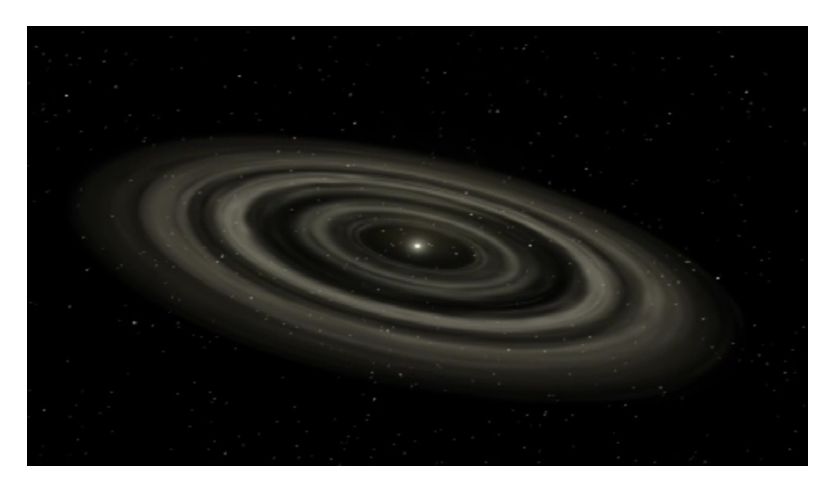
illustration of star formation
sun required about 30 million years to go from a protostar to a main sequence star.
higher mass = forms faster
lower mass = slower


what does degeneracy pressure due for mass of stars?
do not let it get below 0.08
if dp fails then star will turn into a failed star/brown dwarf
there are 3 types of brown dwarfs
L dwarfs = temp between 1400 K — 2200 K
T dwarfs = 500K —1400K
Y dwarfs = below 500K
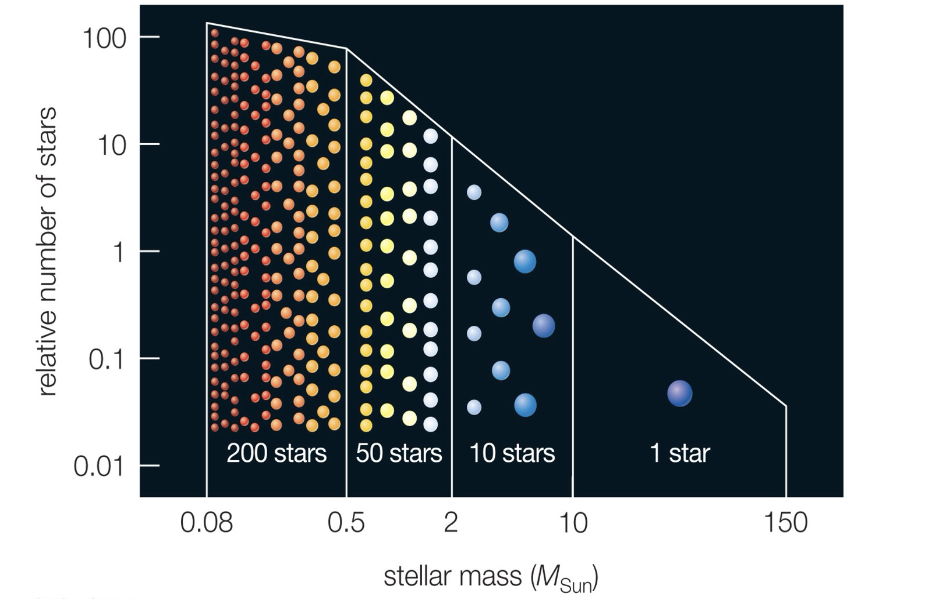
demographic of newborn stars
refer to pic.
UNIT 17
star stuff
when pressure overcomes dense molecular cloud what forms?
protostar
what is life as a low-mass star?
after star ends main sequence life — helium core contracts while a hydrogen shell begins to spread along the surface — shell starts to expand outward — outer layers start to shrink. due to helium mass is added to core which increases temp and helium fusion rate —increase radius weakens gravity at the surface which allows stellar winds to escape —- Degeneracy pressure balances out gravity in helium core.

what does helium fusion require?
high temp — 100 million K because helium has 2 protons
degeneracy pressure increases with temp
false - doesn’t do anything
what is a helium flash?
when temp rises drastically
causes enormous amounts of energy in the core
thermal pressure dominates degeneracy pressure

what happens after helium fusion stops?
helium fuses into carbon shell around the carbon core.
never reaches equilibrium —
thermal pulses makes convection drap carbon up from the core to the surface
what is earths fate?


hydrogen fusion in high mass stars
start with hydrogen fusion — but they fuse it with carbon, nitrogen, and oxygen (elements that were in the molecular cloud) — this speeds up fusion rate because it causes more energy and higher radiation pressure.
higher radiation pressure= strong stellar wind that can blow away mass
same process (no helium flash) but turns into super giants
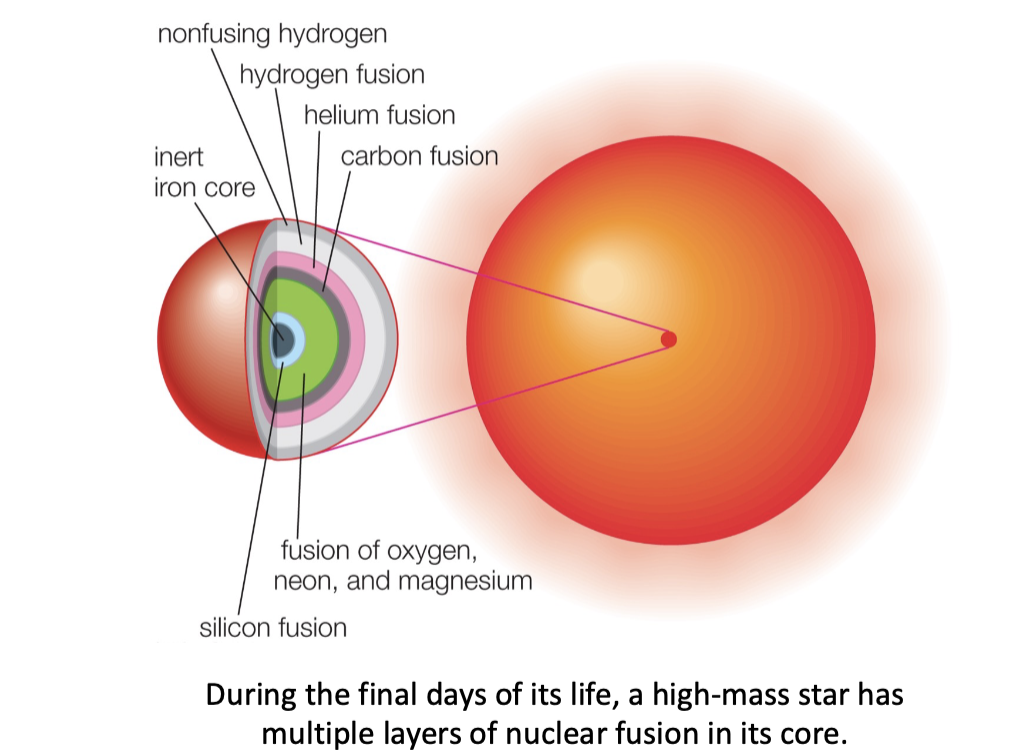

what element is not possible to generate nuclear energy?
iron
iron reverses fusion and fission.
how are super novas created?
DP supports iron core
Gravity overcomes DP and electrons and protons combine to form neutrons
electrons and DP disappears
iron core collapses into a ball of neutrons — halted by neutron degeneracy.
outer layer of star is blown out into space
neutron star is left
if ND is overcame by gravity then black hole forms
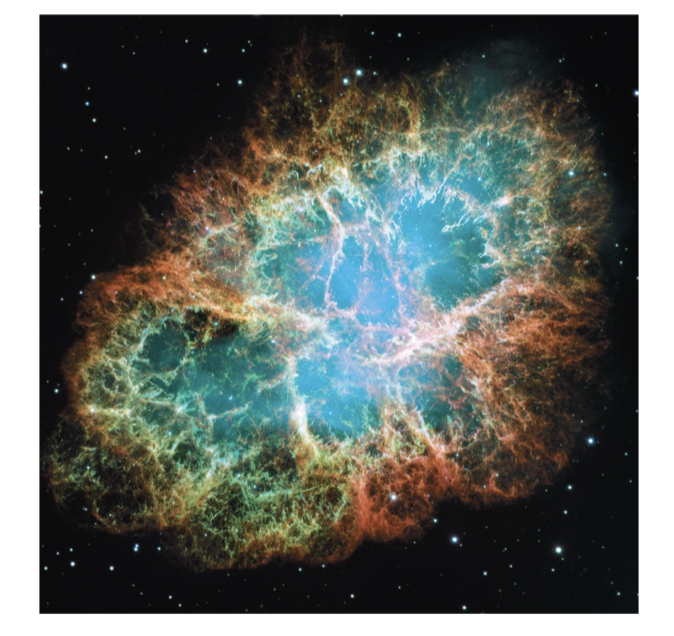
what image is this
crab nebula