Horse teeth
 Call Kai
 Learn
Learn Practice Test
 Spaced Repetition
 Match
Match Flashcards
 Knowt Play
1/74

There's no tags or description
Looks like no tags are added yet.
Name | Mastery | Learn | Test | Matching | Spaced | Call with Kai | Chat |
|---|
No analytics yet
Send a link to your students to track their progress
75 Terms

Incisors: number and main function
12 total; the front teeth used to bite and cut food.

Canine teeth: number and typical occurrence
Up to 4; the slides associate canine teeth primarily with male horses.

Wolf teeth: possible number
0-4; some horses have all four and some have none.

Functional premolars: number
12 total, excluding the optional wolf teeth.

Molars: number
12 total.

Cheek teeth
The premolars and molars used to grind food.

Bars of the mouth
The toothless space between the incisors and premolars.

Deciduous teeth
Nonpermanent baby or milk teeth.
Deciduous dentition: total teeth
24 total: 12 incisors and 12 deciduous cheek teeth. The slide calls the latter molars; anatomically they are deciduous premolars.

High-crowned teeth
Teeth with a long crown; the horse has a reserve crown that progressively erupts as the chewing surface wears.
Continuous tooth eruption
The reserve crown moves into the mouth as the exposed tooth wears; this is not unlimited tooth growth.

Dentine
Hard, calcium-containing tooth tissue described in the slides as bone-like.

Enamel
Very hard tooth tissue described in the slides as porcelain-like.

Cementum (cement)
Bone-like tissue that the slides describe as cushioning the tooth and reducing brittleness.
Deciduous central incisors: eruption
Present at birth or shortly afterward.
Deciduous cheek teeth: eruption
Present at birth or shortly afterward, according to the slides.
Deciduous middle incisors: eruption
Around 4-6 weeks of age.
Deciduous corner incisors: eruption
Around 6-9 months of age.

Permanent teeth versus baby teeth
Permanent teeth are longer and darker and lack the well-defined neck characteristic of baby teeth.
Deciduous teeth: shedding age
Between ages 2 and 5; shedding typically occurs in the fall.
Complete permanent dentition
By age 5.

Permanent central incisors: fully erupted
By age 3.
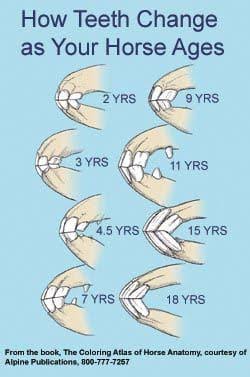
Permanent middle incisors: first visible
By age 3.5.

Permanent middle incisors: fully erupted
By age 4.

Canine teeth: appearance
Around age 4, according to the slides.
Permanent corner incisors: first visible
By age 4.5.

Permanent corner incisors: fully erupted
By age 5.
Wolf teeth: eruption timing
Usually present by age 2; may appear as early as 6 months.
Why are wolf teeth removed?
They can interfere with the bit.
Dental age estimation before age 5
Relatively reliable because the eruption and replacement of teeth follow a recognizable sequence.
Dental age estimation after age 5
Uses incisor cup wear, incisor shape and angle, and the groove on the upper corner incisors.

Dental cups
Pits in the center of the chewing surfaces that gradually disappear with wear.
Lower central incisor cups: disappearance
6th year
Lower middle incisor cups: disappearance
8th year
Lower corner incisor cups: disappearance
9th year
Upper central incisor cups: disappearance
9th year
Upper middle incisor cups: disappearance
10th year
Upper corner incisor cups: disappearance
11th year
Young incisor chewing-surface shape
Oval.
Incisors begin becoming round
Around age 12, beginning with the central incisors.
All incisor chewing surfaces are round
By age 17, according to the slides.
All incisor chewing surfaces are triangular
By age 23, according to the slides.

Galvayne's groove: location
On the upper corner incisor; first appears at the gum line.
Galvayne's groove: first appearance
Around age 10.
Galvayne's groove: progression
Extends down the tooth and becomes darker with age.
Galvayne's groove: age 20
Extends the full length of the tooth and begins to disappear.
Galvayne's groove: age 30
Usually gone, according to the slides.
Young versus old incisor profile
Young horses have a more vertical profile and less tooth exposed; older horses have a more angled profile and more tooth exposed.
Limitation of dental aging
An estimate rather than an exact age.
Signs suggesting an oral examination
Weight loss, pain while eating or drinking, whole grain in feces, dropped partially chewed food, or eating with the head tilted.
Partially chewed food dropped from the mouth
A sign of possible oral or dental trouble; warrants an oral examination.
Whole grain in feces: dental significance
May indicate inadequate chewing and the need for an oral examination.
Milk from a foal's nostrils
May indicate a cleft palate.
Mandible versus maxilla width
The mandible (lower jaw) is narrower than the maxilla (upper jaw).
Typical sharp dental edge locations
Outer edges of the upper cheek teeth and inner edges of the lower cheek teeth.
Why do sharp dental edges develop?
Upper and lower cheek teeth do not align completely, allowing uneven wear as teeth continue erupting.
Floating
Rasping down sharp edges of the cheek teeth; the slides specifically refer to molars.
Other findings to check during an oral examination
Foreign objects, tongue lacerations, and hemorrhages or ulcerations of the oral membranes.
Caudal hooks
Overgrowth of the number 11 teeth, the last large molars at the back of the mouth.
Molars most commonly associated with large caudal hooks
Lower molars 311 and 411.
Caudal hooks: consequences
Sharp points, difficulty chewing, and in severe cases difficulty closing the mouth.
Periodontal disease: importance
The leading cause of tooth loss in horses, especially older horses, according to the slides.
Periodontal disease: common initiating problem
Food debris impacted between cheek teeth.
Periodontal pockets: bacterial involvement
Bacteria enter the pockets and can contribute to periodontal disease.
Periodontal disease: prevalence in the lecture
Up to 34% of horses of all ages have some level; up to 60% of horses age 13 and older have severe disease.

Overbite
Upper incisors project ahead of the lower incisors in the lecture example.

Underbite
Lower incisors project ahead of the upper incisors in the lecture example.
Rostral hook: location in the diagram
Overgrowth at the front of a cheek-tooth row.

Wave complex
An uneven, wave-like chewing surface along the cheek-tooth row.

Identify the tooth groups in this mouth diagram.
Incisors at the front; canine teeth in the gap; premolars and molars form the cheek-tooth rows; wolf teeth are the small first premolars.

Picture review: What stage of baby-tooth eruption is pictured?
Central and middle (intermediate) deciduous incisors are present; corner incisors have not erupted. 8 weeks to 8 months.

Picture review: Which age is illustrated by this deciduous-incisor example?
Age 2

Picture review: Which permanent incisors characterize this age-3 example?
Permanent central incisors are fully erupted; the middle and corner incisors remain deciduous.

Picture review: Which permanent incisors characterize this age-4 example?
Permanent central and middle incisors are fully erupted; corners are not yet fully replaced.

Picture review: What stage is shown in this age-5 example?
All permanent incisors, including the corners, are fully erupted.