DSG325 - Advanced parting lines and Part concavity and undercut strats
 Call Kai
 Learn
 Practice Test
 Spaced Repetition
 Match
 Flashcards
 Knowt Play
1/17

Earn XP
Description and Tags
lecture 09 and 11
18 Terms
What is the rule of thumb for parting lines?
parting line doesn’t have to be planar
discontinuous parting lines change vertical level as they move along the part
What are some considerations for non-planar parting lines?
can be addressed with a counter lock which resists lateral movement
or symmetric manufacture of two parts at the same time
side thrust - pushes die halves laterally
What are some other considerations for parting lines?
keep material as close to parting line as possible (aka keep die pockets shallow
try to avoid thin sections and ribs
thin areas cool faster, losing ductility and require more force to plastically deform
reduces die life, part removal becomes more difficult
should the concave or convex side of a part face the moving platen?
concave face so that it shrinks/adheres to the side with the ejection pins
What is the mold strategy for core and cavity molds?
all features on concave side of part created by mold B (moving)
all features on convex side of part create mold A (stationary)
assuming a two part mold, you can expect to only ever find ejector pin marks on the ___ side of a part
concave
What are some ways to avoid undercut features in core and cavity mold design?
avoid if functionally unnecessary
parting line
side - action
inserts
bump offs
shut offs
How can parting lines be manipulated to avoid undercuts?
move it up and down to “intersect” features that would otherwise be undercuts
use a discontinuous parting line
required draft to be adjusted
What is a side action?
additional mold components that retract in a direction perpendicular to the main mold pull direction
which platen is a side action usually on?
stationary platen
How do bumpoffs work?
relies on slight deformation of plastic part when ejected
must be a smooth undercut feature with ramping geometry
mold geometry can impact eject-ability of part
What are removable inserts?
additional mold components that are inserted into main mold by operator
plastic part forms around it and it is ejected with the part
must be removed by hand by an operator
How do shut offs work?
part of first mold extends into other mold to reach under a feature that would otherwise be an undercut
requires substantial draft angle for metal surfaces to slide past each other >3 degrees

which undercut strategy is this?
shut off

which undercut strategy is this?
side action

which undercut strategy is this?
removable mold inserts
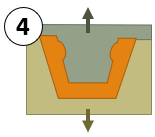
which undercut strategy is this?
bumpoffs

which undercut strategy is this?
parting line manipulation