Lec 16: Adaptions to Aquatic Environments
 Call Kai
 Learn
 Practice Test
 Spaced Repetition
 Match
 Flashcards
 Knowt Play
1/30

There's no tags or description
Looks like no tags are added yet.
31 Terms
What are the characteristics of aquatic environments?
Water is cold with high thermoconduction
Ability to move in water is not innately mammalian
Unusual food sources
Marine environments: hypertonic environment
Amphibious vs obligate aquatic
What are amphibious adaptations?
Webbing between feet and a long tail
Which primarily terrestrial amphibious mammals are examples?
Otters
Which primarily aquatic amphibious mammals are examples?
Seals
Which obligate aquatic mammals are examples?
Whales and dolphins
What are thermoregulatory adaptations?
Larger body sizes with a favorable SA:V ratio; reduced appendage size to reduce heat loss; countercurrent heat exchange in appendages; peripheral vasoconstriction to reduce heat loss in appendages
What is overheating?
Mostly in large-bodied cetaceans; long forelimbs to help dissipate heat; peripheral vasoconstriction in blubber layers; extensive countercurrent heat exchange system
What is testicular countercurrent heat exchange?
Testes are located in the body for heat, but have a cooling system in relation to limbs/extremities

What are pinniped adaptations?
Streamlined body (fusiform); smooth, thick skin; reduced limbs; reduced tail; reduced external genitalia; undulating movement to swim; lost clavicles; nostrils closed when relaxed

What is the family Otariidae (sea lions and fur seals)?
Less adapted to the aquatic environment; reduced external ears; can pull legs under body and walk on land; forelimbs provide propulsion in water; dense fur coat waterproofed by oily secretion
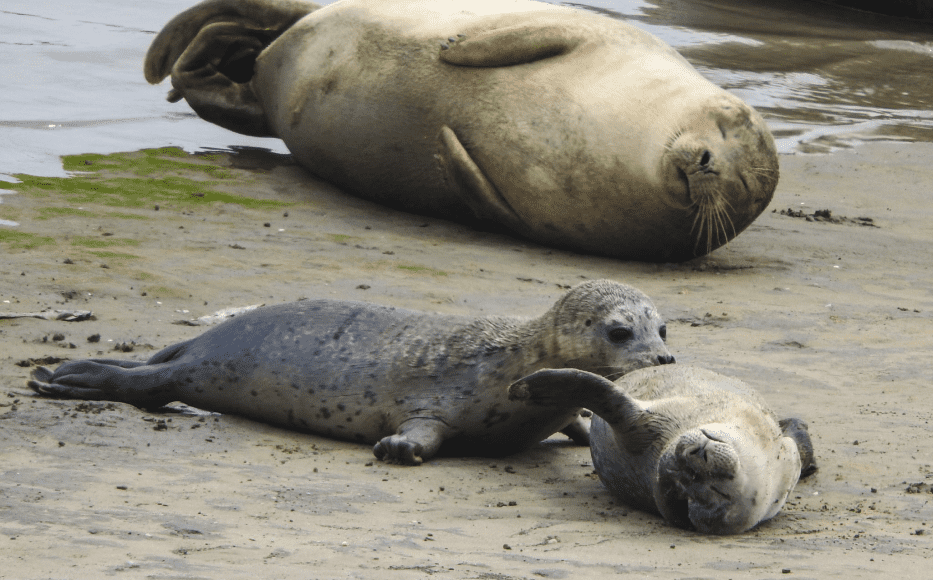
What is the family Phocidae (seals)?
Highly adapted to the aquatic environment; no external ears; lost most fur and insulated with blubber; hind legs grown together; hind legs used for propulsion in water
How do aquatic organisms see?
Must be able to see on land and in water; pinniped eyes can change refractive index; thickened muscular connection for the cornea protects the eye from abrasive salt water; enhanced light-gathering membrane
How do aquatic mammals use touch?
Often little to no light in water
How do aquatic mammals hear?
Can hear well; direct sound to the inner ear
How do aquatic mammals smell?
Barely any sense of smell
What is the water balance issue in marine mammals?
Skin is somewhat impermeable, but sea water is ingested; likely get water from food (fish have kidneys that can convert salt water to usable water)

What are cetacean aquatic adaptations?
Smooth bodies to decrease drag
hind limbs reduced to small vestigial bones
no body hair; spongy outer skin that absorbs/cushions turbulence
propulsion via tail flukes (not homologous to hind limbs)
forelimbs steering and stabilizers
What are the limbs of cetaceans?
Reduction of arm bones to be short; elongation of phalanges (number of bones increased); nipples and male genitalia in pouch
What are cetacean sensory organs?
Can see well, but eyesight becomes less useful at deeper depths; rely mostly on hearing and echolocation for navigation and hunting
What is the suborder Odontoceti?
Toothed whales usually homodont
predatory feeding (ex: porpoises)
Single external nare (blowhole)
Echolocate
What is the suborder Mysticeti?
Baleen whales
filter skimming (ex: bowhead whales)
filter gulping (ex: humpback whales) feeding
Paired external nares
NO echolocation
What is the suborder Mysticeti?
With rostrum out of water and mouth open, zooplankton passes through mouth and baleen and eats whats on baleen
What is filter gulping?
groves on throat are expanded as it fills in by water during feeding and gulps and expels water through mouth and eats zooplankton trapped in baleen
What is baleen?
Keratinized plates in the mouths of baleen whales; forms a filter
What are killer whales?
Superb hunters that feed on large fish, seals, sharks, and other cetaceans
What are sperm whales?
Giant squid specialist; forage in the dark using echolocation
What are beaked whales?
Dive over 1 mile deep in search of smaller squid
What is the narwhal?
Toothless except for two canines; one large "horn", the other reduced. Large canine is likely for sensory function (sense salinity/chemical gradient in the water)
What are the morphological and behavioral adaptations for deep diving?
Glide down rather than actively swimming; bones are noncompressible; lungs emptied before diving and stops breathing; heart rate slows to decrease oxygen consumption
What are the physiological and metabolic adaptations for deep diving?
Drop in metabolism; body temp drops, but blood and vital organ temp stays the same; tissues tolerant of carbon dioxide and lactic acid; sources of oxygen: lungs, blood, myoglobin in muscles
What is the diving adaptations ?
High hematocrit in more myoglobin and use more oxygen efficiently than terrestrial mammals
While Submerge, they undergo bradycardia and reduce blood flow to peripheral areas of the body