370 Effects of DNA Mutations (5.4)
 Call Kai
 Learn
 Practice Test
 Spaced Repetition
 Match
 Flashcards
 Knowt Play
1/5

There's no tags or description
Looks like no tags are added yet.
6 Terms
Mutations
—Permanent change to DNA and can be passed on
—Introduced by:
Errors with inserting the incorrect bases from DNA polymerase
Chemical/photochemical alterations of the nitrogen bases
Insertion/deletion of DNA sequences by viruses or enzymes (that move DNA segments between chromosomes/plasmids) → recombination
—DNA sequences prone to reocmbination → mobile genetic elements
Mutation effects
—Altered bases and other changes are always being repaired by DNA repair enzymes, but changes can be permanent if not recognized before replication
—Can be positive if they enhance the capacity for an organism to multiply (natural selection)
—Can be negative if they render daughter cells unable to replicate or perform certain functions
—Mutations are classified by comparing to cells that don’t have the mutation (wild-type organisms)
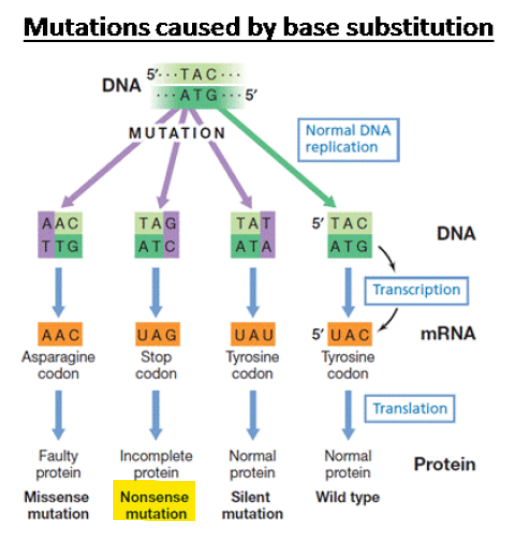
Missense mutation
—Change a codon → change in AA coded by the codon

Nonsense mutation
—Introduce a stop codon → premature termination of translation
—Polypeptide chain obtained is incomplete
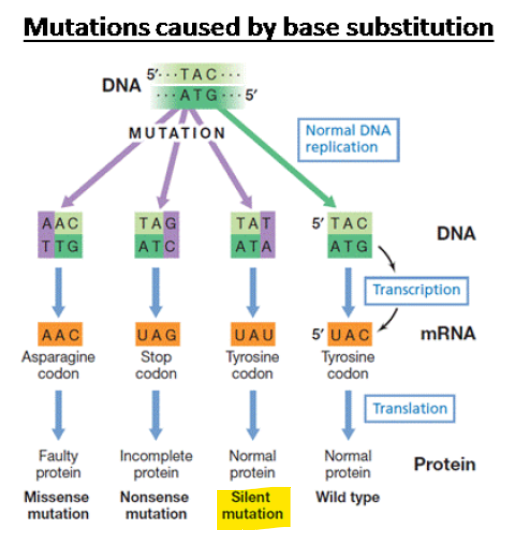
Silent mutation
—Result from the substitution of a single nucleotide
—But new codon still codes for the same AA → same polypeptide chain produced
Frameshift mutation
—Insertion/deletion of a number of nucleotides that is not a multiple of 3
—All codons downstream are in a different reading frame
