PHC 502 Midterm Dr Wen lecture Clinical Study Design & Biomarkers + Ch 6
 Call Kai
 Learn
 Practice Test
 Spaced Repetition
 Match
 Flashcards
 Knowt Play
1/38

There's no tags or description
Looks like no tags are added yet.
39 Terms
What is a randomized control trial (RCT)?
A prospective longitudinal study in which patients are randomly assigned to treatment groups
Why would you run a randomized controlled trial?
Produce comparable groups
Distribution of groups should be unbiased with respect to prognosis and responsiveness to treatment
Treatment is not determined by the investigators, the clinicians, or the participants
The measured/unmeasured and known/unknown prognostic factors + other characteristics of the participants at the time of randomization will be (on avg) evenly distributed/balanced
Why is blinding done in clinical trials? Describe the types of blinding
To eliminate bias
Single blind
Only the researcher doing the study knows which treatment or intervention the participant is receiving until the trial is over
Double blind
Neither participants nor researchers know which treatment/intervention participants are receiving until the clinical trial is over
Triple blind
The study participants, the researchers, and the data analysts do not know which group received treatment
Describe the study design for randomized controlled trials (RCT)

List advantages of RCT
Efficient for investigating causality
“cause” precedes the “effect”
Possible confounding factors are balanced
Randomization facilitates simple statistical analysis
Practical way to minimize several sources of bias
Selection bias
Disadvantages of RCT
Can be long and/or expensive
Requires rigorous control of the allocation/group distribution process
Not ideal for rare conditions or problems with a long latency
Generalizability
Volunteer issues
Define the term biomarker
A laboratory measurement that reflects the activity of a disease process and directly relates to clinical outcomes
A characteristic that is objectively measured and evaluated as an indicator of normal biologic or pathogenic processes, or pharmacological responses to a therapeutic intervention
List examples of biomarkers
Blood pressure
Cholesterol
Fasting glucose
Total lipids & lipid fractions
CD4 count
Tumor size
RNA viral load
Positron Emission Tomography (PET)
Magnetic resonance imaging (MRI)
What is a prognostic biomarker? Give an example
A biomarker used to identify the likelihood of a clinical event, disease recurrence, or progression in patients who have the disease/medical condition of interest
Ex: PSA level, PIK3CA mutation status
What is a predictive biomarker?
A biomarker that is a pre-treatment measurement used to characterize the patient’s disease in order to determine whether the patient is a good candidate for a treatment

Is this biomarker predictive, prognostic, or both? Explain
prognostic
Biomarker + have a better survival rate than biomarker - regardless of treatment
Not predictive because the treatment effect is the same for biomarker - and biomarker +


Is this biomarker predictive, prognostic, or both? Explain
Predictive
Only a treatment effect for biomarker +, no treatment effect for biomarker -
Treatment effect quality differs between groups
Not prognostic because the untreated biomarker + have the same survival rate as untreated biomarker -


Is this biomarker predictive, prognostic, or both? Explain
Both prognostic and predictive
Predictive
Treatment effect is different for biomarker + and - groups
Prognostic
Biomarker + patients have improved survival compared with biomarker - patients, independent of treatment group

What are some reasons why biomarkers may be used in clinical trials?
Replace a distal endpoint with a proximal one
Can be measured earlier
Can be measured more easily or frequently
Can be measured with higher precision, or less subject to competing risks
May be less affected by other treatment modalities
Reduced sample size requirements
Possibility of faster decision making
How can the use of biomarkers increase ROI?
Quantitative correlation with disease progression
Use of biomarkers in early phases of drug development can be used to obtain info early or to choose study cohort
Can reduce the time and expense of drug development
How can biomarkers be used in clinical practice?
Can be diagnostic, prognostic, predictive, or companion
Can be used to screen for diseases in the general population
Can be used to screen for diseases in the at risk population
Can diagnose symptomatic patients
Can be used to divide patient populations to prescribe drug treatment
Can be used to determine drug efficacy
Can be used to determine drug side effects and toxicity
What clinical study designs use biomarkers?
Biomarker stratified designs
Targeted (enrichment) designs
Biomarker-strategy designs
Describe biomarker-stratified clinical trial designs
Treatment options are given at random regardless of biomarker status
Analysis plan is centered on testing the dependence of treatment effect on biomarker status
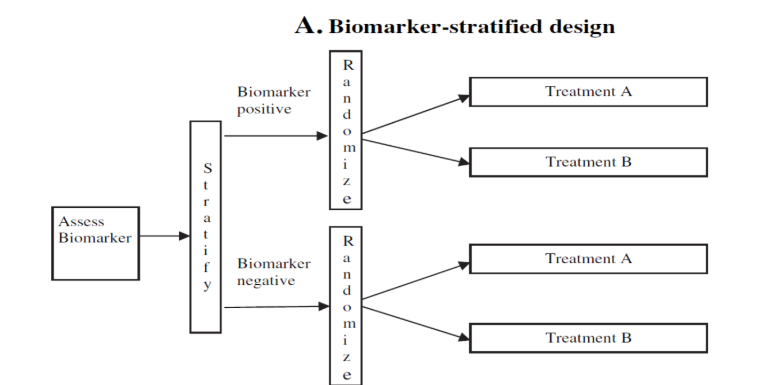
Describe targeted (enrichment) clinical trial designs
Treatment eligibility is restricted to patients considered “most likely” to benefit from the experimental drug

Describe biomarker-strategy clinical trial designs
Patients are randomly assigned to an experimental treatment that uses the biomarker to determine if they get the treatment

What is the fast track program intended for?
To facilitate the development and expedite the review of new drugs that are
intended to treat serious or life-threatening conditions
demonstrate the potential to address unmet medical conditions
Define a surrogate endpoint
A laboratory or physical sign that is used in therapeutic trials as a substitute for a clinically meaningful endpoint that is a direct measure of how a patient feels, functions, or survives and that is expected to predict the effect of the therapy
Can be used to assess the benefit of/harm from a therapeutic agent
List:
Surrogate endpoints
The disease it’s indicated for
Clinical endpoints
Disease: Hypertension
Surrogate endpoints/biomarkers: Blood pressure
Clinical endpoints: Stroke
Disease: Dyslipidemia
Surrogate endpoints/biomarkers: Cholesterol, LDL
Clinical endpoints: Coronary artery disease
Disease: Diabetes
Surrogate endpoints/biomarkers: Glycosylated hemoglobin (HbA1c)
Clinical endpoints: Retinopathy, nephropathy, neuropathy, heart disease
Disease: Glaucoma
Surrogate endpoints/biomarkers: Intraocular pressure
Clinical endpoints: Loss of vision
Disease: Cancer
Surrogate endpoints/biomarkers: Tumor shrinkage, response rate
Clinical endpoints: Progression-free survival, overall survival
What classifies a biomarker as a surrogate endpoint?
If it is expected to predict clinical benefit/harm/lack of benefit or harm based on epidemiologic, therapeutic, pathophysiologic, or other scientific evidence
A correlate of the true clinical outcome
Treatment effect on the surrogate should capture the full effect of treatment on the clinical endpoint
List advantages of using surrogate endpoints in clinical trials
Efficient and improved design of trials
Improved understanding of drug effects
Subgroup differences
Dose and dose interval
Effects over time
Withdrawal
Pharmacodynamic effects
Efficacy in new settings (e.g. pediatric)
Support for results of clinical trials
List disadvantages of using surrogate endpoints in clinical trials
Not a true clinical outcome
Lack of long term stability
Evaluation of biomarkers as surrogate endpoints could be challenging
How many phases of clinical trials are there? Describe each
There are four phases
Phase I
Safety study
Open labeled
20-80 subjects
Phase II
Safety and efficacy studies
Randomized and double-blinded
50-500 subjects
Phase II
Continued safety and efficacy studies
Randomized and double-blinded
100s-1000s of subjects, multisite
Phase IV
Post marketing approval to monitor drug safety and efficacy at large
What are the “seven ethical requirements” in clinical research
Requirements that must be considered to minimize potential exploitation of human subjects
Social value
Scientific validity
Fair subject selection
Informed consent
Favorable risk-benefit ratio
Independent review
Respect for human subjects
Describe the social value requirement within the seven ethical requirements
Ensures that the clinical trial is justified on the basis of scientific research and will result in improvements in health or advancement of scientific knowledge
Resources aren’t directed at nonmeaningful clinical research
Human subjects are not being exploited
Describe the scientific validity requirement within the seven ethical requirements
The clinical trial should be conducted methodically with clear objectives and outcomes that are statistically verifiable
Trial should not be biased
Trial should be able to be executed without unreasonable caveats and conditions
Describe the fair subject selection requirement within the seven ethical requirements
Based on scientific objectives
Not on:
Privilege
Vulnerability
Connivence
Inclusion and exclusion criteria must be designed to satisfy scientific basis
Must be documented evidence to support the choice of selection criteria
Describe the informed consent requirement within the seven ethical requirements
Subjects must be informed about the aims, methods, risks, and benefits of the trial
Availability of alternatives should be explained to the subjects
Subjects should not be pressured into enrolling into the trial
Voluntary enrollment
Can exit at any time without duress or penalty
For young/incapacitated people. proxy decisions must be obtained
Describe the favorable risk-benefit ratio requirement within the seven ethical requirements
Whenever possible subjects should be exposed to minimal risk and maximal benefit
Risk-benefit ratio should be based on proven scientific data at preclinical stage
Clinical trial should not be conducted if there is doubt about the risk-benefit ratio
Describe the independent review requirement within the seven ethical requirements
A third party assesses the clinical trial to avoid conflict of interest
Oversee the welfare of subjects and to ensure that the trial is conducted in accordance w the study being put forward
Describe the respect for human subjects requirement within the seven ethical requirements
Subjects should be protected
New developments in the trial (risks or benefits) must be relayed to the subjects without prejudice
Subject’s decisions should be honored
Trial outcomes must be communicated to subjects promptly and without bias
What is an adaptive clinical trial? (FDA definition)
A study that includes a prospectively planned opportunity for modification of one or more specified aspects of the study design and hypotheses based on analysis of data (usually interim data) from subjects in the study
According to FDA guidelines, an adaptive clinical trial can involve what?
Interim evaluations to stop or to adjust patient accrual
Interim evaluations to assess stopping the trial for early success, futility, or harm
Reversing the hypothesis of noninferiority to superiority or vice versa
Dropping a certain study group(s) or doses, or adjusting doses
Modification of the randomization rate to increase the probability that a patient is allocated to the most appropriate group(s)
What is a meta analysis
A statistical approach that analyzes the combined results from multiple independent clinical studies
What are the advantages of meta-analysis
Can provide
Generalization of results to a larger population
Improvement to accuracy of results
Quantification to inconsistences of results