15. Frontiers in cancer research
 Call Kai
 Learn
 Practice Test
 Spaced Repetition
 Match
 Flashcards
 Knowt Play
1/17

There's no tags or description
Looks like no tags are added yet.
18 Terms
Chemotherapy induced neuropathy (CIPN)
Neuropathy symptoms may occur as result of chemotherapy: tingling, numbness, snesitivity, burning pain
Incidence is high up to 100% after chemotherapy
Can be acute or chronic (acute if shows up immediately after one cycle of chemotherapy, chronic if after a few months post treatment)
How is CIPN measured?
Through questionaire
Through EMG - electromyograph
Nerve conduction velocity
electomyogram - you can see that if impulse passes very slowly through the nerve that the patient has neuropathy
Biomarker
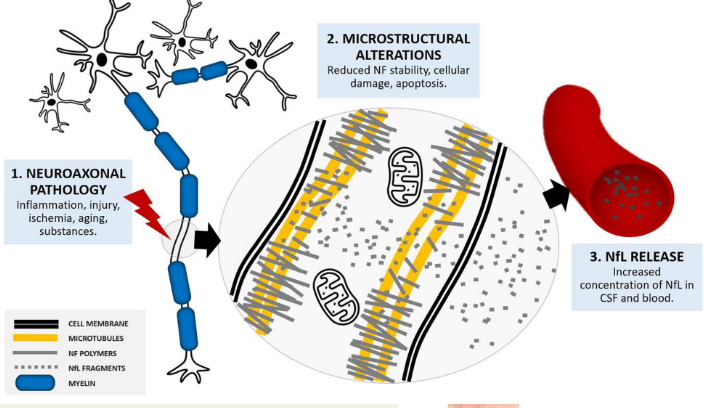
Neurofilament light-chain (NfL)
Neuroaxonal pathology causes microstructural alterations and as a result NfL is released (see picture)
Link between fibre intake and CIPN
Was studied with Cohort data where patients had a habitual fibre intake.
You can see in the picture that as fibre intake increases, CIPN chance decreases

Floreer study
Study will take patients that will undergo chemotherapy and one group will take dietary fibre and one placebo
Then questionnaires, blood and feces will be taken and tests to measure neuropathy

How is the effect of dietary fiber during cancer treatment studied in adults vs. children?
Adults with (colo)rectal cancer:
Dietary fiber and postoperative complications (cohort)
Dietary fiber and gut health after chemoradiation (randomized control trial)
Children with acute lymphobloastic leukemia
Dietary fiber and blood stream infections (cohort)
Effect of different types of fiber and risk of complications
You can see that the fiber from vegetables was most effective

How was fiber quality determined?
Based on different types of species (e.g. apples, bananas, beans, etc)
These were checked for their fiber diversity
Which consists of:
Richness
Evenness
Combination of richness and evenness.

What are the methodological considerations when designing an intervention study? (Dietary fiber and reduction of bowel complaints during and after treatment)
Study poulation: patients with rectal cancer who received neoadjuvant chemoradiation (= initial treatment before primary treatment)
Type of intervention: type of dietary fiber? Single fibers or blend of different fiber types. Dose of intervention? Formulation of product?
Timing and duration of intervention: when do we give the intervention? during treatment? in between treatment?
Study outcomes: clinical outcomes (e.g. bowel complaints) or biological outcomes (e.g. markers of gut health)
Data collection: how will you assess the outcomes (e.g. questionnaires, measurements, etc)
Other things: e.g. changes in behavior because patients really want to get better so they might start consuming pre or pro biotics which would mess up the study.
Question and goal in researching precision nutrition
Question: What explains the variation in people’s dietary responses?
Goal: give personalized dietary advice
Hypothesis vs Data-driven research
Hypothesis driven: Hypothesis → use data to confirm
Data driven: Data → generate new hypothesis
Advantages of machine learning
Exploratory power: you can consider a lot of associations in one model
Can handle many exposures
Predictive performance
Limitations of machine learning
Limited interpretability
Not confirmatory
Large datasets required
Liver fat accumulation
Fat accumulation occurs in >5% of liver cells
Consuming foods high in fat and sugar and little exercise increases this.
Stages of liver fat accumulation
Fatty liver disease is when you accumulate fat in liver (most people remain in this stage)
When more and more fat accumulates you get inflammation and you can even form scar tissue.
Liver cirrhosis occurs when it progresses even further, can cause loss of function

How to assess liver fat?
Imaging (CT scan, MRI, ultrasound)
In MRI scans images are made and the density can be measured.
Liver biopsy
What is the link between liver fat and CRC treatment and prognosis?
They have shared risk factors (e.g. overweight, alcohol consumption)
Because liver might work less effectively, chemotherapy may be less efficient as it is responsible for drug metabolism.
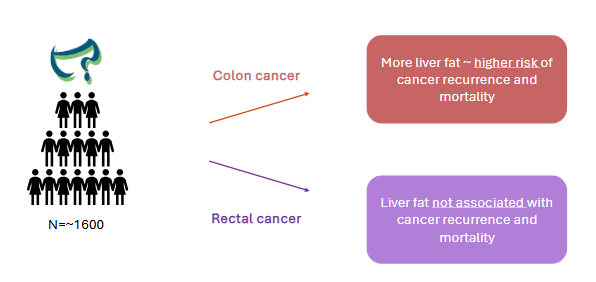
Result liver fat and colon/rectal cancer prognosis
Liver fat and efficacy chemotherapy
The liver is involved in metabolism of certain chemotherpeutic drugs
Result: more liver fat → lower risk of chemotherapy induced toxicities (which may imply lower exposure to the chemotherapy as liver works less good)