EXAM 2 CARE AND NAIMLA MANGMENT CHASE MADE
 Call Kai
 Learn
Learn Practice Test
 Spaced Repetition
 Match
Match Flashcards
 Knowt Play
1/12

There's no tags or description
Looks like no tags are added yet.
Name | Mastery | Learn | Test | Matching | Spaced | Call with Kai | Chat |
|---|
No analytics yet
Send a link to your students to track their progress
13 Terms

what rabbit is this
New Zealand
bred for meat and medical testing, now also companions - medium to large sized breed- muscular, large hindquarters (haunches)- color variations- red, black, mixed coloring- albinism common- “New Zealand White”- white fur, red/pink eyes- more susceptible to ophthalmic diseases- upright ears, females tend to have large dewlap (pouch of fat below jaw)- coat- “flyback fur”- when stroked against direction, will go back to original position

what ear is this
Lops-
French Lop, Holland Lop, Mini Lop, English Lop- vary in body size, ear size across lop breeds- all have distinct natural ear position of drooping, opening of ear facing inward- thicker or longer ears not supported by ear structure, causing droop- cross-breeds may have half-lop ears- difficulties hearing predators or with thermoregulation- uncommon in the wild- may be more prone to ear infections, deafness

what type of rabbit is this
Long-haired rabbits
- Angora (English, French, Satin, Giant), Lion head- increased grooming needs- avoid matting, skin infections- Angora fur grows rapidly ~1inch/month- if ingestion of fur- can cause GI stasis/ ”Wool Block”- difficulties in hot weather, provide shade if outdoor access- Lionheads have small head, longer lower jaw- malocclusion
Guinea pigs history?
domestic guinea pig (Cavia porcellus) originated from South America, originally as food source - from wild ancestor Cavia aperea, still wild populations today in South America- are classified as rodents, Caviidae (cavy) family- American Cavy Breeders Association (ACBA) recognizes 13 breeds- colors, size, hair length vary across breeds

What coat is this
Satin- long coat, flowing from back to front, distinct part, high grooming needs. Peruvian, Abyssinian, American breeds
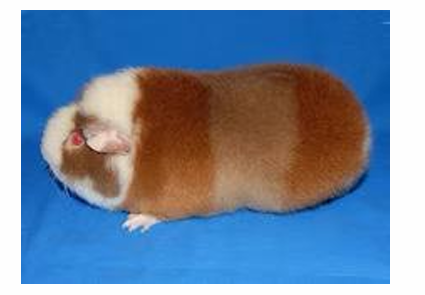
what coat is this
Teddy- short, dense, plush coat. Teddy breed

what coat is this
Silkie- long coat, flowing from front to back, high grooming needs. Silkie or Sheltie breed
Note get the other coat types from slide exam 2, 1
do it
Sensory considerations dogs eyes
tend to have visual issues with close objects (nearsightedness), and reduced depth perception (because eyes are wider apart than humans)- able to see in low light- larger uniocular vision range, smaller binocular, smaller blind spot (can differ by head shape)- dichromatic (red-green color blindness)
Sensory considerations dogs ears
able to hear higher frequencies than humans, range similar, can’t hear lower- can hear sounds from further distances than humans- can detect changes in vibrations on the ground- ears move in response to sound in environment- hearing differs by breed/ear type, head shape
Sensory considerations dogs nose
sense of smell significantly better than humans and cats- can use both nostrils at different times to help with direction of smell- have Jacobson’s organ (vomeronasal) to help detect chemical signals and pheromones for social communication- smell differs by breed, head shape