ENDO FINAL
 Call Kai
 Learn
Learn Practice Test
 Spaced Repetition
 Match
Match Flashcards
 Knowt Play
1/157

There's no tags or description
Looks like no tags are added yet.
Name | Mastery | Learn | Test | Matching | Spaced | Call with Kai | Chat |
|---|
No analytics yet
Send a link to your students to track their progress
158 Terms
50/0.2 gutta-percha
You determine your tooth #8 FFB is a #35K and instrument the MAF to be a 50/.02 with step back hand instrumentation. What size gutta-percha master cone should you use to confirm tug back and take a conefit radiograph?
waveone gold primary
You determine your tooth #10 FFB is a #15K and instrument to MAF to be a WOG Primary 25/.07v. What size gutta-percha master cone should you use to confirm tug back and take a conefit radiograph?
master gutta percha, sealer, accessory cones (if needed)
What should be inside the canal when taking the initial condensation radiograph?
D/ Difficult to remove from the canal
Which of the following is a feature you do not want in an obturation material?
A. Seals canal laterally and apically
B. Unaffected by tissue fluids
C. Inhibits bacterial growth
D. Difficult to remove from the canal
E. Radiopaque
create seal from orifice to apical foramen
What is the objective of obturation?
G/ All of the above are diagnostic tests
Which if the following is not an endodontic diagnostic test?
A. Periodontal Probing
B. Mobility
C. Percussion
D. Palpation
E. Cold
F. Hot
G. All of the above are diagnostic tests
pulp necorosis
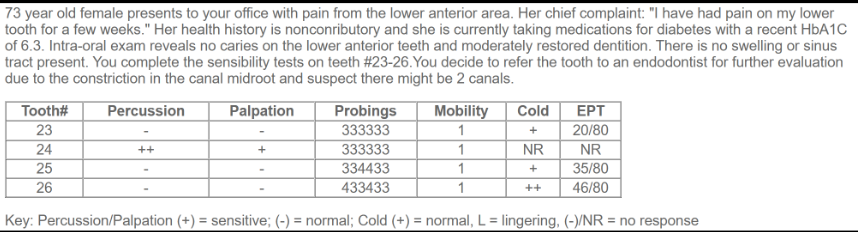
What is the pulpal diagnosis of tooth #24?
symptomatic apical periodontitis
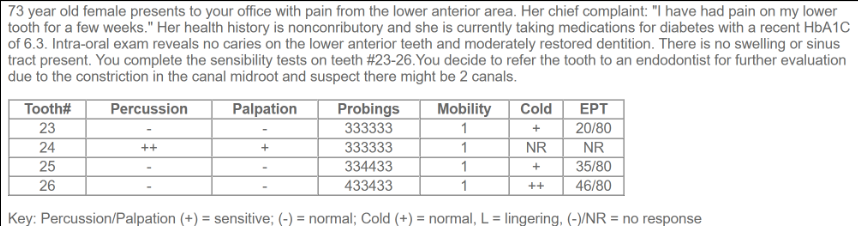
What is the periapical diagnosis of tooth #24?
40%
Approximately how often does a mandibular incisor have 2 canals?
94%
What is the success rate of endodontic microsurgery with use of a microscope according to Setzer, et al. 2010?
Pulp Necrosis
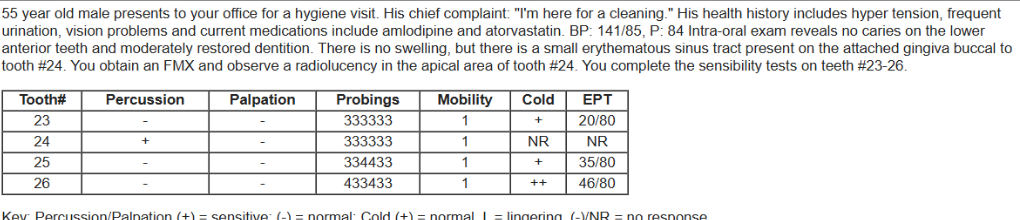
What is the pulpal diagnosis of tooth #24?
Chronic Apical Abscess
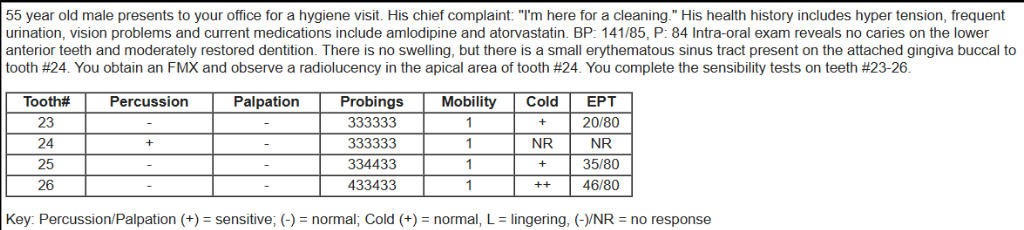
What is the periapical diagnosis of tooth #24?
22%
How often does a mandibular canine have 2 canals?
2 roots, 2 canals
What is the most common tooth morphology for number of roots and canals for a maxillary first premolar?
1 root, 1 canal
What is the most common tooth morphology for number of roots and canals for a mandibular first premolar?
Asymptomatic Irreversible Pulpitis
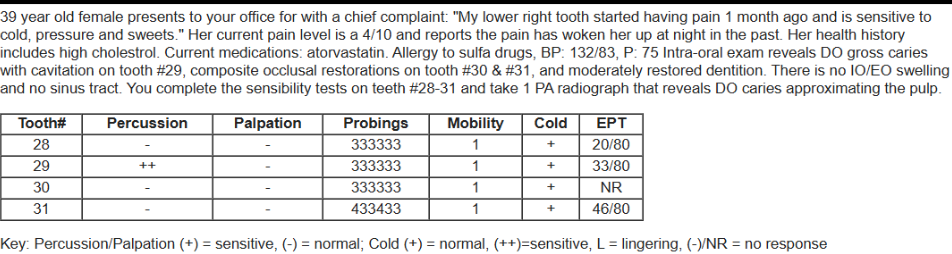
What is the pulpal diagnosis of tooth #29?
Symptomatic Apical Periodontitis
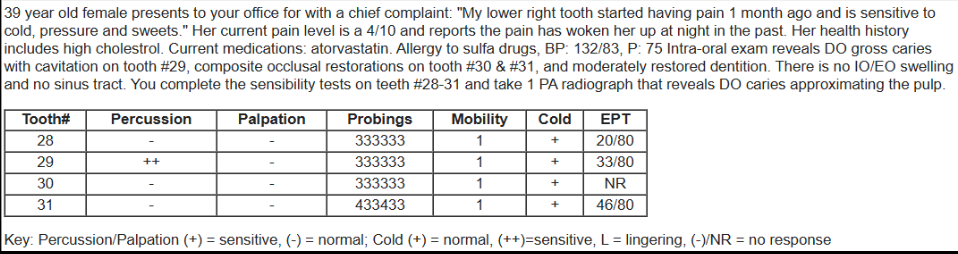
What is the periapical diagnosis of tooth #29?
F/ All of the above are found in the pulp
Which of the following is not a cell found in the pulp?
A. Odontoblast
B. Stem Cell
C. Fibroblast
D. Macrophage
E. Lymphocyte
F. All of the above are found in the pulp
A-delta fiber
Which type of primary afferent axon nerve fiber is best described as myelinated, fast conduction, and is responsible for sharp and cold pain?
Trigeminal Ganglion
Where are the cell bodies of the sensory neurons that innervate the dental pulp of tooth #29 located?
symptomatic irreversible pulpitis
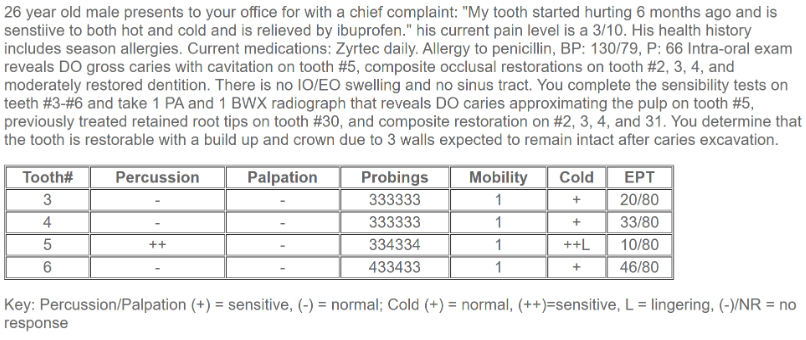
what is the pulpal diagnosis of tooth #5
symptomatic apical periodontitis
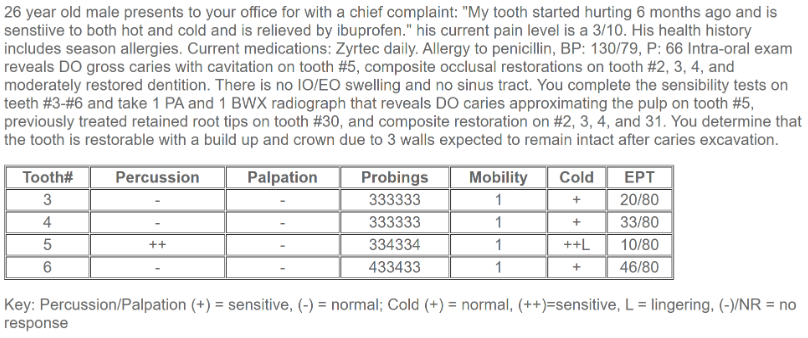
what is the periapical diagnosis of tooth #5
E/ All of the above are potential etiologies
Which of the following is not a possible etiology of pulpal
disease?
A. Caries (microbial)
B. Tooth Preparation (mechanical)
C. Trauma (mechanical)
D. Restorative Materials (chemical)
E. All of the above are potential etiologies
F/ All of the above
Which of the following are key players in pulpal pathosis?
A. Histamine
B. PGE2
C. Bradykinin
D. Bacteria and their byproducts
E. Macrophages
F. All of the above
condensing ostetitis
Which periapical diagnosis is best described by an opaque diffuse appearance that histologically represents an increase in trabecular bone due to persistent irritation?
pulp necrosis
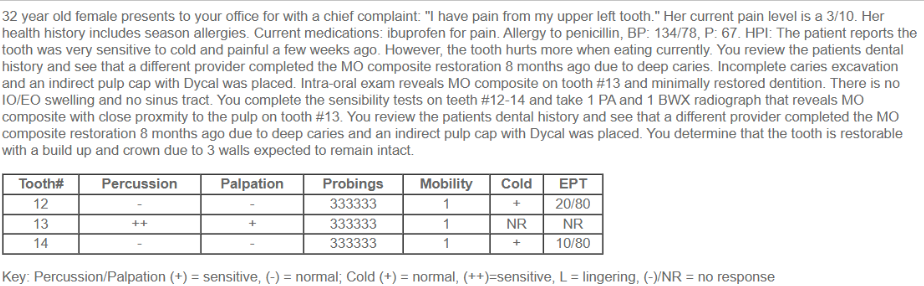
What is the pulpal diagnosis of tooth #13?
Symptomatic Apical Periodontitis
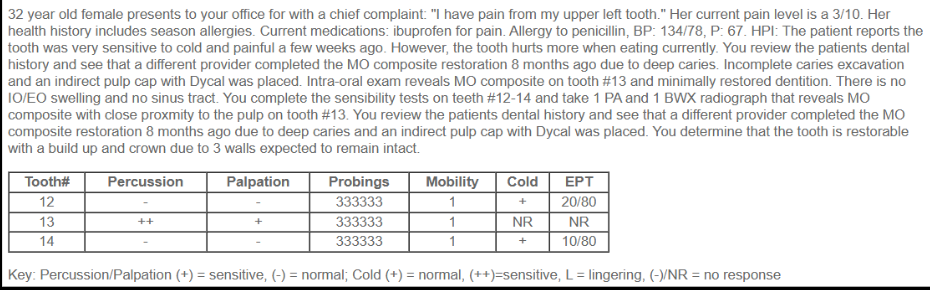
what is the periapical diagnosis of tooth #13
Increased pulpal pathosis with irreversible nature
One of the most common routes of root canal infection is direct pulp exposure. According to Reeves and Stanley (1996), what happens once caries reaches to within 0.5mm of the pulp?
D/ Gram negative bacteria have LPS (lipopolysaccharide) attached to
their cell wall
Which statement is correct regarding gram negative bacteria?
A. Gram negative bacteria have a thick peptidoglycan wall
B. Gram negative bacteria have LTA (lipoteichoic acid) attached to their
cell wall
C. Gram negative bacteria have periplasmic space outside of their outer
membrane
D. Gram negative bacteria have LPS (lipopolysaccharide) attached to
their cell wall
E. All of the above
sodium hypochlorite (NaOCl)
Which irrigant is used in the endodontics clinic during instrumentation, with positive pressure irrigation, to disinfect the canal system and remove the organic components of the smear layer?
Asymptomatic Irreversible Pulpitis

What is the pulpal diagnosis of tooth #30?
symptomatic apical periodontitis
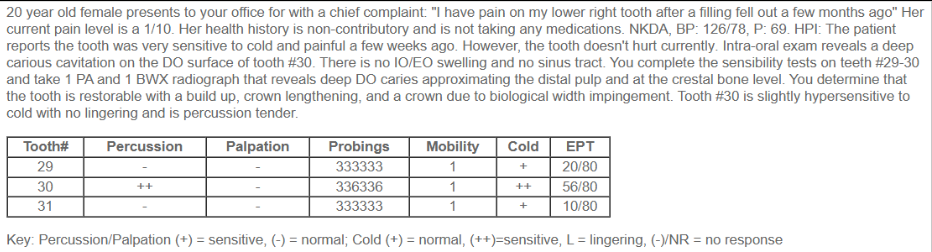
What is the periapical diagnosis of tooth #30?
drainage through tooth w/ RCT and incision and drainage (I&D)
What is the recommended treatment for a tooth that is restorable that has been diagnosed with pulp necrosis and acute apical abscess?
D/ All of the above
What best describes a “Flare Up”?
A. Results in an unscheduled dental visit
B. Inter-appointment emergency
C. Extreme pain or swelling after endodontic treatment
D. All of the above
buccal
You are working on tooth #5 that has 2 canals. The first working length radiograph you take has both files overlapping so you get approval from your instructor to take another radiograph. You decide to angulate the xray source to take a distoangulated radiograph. The second WL radiograph separates the files. Which file/canal is the right side of the image?
pulp necrosis
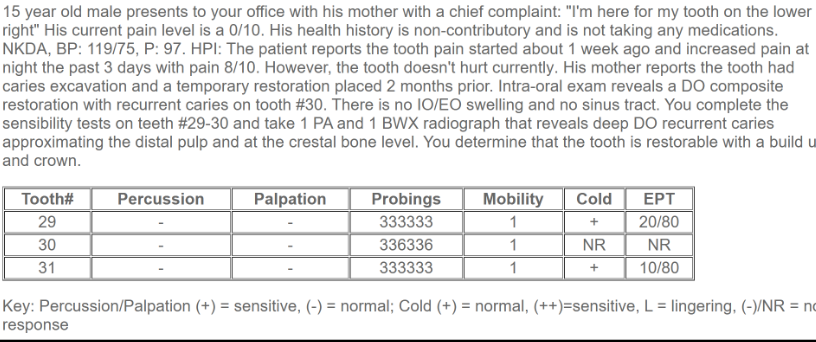
What is the pulpal diagnosis of tooth #30?
condensing osteitis
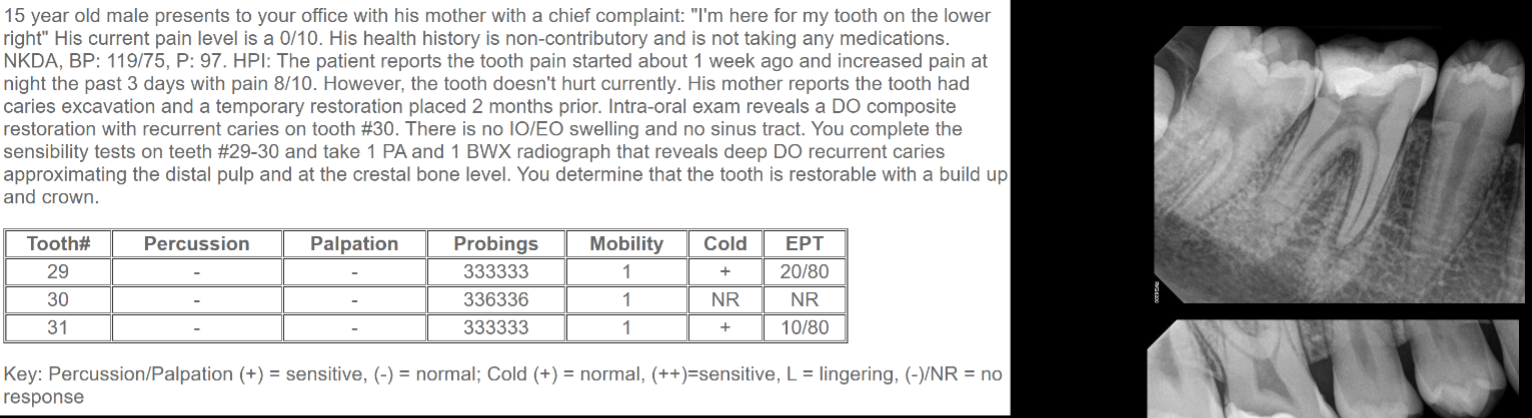
What is the periapical diagnosis of tooth #30?
Condensing Osteitis
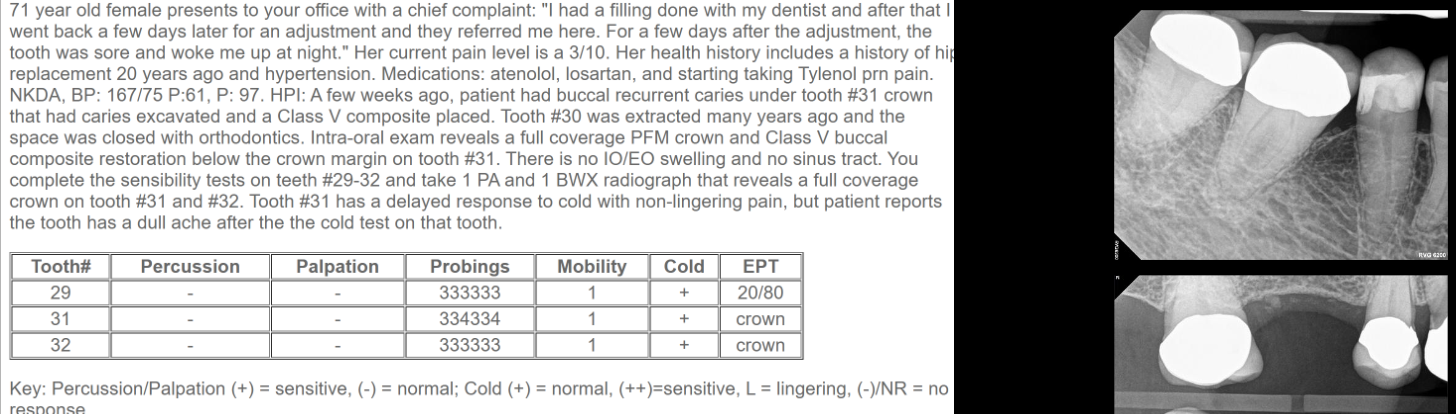
What is the periapical diagnosis of tooth #31
D/ The master gutta-perch cone should stop short of the working length
by 1 mm before it is form.
Which statement is true regarding the size of 0.02 taper master gutta-percha cone you should select to make a custom formed cone?
A. The master gutta-percha cone should stop at working length before it is
formed.
B. The master gutta-perch cone should stop past the working length by
0.5mm before it is form.
C. The master gutta-perch cone should stop past the working length by
1 mm before it is form.
D. The master gutta-perch cone should stop short of the working length
by 1 mm before it is form.
E. None of the above
previously treated
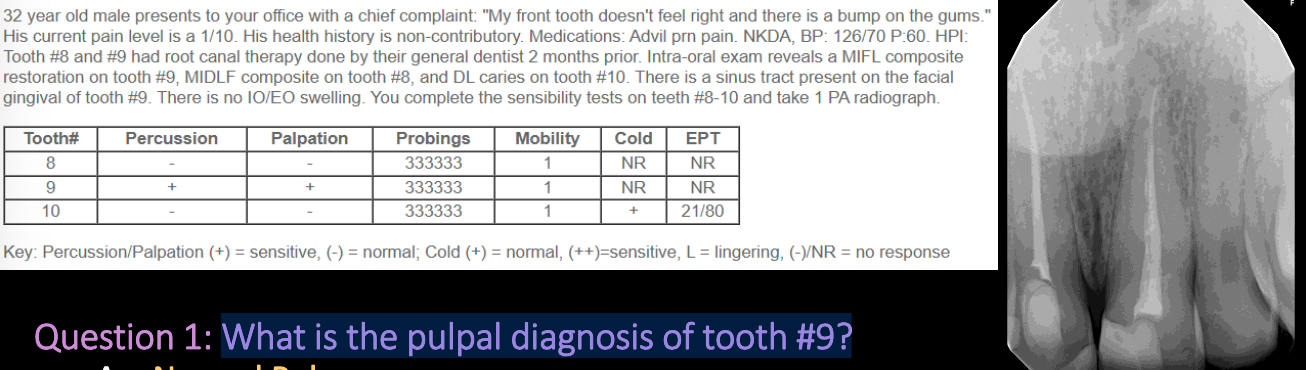
What is the pulpal diagnosis of tooth #9?
chronic apical abcess
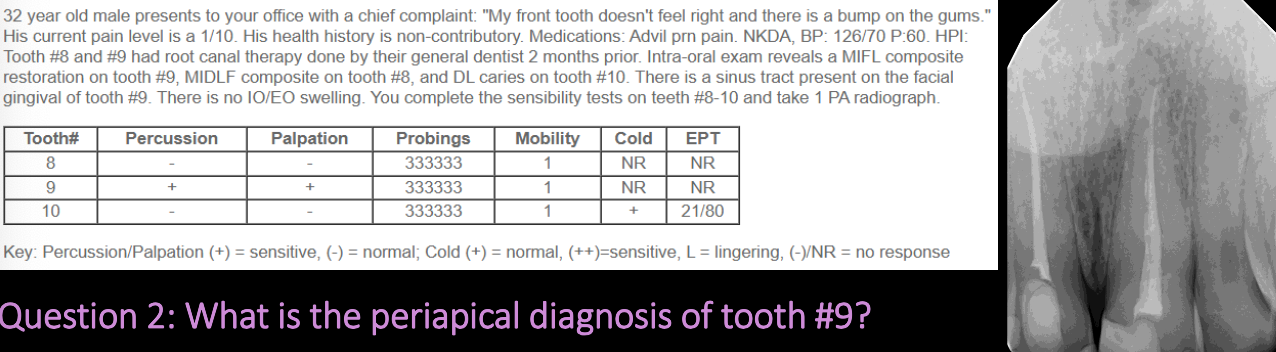
what is the periapical diagnosis of tooth #9
D/ The success of any vital pulp therapy technique does not depend on
placement of a restoration that prevents bacterial microleakage.
Which of the following statements is FALSE?
A. Maintaining a healthy pulp is preferable to RCT, if possible, especially in
immature permanent teeth
B. Vital pulp therapy includes indirect pulp caps, direct pulp caps, and
pulpotomies.
C. Success of vital pulp therapy depends on the pulp status before the
procedure, proper diagnosis, and clinical judgement.
D. The success of any vital pulp therapy technique does not depend on
placement of a restoration that prevents bacterial microleakage.
E. All of the statements above are true.
A/ Mineral Trioxide Aggregate (MTA)
Which of the following is the preferred material to use directly over
the pulp to complete a direct pulp cap on an immature permanent posterior
tooth?
A. Mineral Trioxide Aggregate (MTA)
B. Chloroform
C. Calcium Hydroxide (Dycal)
D. IRM
E. None of the above
E/ All of the above
When might you need to make a formed cone in order to complete
obturation?
A. Larger apical sizes
B. Inadequate apical stop
C. When you know the chances of overfilling are high
D. Open apex (possibly due to over instrumentation)
E. All of the above
previously treated
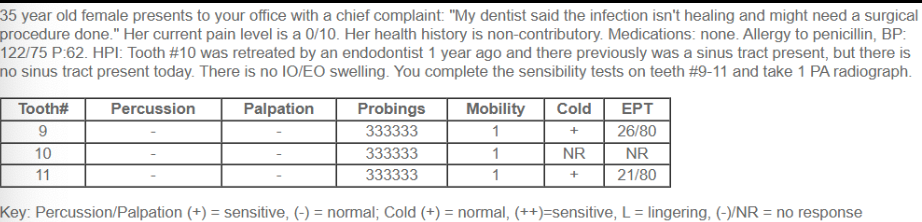
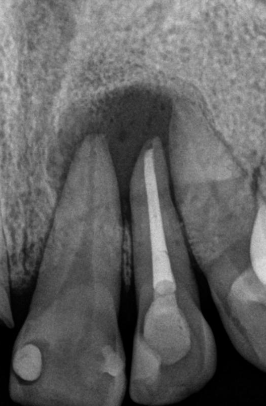
\What is the pulpal diagnosis of tooth #10?
asymptomatic apical periodontitis
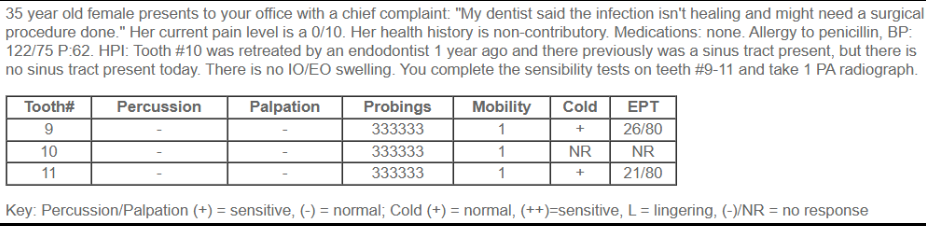
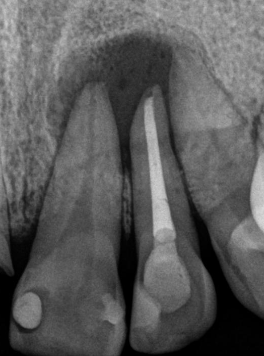
what is the periapical diagnosis of tooth #10?
E/ All of the above increase difficulty
Which of the following is a not a crown morphology that would increase an endodontic case difficulty?
A. Dens invaginatus
B. Full coverage crown
C. Gemination
D. Fusion
E. All of the above increase difficulty
true
True/False. A referral to an endodontist is indicated if there are confusing endodontic testing results due to possible referred pain or non-odontogenic pain
E/ All of the above increase difficulty
Which of the following is a not a canal or root morphology that would increase an endodontic case difficulty?
A. Pulp Stones
B. Root curvatures (dilaceration)
C. Degree of apical closure
D. Increased number of canals in a root (deep split)
E. All of the above increase difficulty
infraction (craze line)
crack of the enamel without loss of tooth structure
vertical root fracture
A fracture in the root whereby the fractured segments are incompletely separated
split root
A continuation of a crack or vertical root fracture whereby the fractured segments are completely separated longitudinally
mand 2nd molar
most common tooth to experience cracked tooth syndrome
endo treatment
vertical root fracture occurs most commonly in teeth with _____
narrow, isolated deep probing
how will vertical root fracture appear on periodontal probing
anterior teeth
pain in ANTERIOR is from
posterior teeth
pain in POSTERIOR is from
true
T/F posterior teeth can refer pain from maxilla to mandible or vice versa
true
T/F anterior teeth do not refer pain from maxilla to mandible or vice versa
true
T/F pain is NOT referred across the midline
max and mand posterior teeth
submandibular lymphnodes can become swollen from infection in
mandibular anterior teeth
submental nodes can become swollen from infection in
true
T/F you MUSt perform diagnostic testing on suspected tooth and adjacent teeth even if the tooth has already been treated with RCT
percussion
detects inflammation of the periapical tissues
palpation
detects how far the inflammation has expanded
thermal tests
valuable in differentiating between reversible and irreversible pulpitis
before
normal tooth should be tested ______ a suspected tooth
true
T/F cold testing can be done through a crown
true
T/F EPT tip needs to be exposed to natural tooth structure
lingual
in a mandibular incisor the second canal will always be ________
96%
percentage of maxillary first molars that have MB2
10
____ percent of MB2 canals in maxillary molars required the use of microscope to find
mandibular
which premolars are mostly one root- one canal
root
when preparing a mandibular premolar access its important to stay parallel to the ______
3
most mandibular molars have ____ canals
mesial
which root of mandibular molar is most likely to have 2 canals
3%
____ percent of mandibularr first molars have a mid mesial canal
true
T/F Except for maxillary molars, the orifices of the canals are equidistant from a line drawn in a mesio-distal direction through the pulp chamber
true
T/F Except for maxillary molars, the orifices of the canals lie on a line perpendicular to a line drawn
mesio-distally across the center of the floor
color of pulpal floor is always darker than chamber
what is the law of color change?
junction of pulpal floor and wall
where are the orifi found in molars?
coronal shaping, working length, glide path, crown down, final instrumentation
steps of instrumentation
provide straight line access
what is the purpose of coronal shaping?
#10 k file
what should be used to establish glide path in molars
MB
which maxillary molar root is the closest to the maxillary Sinus
mesial
the maxillary molar access is on the ____ portion of the occlusal surface
15
What percentage of the Asian population has a radix (extra root) mandibular molar variation?
true
T/F anything that affects the dentin affects the pulp (pulp-dentin complex)
b
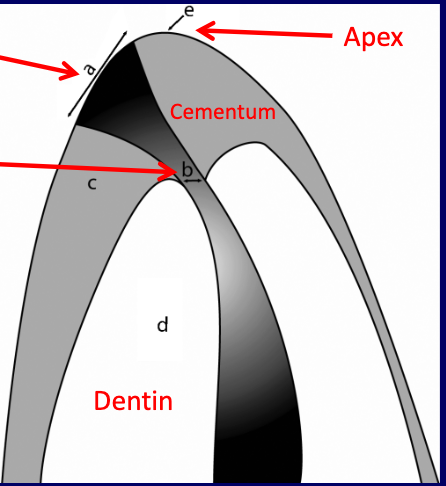
where is the apical constriction (minor apical foramen) ?
all are functions
which of the following is not a function of the pulp:
induction
formation
nutrition
defense
sensation
fibroblasts
most common cell type found in the pulp
all stimuli produce pain
what makes the innervation of pulp unique
A delta fibers
lightly myelinated, fast, sharp pain
C fibers
unmyelinated, slow, dull pain
hydrodynamic theory
theory of dentin hypersensitivity that says stimuli displace fluid within dentinal tubules which activates nerve endings in the dentin or pulp
high alkalinity, antimicrobial, detoxification
benefits of using calcium hydroxide as an intracanal medicament
fuji triage
which temporary material is usually used for larger buildups after caries excavation
3.5mm
how thick should the CAVIT be for a temporary restoration
normal, reversible, irreversible, necrosis, periapical involvement
what is the sequence of worsening pulpal patthology
normal pulp
Asymptomatic and responds normally to vitality tests