Lecture 3: Vertebral Column
 Call Kai
 Learn
 Practice Test
 Spaced Repetition
 Match
 Flashcards
 Knowt Play
1/53

Earn XP
Description and Tags
meowowowowo
54 Terms
vertebral column (spine)
supports trunk, protects spinal cord, weight-bearing (shock-absorption), movement of trunk (movement = lateral flexion/extension, rotation of head, neck, and upper trunk)
components of vertebral column
vertebrae, intervertebral discs (25% of length), vertebral ligaments
cervical spine
C1-7 vertebrae
located at neck
smallest
most mobile
thoracic spine
T1-12 vertebrae
articulate with ribs
limited mobility
lumbar spine
L1-5 vertebrae
largest
bears the most weight
sacrum
a large, triangular bone located at the base of the lumbar spine that connects the spinal column to the pelvis
sacral spine
S1-5 vertebrae
fused
transmit weight to pelvic girdle
coccyx
commonly called the tailbone
a small, triangle-shaped bone at the very bottom of the spine formed by three to five fused or semi-fused vertebrae
coccygeal spine
Co1-4
attachment point for pelvic muscles
fused, vestigial (tailbone)
kyphosis
an outward curve of the spine in the upper back that helps balance the body against gravity
lordosis
the natural inward, forward-bending curve of the spine in the neck and lower back
primary spine curvature
a primary curve present from fetal development that bends outward (convex posteriorly)
secondary curvature
develop after birth due to impact of gravity during erect stance
thoracic and sacral kyphosis
convex (stick out) posteriorly
primary spine curvatures that develop during the fetal period
cervical and lumbar lordosis
concave posteriorly
secondary spine curvatures that develop after birth due to impact of gravity during erect stance
scoliosis
abnormal lateral curvature of spine and rotation of vertebrae
most common vertebral abnormality
typically observed in teenage female patients
muscle assymetry may occur
screening=observe for rib hump/shoulder assymetry during forward bending
bone features/landmarks
surface markings of bone that reflect functional roles
articulations
connection point between two or more bones in skeletal system
facet
head
facet
smooth or flat/nearly flat surface where bones touch (articulate)
head
rounded enlargement that articulates with another bone
foramen (foramina)
hole for passage of soft tissues
canal
tubular passage for soft tissues
process
projection or outgrowth
tubercle
small rounded projection
lamina
the back part of a vertebra (spinal bone) that forms a protective roof over the spinal canal and shields the spinal cord
pedicle
a short, thick cylinder of bone that connects the front part of a vertebra (the vertebral body) to the back part of the arch that protects the spinal cord
features of typical vertebra
vertebral body
vertebral foramen
pedicle
lamina
vertebral arch
superior/inferior articular process
transverse process
spinous process
vertebral notch (inferior)
superior and inferior articular process and vertebral bodies
articulate to facilitate movement
vertebral foramen
houses spinal cord
intervertebral foramen
small, oval-shaped opening between two stacked vertebrae that allows spinal nerves and blood vessels to pass from the spinal canal out to the rest of the body
vertebral arch
protects spinal cord
sup/inferior vertebral notches
accommodate spinal nerves
form intervertebral foramen
spinous and transverse processes
act as anchors for ligaments and muscles
features of typical cervical vertebra
transverse foramen (C1-6)
bidfid spinous process (C2-6)
vertebra prominens (C7 spinous)
superior articular facets + inferior articular facets
uncinate process
triangular vertebral foramen
transverse foramen
accommodates vertebral artery (C1-6)
bifid spinous process
found only in C2-6
two prongs → greater surface area for ligament attachment
vertebra prominens (C7 spinous)
longest process in vertebral column
superior articular facets
face superoposterior and inferior articular facets face inferoanterior
allows for rotation of head
uncinate process
raised lateral margin → concave vertebral body
protects vertebral artery by limiting lateral movement
C1: Atlas
supports cranium through lateral masses (no body)
superior articular facets articulate with occipital condyles permitting “nodding” motion
ring-like structure with no spinous process and articulation with C2 (axis) permits head rotation
C2: Axis
superior articular facets articulate with inferior articular facets of C1
dens
transverse ligament
dens
odontoid process
articulates with anterior arch of C1, permitting head rotation
transverse ligament
holds dens against anterior arch of C1
prevents posterior displacement and spinal cord compression
costal facets
unique to thoracic vertebrae
articular surfaces on vertebra for articulation with ribs
thoracic vertebral body
superior = articulation for head of rib (same level)
inferior: articulation for head of rib (below)
transverse processes (thoracic)
articulation for tubercle of rib
limit mobility
thoracic spinous processes
long, steep, and overlap like shingles
thoracic articular facets
superior: face posterior
permits rotation and limits flexion
inferior: face anterior
additional thoracic vertebrae features
heart-shaped body
circular vertebral formamen
features of typical lumbar vertebra
large kidney-shaped body (bears the most weight)
short hatchet-shaped spinous process
superior articular facets (face medially) and inferior articular facets (face laterally) to facilitate flexion and extension
mamillary processes
accessory processes

mamillary processes
found in typical lumbar vertebra
on root of transverse processes
deep back muscle attachment
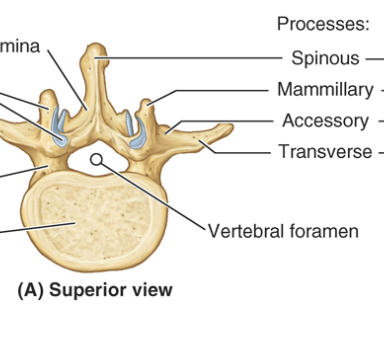
accessory processes
on root of transverse processes
deep back muscle attachment
large triangular vertebral foramen

sacrum and coccyx
fused vertebrae
sacrum articulates with pelvis at auricular surface

sacral canal
houses sacral spinal nerves and exits anteriorly at anterior sacral foramina and inferiorly at sacral hiatus
