Quiz 2- Micro
 Call Kai
 Learn
Learn Practice Test
 Spaced Repetition
 Match
Match Flashcards
 Knowt Play
 Podcast
1/83

Earn XP
Description and Tags
failed it!, chapter 18,19,20,21
Name | Mastery | Learn | Test | Matching | Spaced | Call with Kai | Chat |
|---|
No analytics yet
Send a link to your students to track their progress
84 Terms
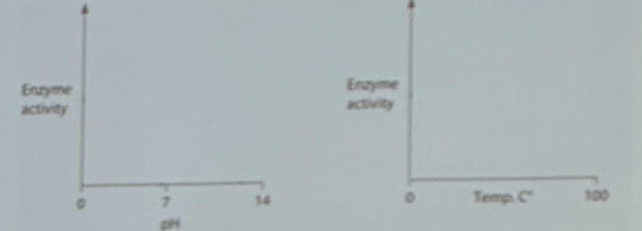
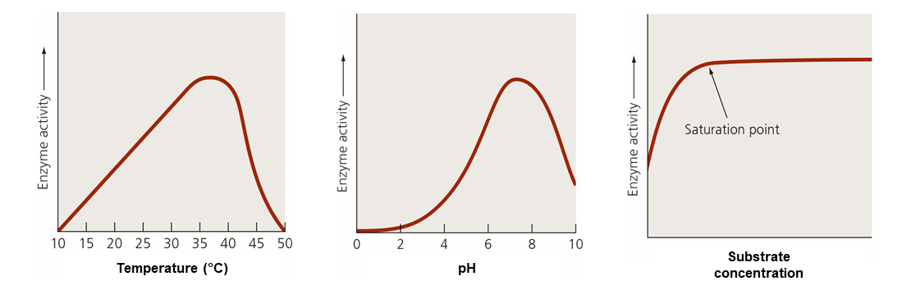
Consider the thermophilic acidophile. sulffolobus acidocaldarius. Use a single curve/line on each graph below to predict the PH profile and expected temperature of S. acidocaldarius enzyme activities.


The graph below illustrates the course of a reaction with and without an enzyme. What energy changes are represented at A, B, and C? Is it exergonic or endergonic
a. Activation energy without enzyme
b. Activation energy with enzyme
c. change in free energy (Delta G)
Exergonic(products have less energy than reactants)

Is this endergonic or exergonic?
exergonic

Is this endergonic or exergonic?
endergonic
The regulation of enzyme activity serves many important purposes in biological systems. Unlike prokaryotes, eukaryotes mRNA transcripts undergo modification(RNA processing) to produce a functional mRNA. Sketch a functional eukaryotic mRNA that includes the 3 modifications that are needed to produce the mature mRNA from pre-mRNA.
Functional eukaryotic mRNA includes a 5' cap, a poly-A tail, and splicing of introns.


If a mutation occurs in the active site of Enzyme 3 such that it can no longer bind to its substrate, predict the effect on the protein concentration levels of Intermediate A, Intermediate B, and the End-product. (either increase, decrease, or no change)
Intermediate A= No change
Intermediate B= Increase
End-product= Decrease

Compare the feedback inhibition mechanisms displayed with competitive inhibition. Draw a single line on each of the graphs below to compare how enzyme activity vs. substrate concentration would differ. A graph of a non-inhibited reaction is included for reference on each graph.
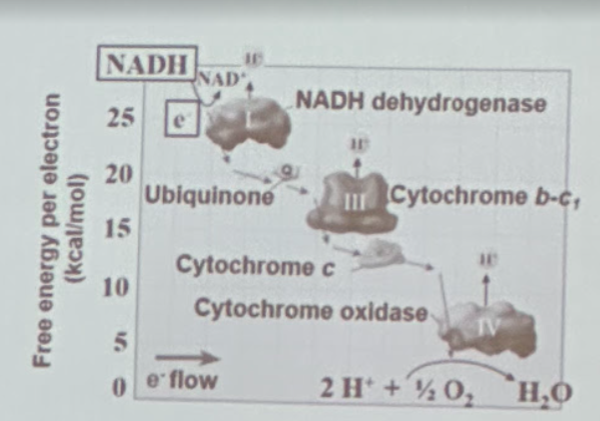
Estimate the total charge in free energy per electron as it moves from NADH to oxygen through the electron transport chain? What is the function of ubiquinone in the electron transport chain?
-25 kcal/mol, Ubiquinone transports electrons

Lac operon
catabolic, inducible (default off), structural gene= Z, Y, A, small effector molecule= allolactose

Trp operon
anabolic, repressible (default on), structural gene= E, D, C, B, A, small effector molecule= tryptophan
Cellular respiration oxidizes glucose into blank and blank
CO2 and H2O

What are the 4 stages of cellular respiration?
Glycolysis
Preparation for citric acid cycle(breakdown of pyruvate to form acetlycoA)
Citric acid cycle
Electron transport chain
Glycolysis produces a net gain of +2 ATP via blank
substrate-level phosphorylation.
The citric acid cycle produces blank per glucose
2 ATP, 6 NADH, and 2 FADH2, 4 CO2
The electron transport chain produces 30-34 ATP via blank
oxidative phosphorylation.
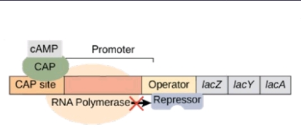
Label the lac operon as either Glucose absent/present and lactose absent/present
glucose absent, lactose absent


Label the lac operon as either Glucose absent/present and lactose absent/present
Glucose present, lactose present
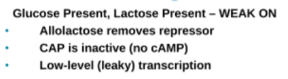
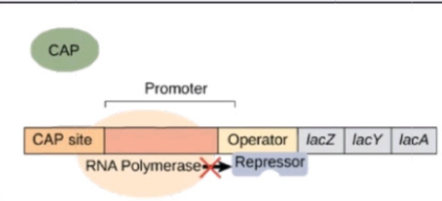
Label the lac operon as either Glucose absent/present and lactose absent/present
Glucose present, lactose absent
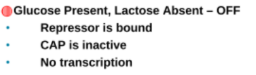

Label the lac operon as either Glucose absent/present and lactose absent/present.
Glucose absent, lactose present
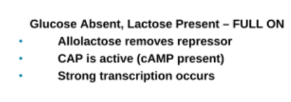
define genetic recombination?
genetic exchange betweem DNA molecules
Define vertical gene transfer
passing of genes to the next generation
Define horizontal gene transfer
genetic exchange between current generations
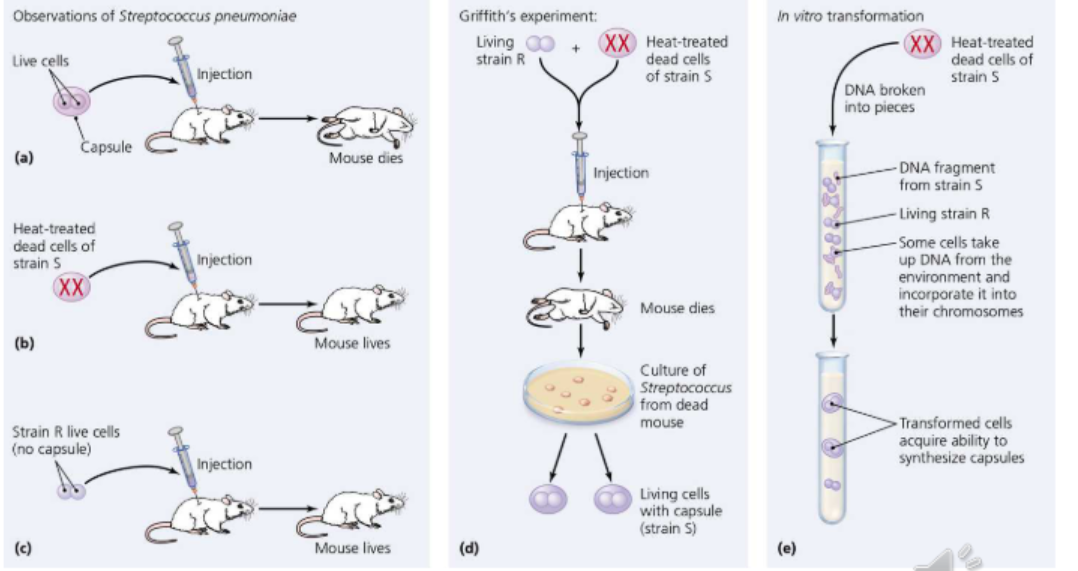
Frederick Griffith was a British bacteriologist who conducted a series of experiments in the 1920s, investigating bacterial transformation in Streptococcus pneumoniae. His work was one of the first to suggest that genes carry the information that determines an organism's traits and laid the groundwork for future DNA research. What significant difference did Griffith observe between the R and S strains of Streptococcus pneumoniae?
In Griffith's experiment, what happened when a mouse was injected with a combination of heat-killed S strain and live R strain of Streptococcus pneumoniae?
The R strain had rough colonies and was non-pathogenic, whereas the S strain had smooth colonies and was pathogenic.
The mouse died and live S strain bacteria were recovered.

What is transformation method of horizontal gene transfer?
uptake of free DNA from the environment by a bacterial cell and a competent recipient(Ex. Frederick Griffith's experiment) that incorporates it into its genome.

What is transduction method of horizontal gene transfer?
uses viruses as DNA shuttles, spreading bacterial genes without direct contact or uptake from the environment by a bacteriophage

What is conjugation method of horizontal gene transfer?
transfer of genetic material between bacterial cells via direct physical contact and F Plasmids which is either in cytosol or incorporated into chromosome of donor(Hfr) cell


What are the parts of bacterial conjugation? Define?
F(fertility) plasmid= codes for conjugation pili
F+ cells= contain an F plasmid (F factor)
Hfr(high-frequency recombination) cells= F-plasmid has integrated into the bacterial chromosomal DNA
F- cells= lack F plasmid, have no pili, can be recipient cells
Define Transposons? What are the 2 types?
Transposons, also known as jumping genes, are DNA sequences that can change their position within the genome, thereby causing mutations and altering the cell's genetic identity. They can be classified into simple transposons, which carry only transposase genes, and complex transposons, which may carry additional genes such as those for antibiotic resistance.
What are the effects of transposons in a genome?
molecular hitchhikers that jump into genomes and change genetic identity and genome size through frameshift mutations
Difference between Jumping, Replicating, and Plasmid transposons?
Jumping transposons move from one location to another within the genome, replicating transposons duplicate themselves when they move, and plasmid transposons are found within plasmids, allowing for horizontal gene transfer between bacteria.

Define mutation?
a rare usually harmful permanent change in the DNA sequence of a gene or chromosome, can be involve large region or single nucleotide, that acts as engine for evolution by generating genetic variation for natural selection.

What is the role of UV radiation mutagen in gene mutation?
can induce covalent bonding between adjacent thymine bases to produce dimer mutations.

What is the role of nucleotide analog mutagen in gene mutation?
compounds that resemble normal nucleotides and incorporate into DNA during replication, leading to base-pairing errors and potentially causing mutations.

What is the role of Frameshift mutagens in gene mutation?
can alter a gene’s reading frame resulting in severe mutation of the normal protein sequence(ex. Acridine compounds). The two types are insertion and deletion.

What are the 3 types of substitution mutations?
Silent= results in no change in amino acid
Missense= swaps one amino acid for another
Nonsense= change and amino acid codon to a stop codon

What is the Mismatch repair DNA repair mechanism?
a single-strand repair that corrects base-pair mismatches from DNA replication.
A mismatch in newly synthesized DNA is detected
New DNA strand is cut and the mismatch nucleotide + it’s neighbors are removed.
Missing patch is replaced with correct nucleotide by DNA polymerase.
DNA Ligase seals the gap in the DNA backbone.
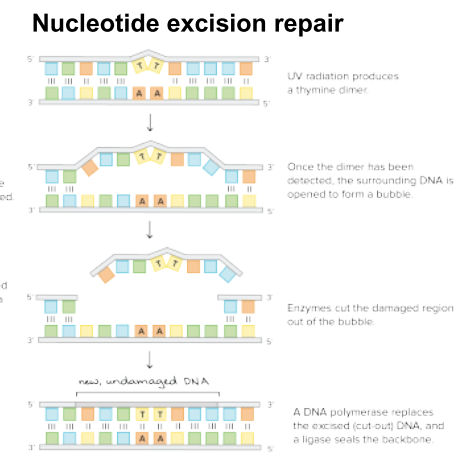
What is the Nucleotide excision repair DNA repair mechanism?
Fixes bulky, helix-distorting lesions like thymine dimers and other chemically damaged bases.
UV radiation produces thymine dimer
Once dimers are detected the surrounding DNA is open to form a bubble.
Enzymes cut the damaged region out of the bubble.
DNA polymerase replaces the excised(cut-off) DNA and Ligase seals the backbone.

What is the Base excision repair DNA repair mechanism? 4 steps
Repair fixes abnormal or chemically damaged bases.
Diamine converts a cytosine to uracil
Uracil is detected and removed, leaving a base-less nucleotide
The base-less nucleotide is removed, leaving a small hole in the DNA backbone.
The hole is filled with right base by DNA polymerase and gap is sealed by ligase.
Blank is descendant of a cell that carries an uncorrect mutuation?
Blank is naturally occurring in cells without mutations.
Mutants, Wild-type cells

For isolating mutants in what technique do mutants grow and wild type not grow? Directly identifying mutants based on their ability to grow
Positive selection techniques

For isolating mutants in what technique do mutants not grow and wild type grow? Identifying mutants based on their inability to grow under specific conditions.
Negative selection techniques

What is the AMES test? What’s it’s role in discovering carcinogens?
A widely used assay that assesses the mutagenic potential of chemical compounds by measuring the frequency of mutations in specific strains of bacteria (e.g., Salmonella typhimurium). It is used to identify potential carcinogens by using mutation rate as a readout, where more revertant colonies= higher mutation rate= potential carcinogen risk.
A bacterial strain, previously unable to synthesize vitamin B12, acquires this ability after being cultured alongside a B12-producing strain. Genetic analysis shows that a section of DNA responsible for B12 synthesis is now present in the previously non producing strain. Which process most likely explains the acquisition of the B12 synthesis gene in the non- producing bacterial strain?
Horizontal gene transfer via conjugation, transformation, or transduction
Considering the mechanism of homologous recombination in bacteria, how might this process be exploited in genetic engineering to introduce a specific gene into a bacterial genome?
By introducing a plasmid with the desired gene flanked by sequences homologous
to a target site in the bacterial genome.
In a laboratory experiment, scientists observe that after infecting a bacterial culture with a bacteriophage, some bacteria acquired antibiotic resistance genes that were not present before the infection. The scientists confirmed that the bacteriophage was carrying these antibiotic resistance genes from a previous host. What is the most likely mechanism for the bacteria acquiring antibiotic resistance in this scenario?
Horizontal gene transfer through transduction
In an experiment, a scientist observes that a strain of bacteria with a plasmid containing a gene for a green fluorescent protein (GFP) is able to transfer this trait to a recipient strain. The recipient strain does not initially fluoresce green but begins to do so after interaction with the GFP-containing strain. Which statement best explains the observed change in the recipient strain?
The GFP gene was transferred through horizontal gene transfer via conjugation
During a conjugation experiment, a biologist notes that a particular cell (Cell A) is able to transfer genes efficiently to multiple recipient cells. Upon closer inspection, it's observed that Cell A contains its entire chromosome integrated with an F plasmid. Based on this information, how should Cell A be classified, and what is the implication of its genetic composition?
As an Hfr cell, suggesting it can transfer parts of its chromosomal DNA.
In a bacterial conjugation experiment, a scientist observes that after conjugation between two bacterial cells, one of which is an Hfr cell, the recipient cell exhibits new genetic traits that were previously only observed in the Hfr cell. However, the recipient cell does not gain the ability to form a sex pilus. What is the most likely explanation for the recipient cell's acquisition of new traits but not the ability to form a sex pilus?
The F plasmid in the Hfr cell failed to transfer completely.
A researcher is analyzing a bacterial genome and discovers a segment of DNA that contains genes for antibiotic resistance, as well as repeat sequences at both ends of this segment. This segment is flanked by inverted repeat sequences and has caused a disruption in a gene that previously coded for a vital metabolic enzyme. Which of the following best describes the segment of DNA and its impact on the bacterial genome?
It is a complex transposon that has led to a harmful mutation by disrupting a vital gene
Which of the following best explains the role of transposons in creating genetic diversity within a genome?
Transposons can move to different locations within the genome, potentially causing
gene disruptions or new gene combinations, thereby increasing genetic variability
How might the presence of complex transposons affect the regulation of genes within a genome?
Complex transposons contain genes unrelated to transposition, which can introduce new regulatory elements or pathways when inserted near other genes, affecting their expression.
Nucleotide analogs are chemical compounds that resemble natural nucleotides, the building blocks of DNA and RNA, but with structural modifications. Why are some nucleotide analogs used as therapeutic agents in medicine?
They can interfere with viral replication or target rapidly dividing cancer cells
Frameshift mutagens are chemical agents or environmental factors that can induce frameshift mutations in the DNA of an organism. Frameshift mutations are a type of genetic mutation where the insertion or deletion of nucleotides disrupts the normal reading frame of the genetic code during transcription and translation. What is the consequence of a frameshift mutation induced by acridine compounds in the DNA sequence?
Synthesis of a non-functional or truncated protein
Codons are specific sequences of three nucleotides (triplets) found in messenger RNA (mRNA) molecules. Assuming completely random incorporation of point mutations into a protein coding DNA sequence, what is the most likely frequency of occurrence (most frequent to least frequent) for silent mutations, missense mutations, and nonsense mutations to occur?
Missense mutations > Silent mutations > Nonsense mutations
DNA direct repair mechanisms are specialized enzymatic pathways that correct specific types of DNA damage without the need for excision or replacement of nucleotides. Which type of DNA damage does base-excision repair primarily address?
Presence of abnormal or damaged bases
During DNA replication, a DNA polymerase mistakenly inserts an incorrect nucleotide opposite an adenine (A) base, forming a mismatched base pair. Which repair pathway is specifically designed to recognize and correct this type of error?
Mismatch repair
In bacteria, how do the proteins involved in DNA repair distinguish between the original (template) and newly made DNA strands during mismatch repair?
By detecting methyl groups on the original DNA strand
A researcher uses a substance that kills cells unable to synthesize a specific amino acid. After applying this substance to a bacterial culture, only a few colonies survive. Which type of selection technique is being demonstrated, and what does the survival of these colonies suggest about the mutants?
Positive selection; the surviving mutants likely possess a mutation conferring
resistance to the substance
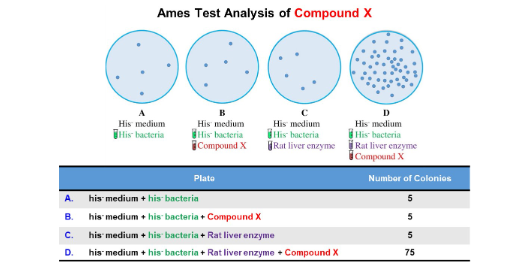
What is the role of rat liver enzyme in the Ames test as shown in the experimental setup?
To metabolize Compound X, potentially converting it into a form that may cause mutations in the bacteria.
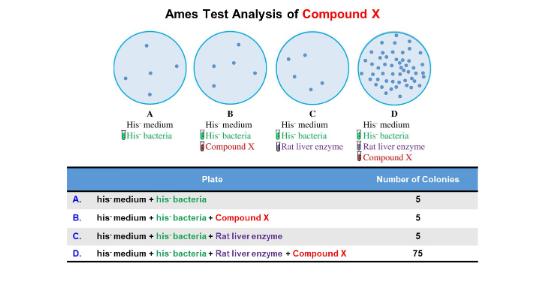
The Ames test is designed to identify potential mutagens through their effects on bacterial growth. What does the contrast between Plates C and D tell us about the mutagenic activation of Compound X?
The increase in revertant colonies in Plate D suggests that Compound X becomes mutagenic after metabolic activation
Define biotechnology?
use of microorganisms to make useful products.
Define recombinant DNA technology?
genetic engineering goal oriented manipulation of genomes by scientist
What are the 3 main goals of recombinant DNA technology?
Eliminate undesirable traits
Combine beneficial traits of 2 or more organism
Create organisms that synthesize products that humans need
Explain the role of restriction enzymes and plasmids in construction of recombinant DNA vector and gene libraries?
Restriction enzymes cut DNA at specific site so a gene can be inserted into a plasmid, while the plasmid acts as a vector to carry and replicate DNA in a host cell, repeating this process with many DNA fragments produces a gene library.
What are the 3 steps of Polymerase Chain Reaction(PCR) in DNA amplification described?
Denaturation= heating DNA sample to 94-98 degree C, causing the double-stranded DNA molecule to separate(denature).
Priming/ annealing= temp is lowered to allow short DNA primers to bind(anneal) to complimentary sequences on each single strand of DNA. Primers provide a staring point for DNA polymerase to extend the DNA.
Extension= temp is raised to 72 degrees C for thermostable Taq DNA polymerase which extends primers by adding nucleotides to 3’ end of each primer building a new DNA strand. Resulting in 2x amount of DNA present in each cycle of PCR.
*These 3 steps are repeated for a certain number of cycles(20-40) to get exponential amplification of the DNA sequence of interest.
What are the 4 tools of recombinant DNA technology described?
Mutagen= chemical or physical agents that cause mutations, used by molecular biologist to create change in genetic sequences for studying gene function and creating new phenotypes.
Reverse Transcriptase= an enzyme that synthesizes DNA for RNA templates, used to create complimentary DNA(cDNA) from mRNA, enabling the study and cloning of expressed genes.
cDNA(complimentary DNA)= DNA synthesized from an mRNA template using reverse transcriptase used in cloning and gene expression studies as it represents only the coding region of genes.
Synthetic Nucleic Acids= manmade DNA or RNA molecules created in vitro, used to design specific genes for cloning, to create primers for PCR, and to study gene function/regulation.
What is gel elecrophoresis?
involves separating DNA fragments by size as they migrate through an agarose gel under a electric field, with smaller fragments moving faster than larger.
What is Southern blotting?
Separated DNA fragments from gel electrophoresis are transferred to a membrane and hybridized with a labeled DNA probe to detect specific sequences.

What are 4 techniques for introducing DNA into cells?
Electroporation
Protoplast fusion
Gene gun
Microinjection
What is DNA microarrays and its uses/applications?
A collection of microscopic DNA spots attached to a solid surface used to monitor gene expression of thousands of genes at once, diagnose predisposition for disease, GeneID, single nucleotide polymorphism detection-genotyping/forensics/cancer.
What are the medical applications of recombinant DNA technology?
the production of insulin, growth hormones, and vaccines. It is also used in gene therapy and the development of targeted cancer treatments.

What are the agricultural applications of recombinant DNA technology?
the development of genetically modified crops for improved yield, pest resistance, herbicide tolerance, and enhanced nutritional content.


What is the difference between sticky and blunt ends of restriction enzymes?
Sticky ends have overlapping sequences that can easily form hydrogen bonds with complementary DNA(more efficient for precise gene splicing), while blunt ends are straight cuts(down the middle) with no overhangs, making them less efficient for pairing(versatile/universal but harder to ligate)

Restriction enzymes, also known as restriction endonucleases, are enzymes that recognize specific DNA sequences and cleave the DNA at or near these sequences. These recognition sites are often palindromic sequences. Which of the following DNA sequence pairs is a palindrome?
A
When a restriction enzyme cleaves DNA asymmetrically, it can result in overhanging single-stranded DNA sequences. These overhangs can be located at which end(s) of the DNA fragment?
Both the 5' and 3' ends

Examine the table of restriction enzymes and recognition/cleavage sites to answer the questions below. Which restriction enzymes will produce 3’ overhangs following digestion? Select all that apply.
C and E

Cutting with which two different restriction enzymes would generate fully complementary sticky ends that could be used to construct a recombinant DNA plasmid? Select the correct two.
A and D
Plasmid vectors are small, circular DNA molecules that are commonly used in molecular biology and genetic engineering as vehicles for carrying and replicating foreign DNA fragments within host organisms, typically bacteria or yeast. What is the primary purpose of an antibiotic resistance gene in a plasmid vector?
To provide a selectable marker for identifying and selecting transformed cells.
What is the primary function of an origin of replication (ori) in a plasmid vector?
It facilitates the replication of the plasmid within host cells.

The human insulin gene has been modified to possess EcoRI restriction enzyme recognition sites at both the 5’ and 3’ ends. The gene is added to a mixture containing EcoRI and a plasmid vector that carries two antibiotic resistance genes (ampicillin and tetracycline). The plasmid vector has one recognition site for EcoRI located in the tetracycline resistance gene. This mixture is incubated at 37°C for several hours, exposed to DNA ligase, and then added to bacteria growing in nutrient broth. For bacterial isolates containing a plasmid into which the insulin gene has integrated, select the letter that corresponds to the expected growth characteristics for these bacteria when grown in the presence of antibiotics as indicated in the table below
B. Growth in the presence of ampicillin.
What is the primary purpose of the polymerase chain reaction (PCR)
To amplify specific DNA sequences
PCR typically uses a DNA polymerase called Taq polymerase, which is derived from thermophilic bacteria. Why is Taq polymerase specifically chosen for PCR instead of other DNA polymerases?
Unlike other DNA polymerases, Taq polymerase is heat stable and survives the 94°C denaturation step in PCR
If the denaturation step of PCR is skipped, how would it affect the amplification of the target DNA sequence?
The target DNA sequence would not be amplified, resulting in no detectable product.
Which of the following best describes the complete sequence of steps that occur during every cycle of PCR?
1. The primers hybridize to the target DNA sequence.
2. The mixture is heated to a high temperature to denature the double stranded
target DNA.
3. Fresh Taq DNA polymerase is added.
4. Thermostable polymerase extends the primers to make a copy of the target DNA.
2,1,4