AP Art History Works
 Call Kai
 Learn
 Practice Test
 Spaced Repetition
 Match
 Flashcards
 Knowt Play
1/41

There's no tags or description
Looks like no tags are added yet.
42 Terms

1.
Name: Apollo 11 Stones
Location: Namibia
Civilization/Era: Paleolithic
Date: c 25,500-25,300 BCE
Material: Charcoal on stone
Fun Facts:
Named after the Apollo 11 moon landing because the cave was discovered in 1969.
The animal may combine human and animal features, possibly suggesting a supernatural or spiritual figure.
Unlike cave paintings, these are portable works of art made on small stone slabs.

2.
Name: Great Hall of the Bulls
Location: Lascaux, France
Civilization/Era: Paleolithic Europe
Date: 15,000-13,000 BCE
Material: Rock Painting
Fun Facts:
The cave is dominated by large animals such as bulls, horses, and deer, while human figures are extremely rare.
Artists used the natural bumps and contours of the cave walls to make the animals appear more three-dimensional.
Because many paintings are deep inside the cave, scholars think they may have had a ritual or spiritual purpose rather than simply being decoration.

3.
Name: Camelid Sacrum in the shape of a Canine
Location: Tequixquaic, central Mexico
Date: 14,000-7000 BCE
Material: Bone
Fun Facts:
The artist used the natural shape of the camelid sacrum bone because it already resembled an animal’s head.
The bone came from an extinct camelid, related to modern camels, llamas, and alpacas.
Its exact date is uncertain because it was discovered in the 1800s without careful archaeological documentation.

4.
Name: Running Horned Woman
Location: Tassili n’Ajjer, Algeria
Date: 6000-4000 BCE
Material: Pigment on rock
Fun Facts:
The woman is much larger than the nearby figures, possibly showing that she was especially important or powerful.
Her body is covered with dots that may represent body paint, tattoos, or scarification.
Her horns, jewelry, and dynamic pose have led scholars to suggest that she may be involved in a ritual or ceremonial dance.

5.
Name: Beaker with Ibex Motifs
Location: Susa, Iran
Date: 4200-3500 BCE
Material: Painted Terra Cotta
Fun Facts:
The ibex’s horns are greatly exaggerated and form a large circular shape that dominates the design.
The animals are highly stylized and reduced to geometric shapes instead of being shown realistically.
The beaker was found in a burial context, suggesting that it may have had a funerary or ceremonial purpose.

6.
Name: Anthropomorphic Stele
Location: Arabian Peninsula
Date: Fourth Millenium BCE
Material: Sandstone
Fun Facts:
“Anthropomorphic” means human-shaped, and the figure is simplified into a basic stone representation of a person.
The figure appears to wear a belt and carries a dagger or sword-like weapon.
Similar stelae have been found across the Arabian Peninsula, suggesting a widespread cultural tradition.

7.
Name: Jade Cong
Location: Liangzhu, China
Date: 3300-2200 BCE
Material: Carved Jade
Fun facts:
A cong has a distinctive square exterior with a circular opening through the center.
Jade is extremely hard and difficult to carve, so producing a cong required enormous time and skill.
Cong were commonly found in elite burials and probably had important ceremonial or ritual significance.

8.
Name: Stonehenge
Location: Wiltshire, England
Civilization/Era: Neolithic Europe
Date: c 2500-1600 BCE
Material: Sandstone
Fun facts:
Some of Stonehenge’s smaller bluestones were transported all the way from Wales.
The builders used techniques similar to woodworking, including mortise-and-tenon joints, to connect the stones.
Stonehenge is aligned with the movement of the sun, especially the summer and winter solstices.
A nearby wooden monument, often called Woodhenge, may have formed part of the same ritual landscape. One interpretation is that wood represented life and the living, while the more permanent stone represented death and the ancestors.

9.
Name: The Ambum Stone
Location: Ambum Valley, Enga Province, Papua New Guinea
Date: c 1500 BCE
Material: Greywacke
Fun facts:
Scholars are not completely certain what animal it represents, although an echidna is one common interpretation.
The stone was carefully carved and polished even though its greywacke material is extremely hard.
Similar stone objects in the region were later associated with ancestors, fertility, or spiritual power.
10.
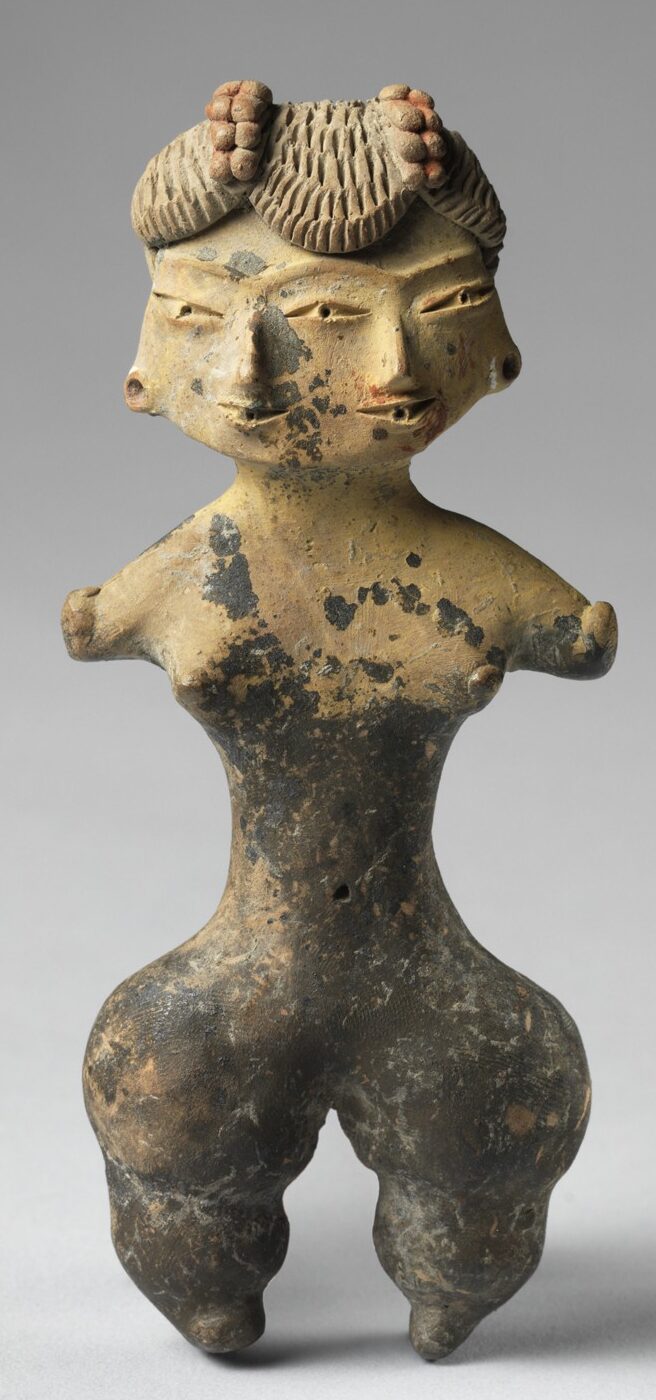
Name: Tlatilco Female figurine
Location: Central Mexico, site of Tlatilco
Date: 1200-900 BCE
Material: Ceramic
Fun facts:
This particular figurine has two faces, making it one of the easiest Tlatilco figures to recognize.
Tlatilco female figurines often emphasize elaborate hairstyles, small waists, and wide hips.
Many of these figurines were found in graves, suggesting that they had an important funerary or ritual purpose.

11.
Name: Terra Cotta Fragment
Location: Lapita, Reef Islands, Solomon Islands
Date: 1000 BCE
Material: Terra Cotta (incised)
Fun facts:
Lapita pottery is so distinctive that archaeologists use it to help trace the movement of Lapita peoples across the Pacific.
The geometric decoration includes a stylized human face hidden within the pattern.
The designs were created by pressing or stamping patterns into the wet clay before the pottery was fired.

12.
Name: White Temple and its Ziggurat
Location: Uruk (Modern Warka, Iraq)
Civilization/Era: Sumerian
Date: c. 3500-3000 BCE
Material: Mud Brick
Fun facts:
The cella, or central sacred room, was restricted and not open to everyone. Access to the most sacred part of the temple was limited, reinforcing the special status of priests and religious elites.
The processional route was deliberately indirect: visitors climbed a steep stairway, followed a ramp around the ziggurat, then had to turn again to enter the temple. That made approaching the sacred space feel controlled and ceremonial, while people below could see the elevated procession and the authority of those allowed to climb it. Khan Academy
The sides of the ziggurat had recessed vertical bands/lines that created dramatic patterns of light and shadow. They emphasized the monument’s height and made the huge structure look even more imposing from below.

14.
Name: Statues of votive figures, from the Square Temple at Eshnunna
Location: Eshnunna (Modern Tell Asmar, Iraq)
Civilization/Era: Sumerian
Date: c. 2700 BCE
Material: Gypsum with inlaid shell and black limestone
Fun facts:
They were prayer offerings placed in the temple so they could symbolically continue worshipping the gods on behalf of the person who donated them.
Their huge eyes symbolize constant attention to the gods, making the figures look eternally alert and devoted.
Many were found buried beneath temple altars, likely after they were removed from display, which shows they were still treated as sacred objects rather than simply thrown away.
16.
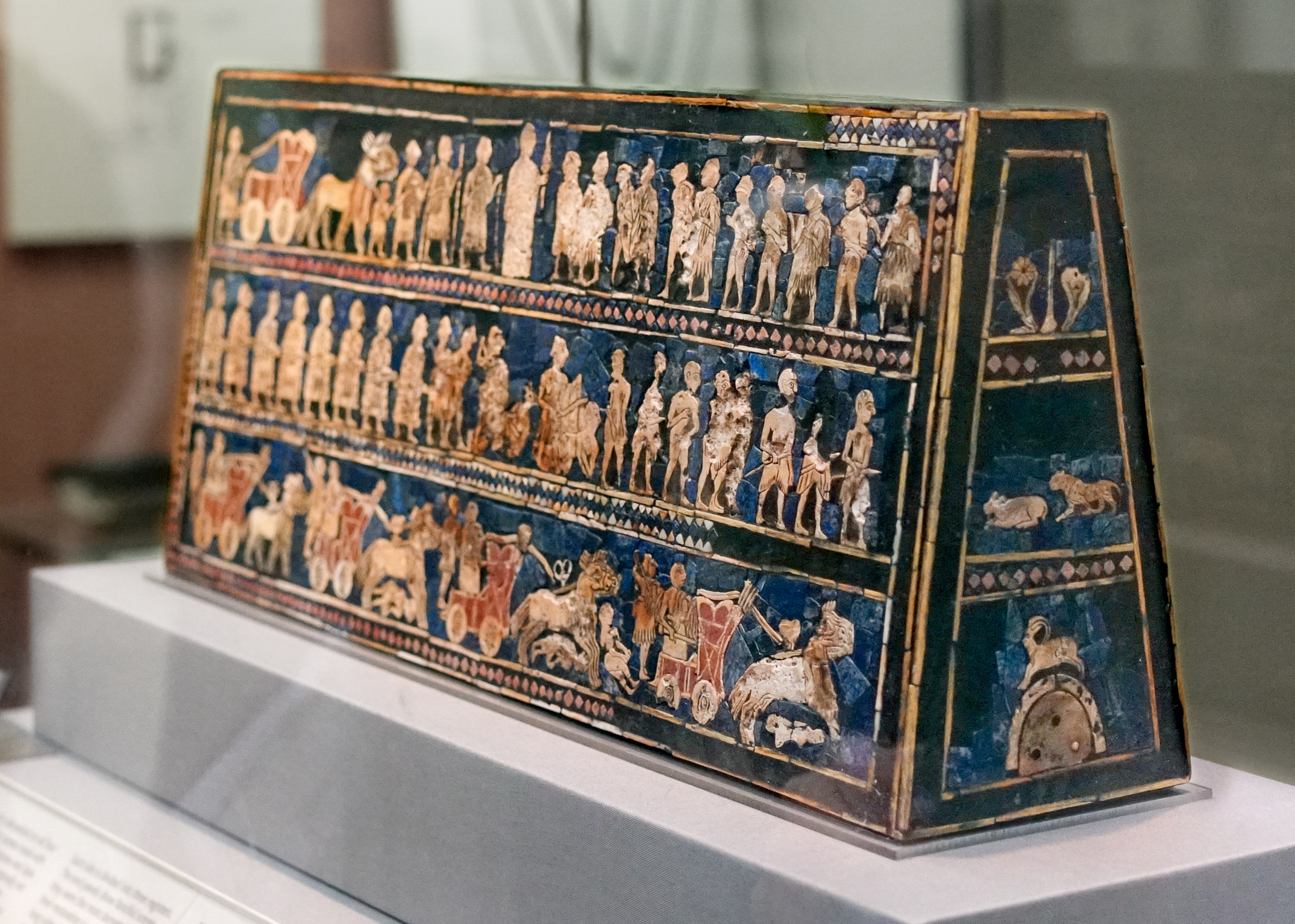
Name: Standard of Ur
Location: the Royal Tombs at Ur (modern Tell el-Muqayyar, Iraq)
Civilization/Era: Sumerian
Date: c. 2600-2400 BCE
Material: Wood inlaid with shell, lapis lazuli, and red limestone
Fun facts:
Its exact function is unknown. It may have been carried into battle as a military standard to help identify or organize the army, or it may have been part of a musical instrument.
It uses hierarchy of scale, meaning the king is shown larger than everyone else to emphasize his importance and power.
The two main sides show war and peace: one side shows battle and prisoners, while the other shows a banquet, music, animals, and prosperity.

19.
Name: The Code of Hammurabi
Location: Babylon (modern Iran)
Civilization/Era: Babylonian
Date: c. 1792-1750 BCE
Material: Basalt
Fun facts:
The laws are famous for the idea of “an eye for an eye,” meaning punishments could correspond directly to the crime.
At the top, Hammurabi is shown receiving authority from Shamash, the god of justice, suggesting that his laws had divine approval.
The stele contains laws about things like crime, marriage, property, trade, and social class, showing how Hammurabi used a written legal code to organize society.
25.
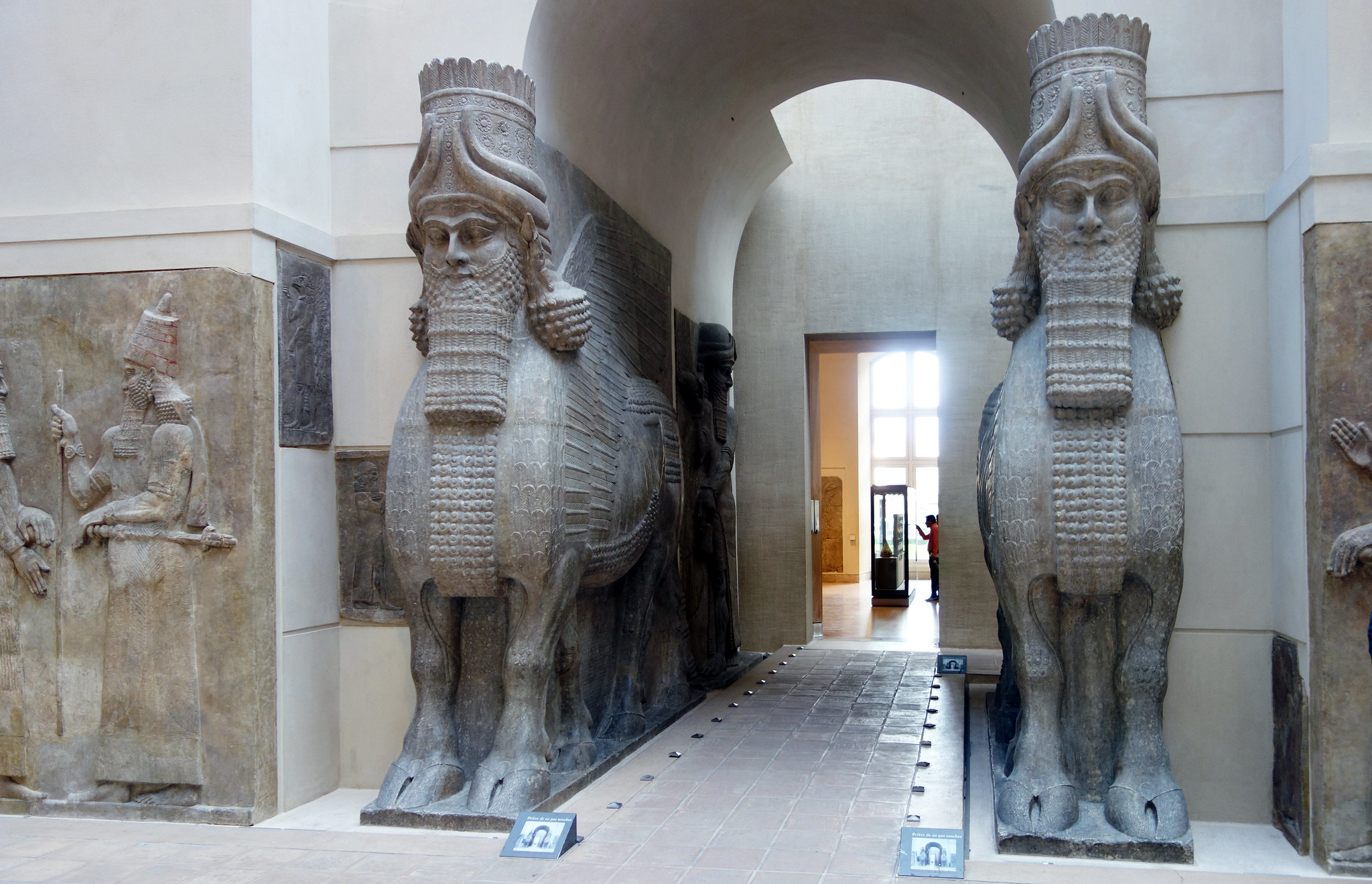
Name: Lamassu from the citadel of Sargon II
Location: Dur Sharrukin (modern Khorsabad, Iraq)
Civilization/Era: Neo-Assyrian
Date: c. 720-705 BCE
Material: Alabaster
Fun facts:
The Lamassu has five legs so that it looks stationary from the front but appears to be walking when viewed from the side.
It combines a human head, bull’s body, and wings, representing intelligence, strength, and supernatural power.
Lamassu were placed at palace entrances as protective guardians, but their huge scale also intimidated visitors and showed the king’s power.

30
Name: Audience Hall (apadana) of Darius and Xerxes
Location: Persepolis, Iran
Civilization/Era: Persian
Date: c. 520-465 BCE
Material: Limestone
Fun facts:
Reliefs on the stairways show representatives from 23 nations of the Persian Empire bringing gifts or tribute to the king.
Visitors walking up the stairs would see images of other people also approaching the king, making the entire experience a carefully staged display of imperial power.
The different groups are shown in an orderly and dignified procession rather than as violently defeated enemies, emphasizing the idea of a large, diverse, but unified Persian Empire.
13.
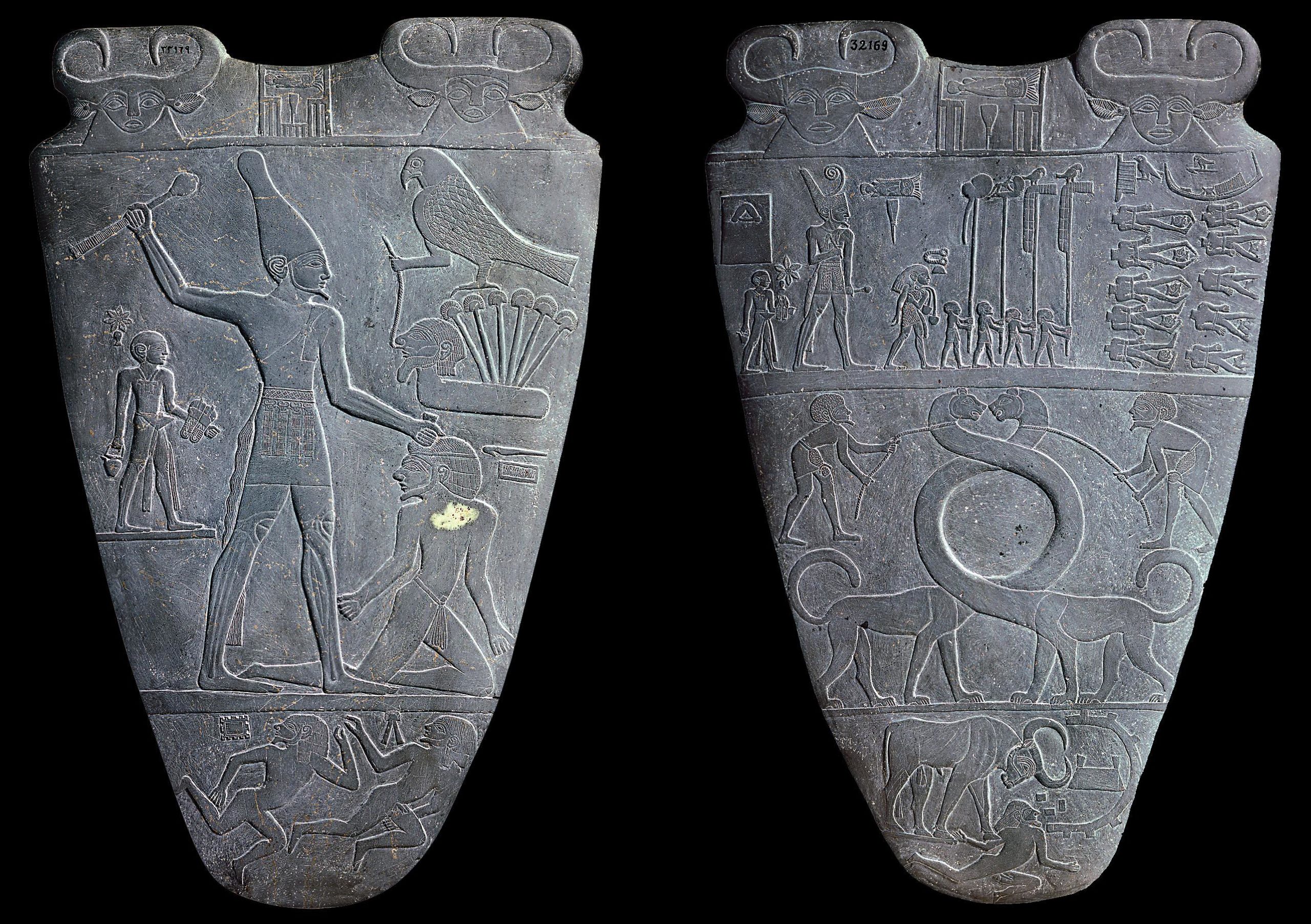
Name: Palette of the King Narmer
Civilization/Era: Predynastic Egypt
Date: c. 3000-2920 BCE
Material: Greywacke
Fun facts:
The palette represents the unification of Upper and Lower Egypt, with Narmer shown wearing the crowns associated with both regions.
It uses hierarchy of scale: Narmer is much larger than the other figures, emphasizing his political and military power.
The intertwined necks of the two mythical animals on one side create a circular space that may have been used to grind ceremonial cosmetics, connecting the object’s practical form with royal symbolism.

15.
Name: Seated Scribe
Location: Saqqara, Egypt
Civilization/Era: Old Kingdom, Fourth dynasty
Date: c. 2620-2500 BCE
Material: Painted limestone
Fun facts:
Unlike pharaohs, the scribe is shown with a more realistic body, including a softer stomach and less idealized physique, showing that Egyptian art changed depending on social status.
His eyes are made from inlaid materials, giving them a striking, lifelike appearance and making him seem alert and intelligent.
Scribes were extremely important because very few Egyptians could read and write, so being a scribe gave someone high status even if they were not royalty.

18.
Name: King Menkaura and queen
Civilization/Era: Old Kingdom, fourth dynasty
Date: c. 2490-2472 BCE
Material: Greywacke with traces of red and black paint
Fun facts:
The woman is shown at almost the same scale as Menkaura, which is unusual and suggests that she had very high status.
Scholars are not completely sure who the woman is; she may have been Menkaura’s wife, mother, or another important royal woman.
Their rigid frontal poses, idealized bodies, and forward-facing stance emphasize timelessness, stability, and royal authority rather than natural movement.

17.
Name: Great Pyramids (Menkaura, Khafre, Khufu) and great sphinx
Location: Giza, Egypt
Civilization/Era: Old Kingdom, Fourth Dynasty
Date: c. 2550-2490 BCE
Material: Cut limestone
Fun facts:
The pyramids were built as royal tombs, and their enormous scale showed the pharaohs’ power and their connection to the gods.
The pyramids are aligned very precisely with the cardinal directions, showing how advanced Egyptian planning, engineering, and astronomy were.
The Great Sphinx combines a human head with a lion’s body, symbolizing the pharaoh’s intelligence and strength while also acting as a guardian of the pyramid complex.

20.
Name: Temple of Amun-Re and Hypostyle Hall
Location: Karnak, near Luxor, Egypt
Civilization/Era: New Kingdom, 18th and 19th Dynasties
Date: Temple: c. 1550 BCE, Hall: c. 1250 BCE
Material: Cut sandstone and mud brick
Fun Facts:
The Great Hypostyle Hall contains 134 enormous columns, creating the feeling of a dense stone forest.
Many of the columns and walls were originally brightly painted, so the temple would have looked much more colorful than it does today.
The tallest columns have papyrus-shaped capitals, connecting the architecture to the marshes and natural landscape associated with creation in Egyptian religion.

21.
Name: Mortuary Temple of Hatshepsut
Location: Near Luxor, Egypt
Civilization/Era: New Kingdom, 18th Dynasty
Date: c. 1473-1458 BCE
Material: Sandstone, partially carved into a rock cliff, and red granite
Fun Facts:
The area around the temple was once much greener and more lush, with gardens and planted trees creating a dramatic contrast with the desert cliffs.
The temple was used for funerary rituals and the continuing worship of Hatshepsut after her death; it was not primarily where her body was embalmed.
The terraces, ramps, and long horizontal lines were designed to blend into the cliffs behind the temple, making the architecture feel connected to the natural landscape.

22.
Name: Akhenaton, Nefertiti, and Three Daughters
Civilization/Era: New Kingdom (Amarna), 18th Dynasty
Date: c. 1353-1335 BCE
Material: Limestone
Fun Facts:
Akhenaten radically changed Egyptian religion by promoting the worship of Aten, the sun disk, above the traditional gods and making one of the first monotheistic religions.
Nefertiti is shown almost the same size as Akhenaten, emphasizing her unusually important role, and the royal family is shown in a relaxed, affectionate scene rather than the stiff poses typical of earlier Egyptian art.
Rays from Aten end in hands holding ankhs, the Egyptian symbol of life, showing Aten giving life to the royal family. The elongated bodies and more natural family scene are characteristic of the Amarna style.
23.
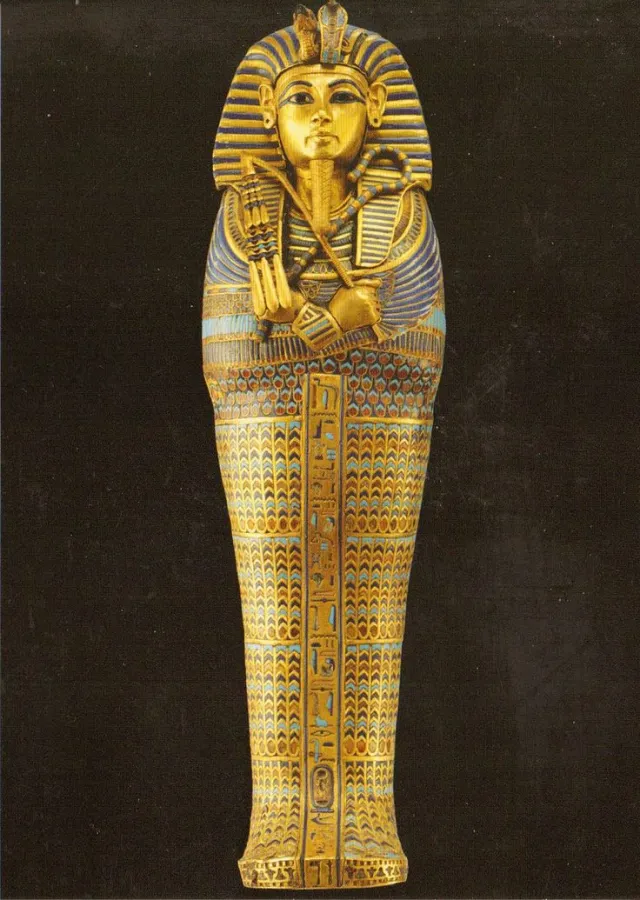
Name: Tutankhamun’s Tomb, Innermost Coffin
Civilization/Era: New Kingdom, 18th Dynasty
Date: c. 1323 BCE
Material: Gold with inlay of enamel and semiprecious stones
Fun Facts:
Tutankhamun means “Living Image of Amun,” reflecting the restoration of the traditional god Amun after Akhenaten’s religious changes.
His tomb became especially famous because it was discovered in 1922 with much of its burial treasure still intact, giving archaeologists an unusually complete picture of a royal Egyptian burial.
His innermost coffin is made of solid gold and shows him holding the crook and flail, symbols of royal authority, while the idealized face presents him as an eternal, divine ruler.

24.
Name: Last Judgement of Hu-Nefer, from his tomb
Civilization/Era: New Kingdom, 19th dynasty
Date: c. 1275 BCE
Material: Painted Papyrus scroll
Fun Facts:
The scene reads like a story, left to right. First, he's brought by Anubis, who then weighs his heart against the feather of Maat. If it's lighter, then the feather, he gets to continue, but if it's heavier, it gets eaten by Ammit. Thoth records the result, then Horus leads Hunefer to Osiris.
In front of Osiris are the four sons of Horus standing on a lotus flower, which represents eternal life, and the four sons represent the four canopic jars.
Anubis is holding an ankh, which is a symbol for eternal life.

26.
Name: Athenian Agora
Civilization: Archaic through Hellenistic Greek
Date: 600 BCE-150 CE
Material: Plan
Fun facts:
The Agora was the civic center of Athens—a place for politics, business, religion, and everyday public life.
The Panathenaic Way ran through the Agora and was used for the major Panathenaic procession to the Acropolis.
The stoa was a covered colonnaded walkway used for gathering and commerce, while the tholos was a round civic building connected to the Athenian government.
27.
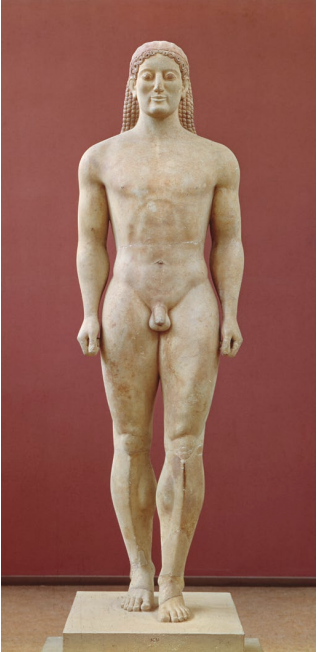
Name: Anavysos Kouros
Civilization: Archaic Greek
Date: c. 530 BCE
Material: Marble with remnants of paint
Fun facts:
It was a grave marker for Kroisos, a young man who died in battle.
His idealized, muscular body represents youth, strength, and good health, not a realistic portrait.
The figure shows the Archaic style: rigid frontal pose, one foot forward, and the Archaic smile.

28.
Name: Peplos Kore from the Acropolis
Civilization: Archaic Greek
Date: c. 530 BCE
Material: Marble, painted details
Fun facts:
It was likely a votive offering to Athena on the Acropolis.
Unlike male kouroi, korai are fully clothed, and the sculpture emphasizes patterned drapery and decorative detail.
It was originally brightly painted, showing that ancient Greek sculpture was much more colorful than the plain white marble we see today.
34.
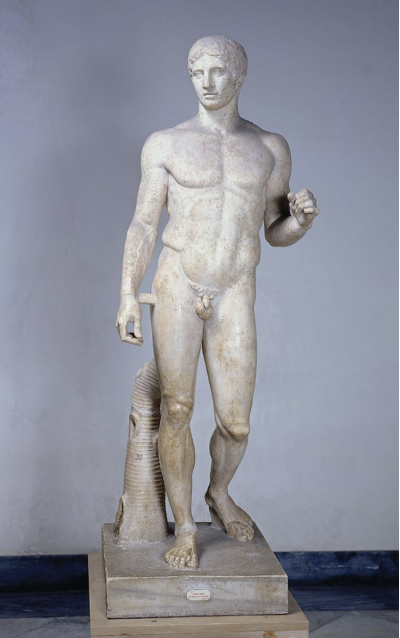
Name: Doryphoros (Spear Bearer)
Artist: Polykleitos
Date: Original 450-440 BCE
Material: Roman copy (marble) of Greek original (bronze)
Fun facts:
Polykleitos used his Canon of ideal proportions: the head is about one-seventh of the body, creating a mathematically balanced ideal human figure.
It demonstrates contrapposto, or “motion at rest”: weight rests on one leg while the opposite arm is active, creating a cross-balance between relaxed and engaged parts of the body.
It represents the Greek ideal of kalokagathia—the idea that a beautiful, athletic body reflected a good and virtuous person. The surviving work is a Roman marble copy of a Greek bronze original, and a copy was found in a palaestra, or athletic training complex, at Pompeii.

35.
Name: Acropolis
Artists: Iktinos and Kallikrates
Location: Athens, Greece
Date: c. 447-410 BCE
Material: Marble
Fun facts:
The Acropolis was the religious center of Athens and was rebuilt after the Persian destruction of the city, making it a major symbol of Athenian power and identity.
The Parthenon was dedicated to Athena, the patron goddess of Athens, and housed a massive cult statue of her.
The complex combines architecture, sculpture, religion, and civic pride, so it works as both a sacred site and a statement of Athenian greatness.

35. (Cont’d)
Name: Helios, horses, and Dionysus
Fun facts:
These figures come from the east pediment of the Parthenon, which represented the birth of Athena.
Helios’ horses rise at one end, suggesting sunrise, while other reclining figures fit into the narrowing corners of the triangular pediment.
The sculptor adapted the bodies to the shape of the pediment, showing how Greek artists made figures work naturally within architectural space.

35. (Cont’d)
Name: Plaque of the Ergastines
Fun facts:
It comes from the Panathenaic Procession frieze of the Parthenon.
The ergastines were young Athenian women who helped weave the sacred peplos for Athena.
The scene is important because it shows real Athenians participating in a religious festival, not just gods and mythological figures.

36.
Name: Grave Stele of Hegeso
Artist: Kallimachos
Date: c. 410 BCE
Material: Marble and paint
Fun facts:
It was a grave marker for a wealthy Athenian woman named Hegeso.
Hegeso is shown larger and seated while her servant stands, using hierarchy of scale and positioning to emphasize Hegeso’s higher social status.
She appears to select jewelry from a box held by her servant, emphasizing wealth, domestic life, and the expected role of elite Athenian women rather than showing dramatic grief.
37.
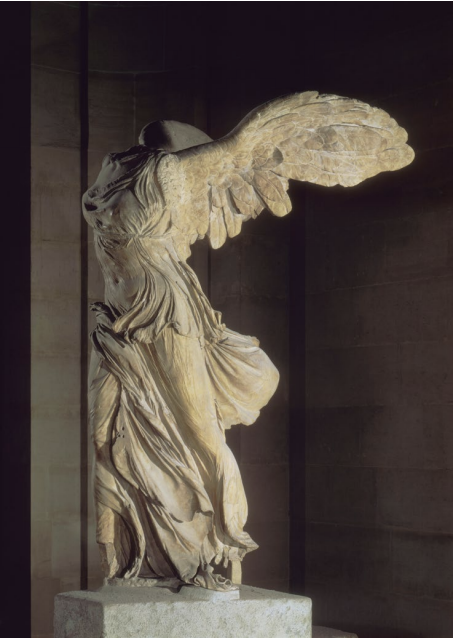
Name: Winged Victory (Nike) of Samothrace
Civilization: Hellenistic Greek
Date: c. 190 BCE
Material: Marble
Fun facts:
The sculpture was discovered on the island of Samothrace and originally stood in a sanctuary overlooking the sea, probably commemorating a naval victory.
Nike stands on the prow of a ship, making the sculpture appear as though she has just landed dramatically on the vessel.
The wind-blown, deeply carved drapery seems to cling to her body while whipping around her, creating the drama, movement, and theatricality associated with Hellenistic art.

41.
Name: Seated Boxer
Civilization: Hellenistic Greek
Date: c. 100 BCE
Material: Bronze
Fun facts:
The boxer looks exhausted rather than heroic: he sits hunched over and turns his head as though reacting to someone nearby, capturing a vulnerable moment after a fight.
The artist used copper inlays to show details such as blood and injuries and other materials for the eyes, increasing the sculpture’s realism.
His broken nose, scars, swollen/cauliflower ears, and wrapped hands show the physical consequences of boxing, making him dramatically different from the perfect athletes of the Classical period.

33.
Name: Niobides Krater
Artist: Niobid Painter
Date: c. 460-450 BCE
Material: Clay, red figure technique
Fun facts:
It uses the red-figure technique, where the figures remain the natural red color of the clay while the background is painted black.
Instead of arranging everyone along a single ground line, the artist places figures at different heights throughout the scene, creating a greater sense of depth and space.
One side shows Apollo and Artemis killing the children of Niobe after she arrogantly claimed superiority over their mother, Leto—making the scene a warning about hubris, or excessive pride.

38.
Name: Great Altar of Zeus and Athena at Pergamon
Location: Asia Minor (Present-day Turkey)
Civilization: Hellenistic Greek
Date: c. 175 BCE
Material: Marble (architecture and sculpture)
Fun facts:
The enormous frieze is carved in very deep, high relief, creating dramatic shadows and making the figures seem almost fully three-dimensional.
Some figures appear to spill out of the frieze and onto the staircase, breaking the boundary between sculpture and the viewer’s space.
The frieze shows the Gigantomachy, the battle between the Olympian gods and the Giants, and its intense movement, emotion, and twisting bodies are classic features of Hellenistic art.

40.
Name: Alexander Mosaic
Location: Pompeii
Civilization: Republican Roman
Date: c. 100 BCE
Material: Mosaic
Fun facts:
The mosaic shows Alexander the Great defeating the Persian army of Darius III, probably representing the Battle of Issus.
The artist uses overlapping bodies and diagonally angled spears to create depth and a convincing 3D effect.
The scene is extremely dramatic: Alexander charges forward while Darius looks back in alarm, emphasizing Alexander’s courage and victory.

31.
Name: Temple of Minerva and sculpture of Apollo
Artist: master sculptor Vulca
Location: Veii, near Rome, Italy
Civilization: Etruscan
Date: c. 510-500 BCE
Material: Original temple of wood, mud brick, or tufa (volcanic rock); terra cotta sculpture
Fun facts:
The temple followed the Etruscan temple plan: it stood on a high podium, had a deep front porch, and was meant to be approached mainly from the front.
The Apollo sculpture stood on the roof of the temple and was made of terracotta, which was much easier for Etruscans to use than large blocks of marble.
Apollo is shown in a very energetic, striding pose, with an Archaic-style smile and patterned hair, but he has more movement than a typical Greek kouros.

29.
Name: Sarcophagus of the spouses
Civilization: Etruscan
Date: c. 520 BCE
Material: Terra cotta
Fun facts:
It was found at Cerveteri, an Etruscan necropolis, or “city of the dead.” The tombs there were built from tufa and often look like grassy hills from the outside.
The couple reclines on a triclinium, a dining couch used at banquets, showing that feasting and social life were important ideas even in the afterlife.
The husband and wife are shown together and at nearly equal scale, which suggests that Etruscan women had a more visible social role than women in many Greek societies.

32.
Name: Tomb of the Triclinium
Location: Tarquinia, Italy
Civilization: Etruscan
Date: c. 480-470 BCE
Material: Tufa and Fresco
The tomb is decorated with scenes of banqueting, dancing, and music, presenting the afterlife as joyful rather than frightening.
The figures are shown with lots of movement and color, giving the tomb a lively, celebratory feeling.
It gets its name from the triclinium, or dining couch, because banquet scenes were such an important part of Etruscan funerary culture.