3. Microfiltration and Ultrafiltration
 Call Kai
 Learn
 Practice Test
 Spaced Repetition
 Match
 Flashcards
 Knowt Play
1/16

There's no tags or description
Looks like no tags are added yet.
17 Terms
Define microfiltration
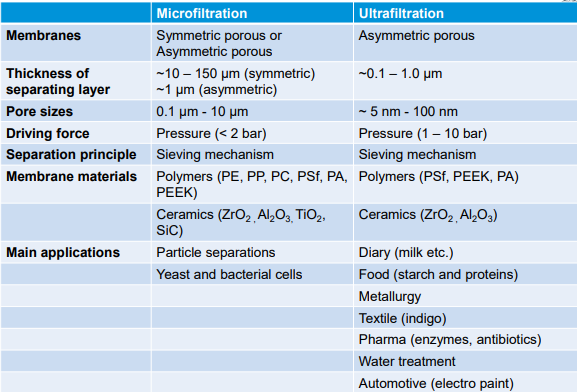
Microfiltration is a pressure-driven process for removing micron-sized particles, such as bacteria, yeast cells, colloids, and smoke particles.
microfiltration membranes have pore sizes ranging from 0.1 to 10 µm
Microfiltration often operate with Pressure (< 2 bar)
What are the factors that affect the structure of the membrane?
Pore size (Pore size on a membrane refers to the diameter of the openings/pores within the membrane material)
Pore size distribution (refers to the variation in sizes of the pores within a membrane)
Porosity (refers to the void volume fraction of the membrane)
ɛ = (Volume of Voids / Total Volume)
What are microfiltration membranes prepared with?
Microfiltration membranes can be prepared from two main classes of materials:
Organic materials (polymers)
Inorganic materials (ceramics, metals, glasses)
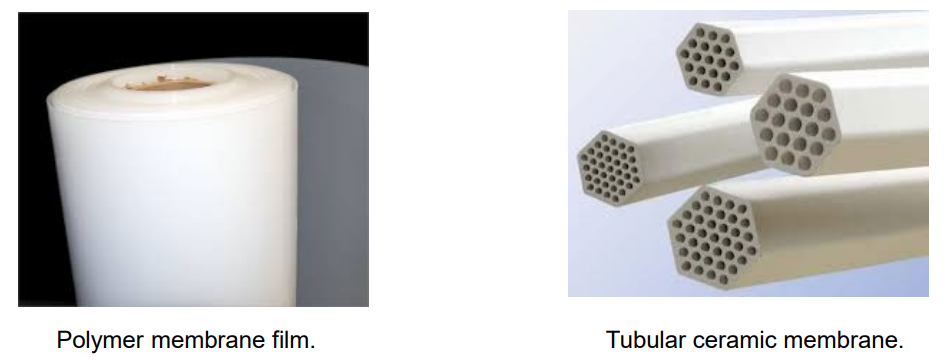
What are the advantages and disadvantages of polymer membrane film & tubular ceramic membranes?
for an ideal membrane, we need to make the porosity as high as possible and the pore size distribution as narrow as possible
inorganic membrane usually has narrow pore size distribution

Microfiltration membrane manufacturing methods

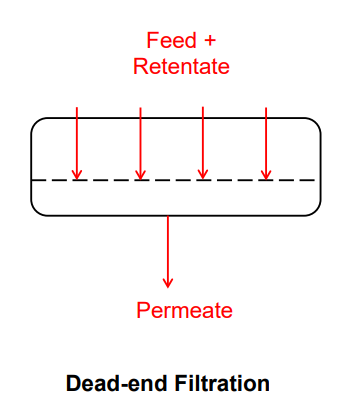
What is dead-end filtration?
The main problem affecting microfiltration is the decline in flux over time
Dead-end filtration form thicker and more compacted cake with filtration time, which decrease membrane flux
What is cross-flow filtration?
cross-flow can reduce the membrane surface fouling
the cross-flow velocity should be high enough to maintain a cleaner surface
in practice, most membranes still require periodic cleaning

What are the applications of microfiltration?
Juice/beer industry (sterilisation or clarification of drinks)
Dairy industry (increase shelf life of dairy products)
Water industry (used to remove suspended material and micro-organisms, improving water quality)
Define ultrafiltration
Ultrafiltration lies between nano- and micro-filtration, usually used to retain macromolecules from a solution.
The lower limit is ∽2000 Da molecular weight cut-off (the smallest molecular weight this filtration can deal with, 1Da=1g/mol)
Ultrafiltration membranes have pore sizes ranging from 5 nm to 0.1 µm.
Ultrafiltration often operates with pressure (1-10 bar)
Describe the structure of ultrafiltration membranes

What are the applications of ultrafiltration?
Food industry (concentration of milk, clarification of beer, concentration of egg products, recovery of potato starch, etc.)
Dairy industry
Waste water treatment (oil/water emulsion separation and colour removal)
Pharmaceuticals (macromolecules)
Textiles (colour removal/dye recovery)Metallurgy (mineral precipitates)
How do we determine the flux based on pore structure?

How do we determine the flux for straight capillaries and pressure-driven membranes?
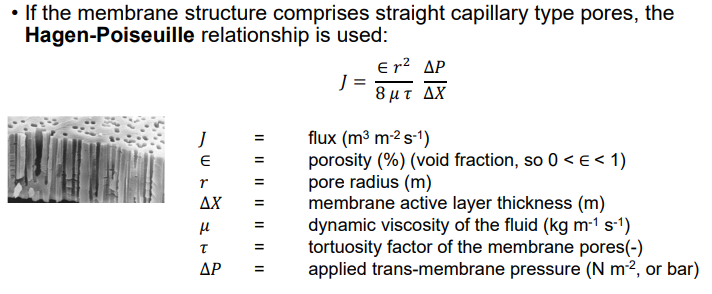
What is the tortuosity factor?
A measure of how “bendy” or tortuous a path is:
𝜏 close to 1 (more bendy/tortuous)
𝜏 > 1 (more straight)
What are nodular structures?

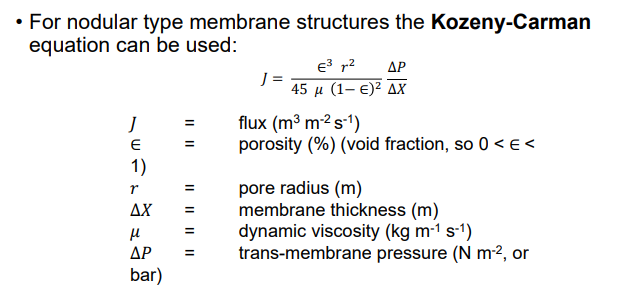
How do we determine the flux for nodular structures?
Summary of microfiltration and ultrafiltration membranes