Procedures - Unit 3, Wk 11 Fluro pt. 1
 Call Kai
 Learn
 Practice Test
 Spaced Repetition
 Match
 Flashcards
 Knowt Play
1/95

Earn XP
96 Terms
What are the three cardinal rules of radiation protection? Which is the most effective in reducing occupational dose?
Time, Distance, Sheilding
Briefly describe each radiation safety method:
Bucky Slot Cover
Lead Gloves
Lead Apron
Fluoro Timer
Bucky slot cover: Reduces scatter from the fluoro table
Lead Gloves: Protect hands from radiation (Compton scatter)
Lead Apron: Protects body and organs from radiation (Compton scatter)
Fluoro Timer: 5 minute timer. Only counts when fluoro is active.
Where is the best place for the technologist to stand during fluroroscopy?
Side of the table behind the RPA or doctor.
Never stand at the foot or head of the table
What tools may be used to help visualize GERD?
Esophagram is the exam that visualizes this.
Tools are breathing exercises, water tests, compression paddle, and toe-touch
What is the Valsalva maneuver?
Deep breath in, hold it, and bear down as though trying to move bowels
What type of breathing instructions should be given to the patient during an esophagogram using a thin barium mixture?
Valsalva Maneuver and Mueller Maneuver
When must the technologist inform the radiologist during the small bowel timed imaging?
When the contrast passes through the ileocecal valve.
To make the patient as comfortable as possible during a single-contrast barium enema, the radiographer should:
Communicate with the patient throughout the exam as much as possible.
Warm the contrast to 85-90 degrees.
The barium enema bag should be placed:
No higher than 24” above the table
If the patient has a SBS, UGI, and BE scheduled in one day, what order should they be competed in?
BE
UGI
SBS
Ingestion of barium sulfate is contraindicated in which of the following situation(s)?
Esophageal or bowel perforation
Bowel obstruction
recent or soon GI tract surgery
allergy to barium
What is a potential risk associated with the use of water-soluble contrast agents, especially for geriatric patients?
Dehydration
List side effects that may occur with injected iodinated contrast:
Sensation of warmth, metallic taste, nausea, headache, dizziness
Largest solid organ in the body, is located in the _____________ quadrant.
Right upper
Where is the gallbladder located in relation to the liver?
Posterior and inferior
There are ___ major lobes and ___ minor lobes.
2
2
What separates the right and left lobe?
Falciform ligament
Bile is manufactured in the __________ and stored in the ___________.
Liver
Gallbladder
What are the major functions of bile?
Aid in the digestion of fats by emulsifying fat globules and in the absorption of fat following its digestion.
The ________ is the main organ involved in metabolism.
Liver
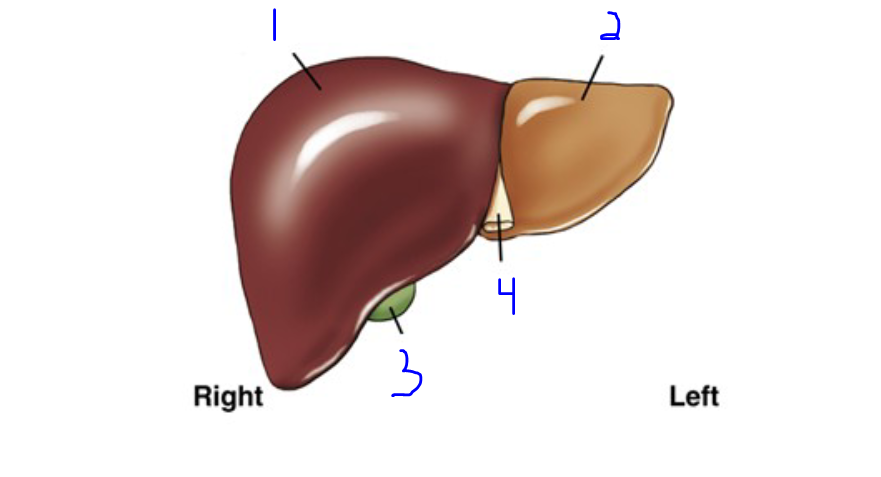
Label 1-4
Right lobe
Left lobe
Gallbladder
Falciform ligament
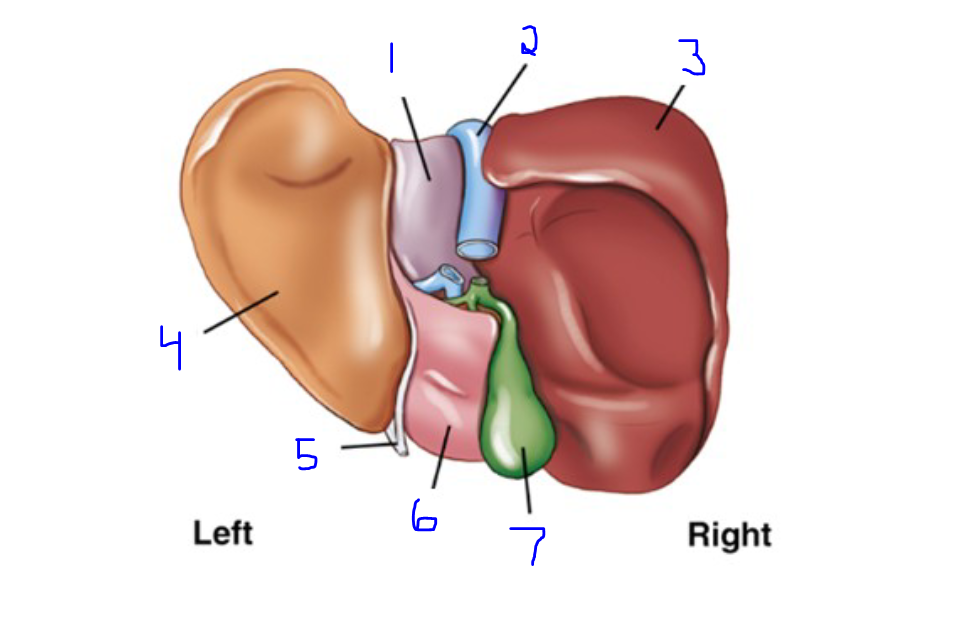
Label 1-7
Caudate lobe
Inferior Vena Cava
Right lobe
Left lobe
Falciform ligament
Quadrate lobe
Gallbladder
Bile is carried to the gallbladder via the _____________ or into the duodenum via the ________________.
Cystic duct
Common bile duct
What are the 3 parts of the gallbladder?
Fundus, Body, and Neck
List the 3 primary functions of the gallbladder:
Store bile
Concentrate bile
Contract when stimulated
The hormone secreted when fatty acids are in the duodenum:
Cholecystokinin
The terminal end of the common bile duct is closely associated with the terminal end of the _____________ duct or duct of _______________.
Pancreatic
Wirsung
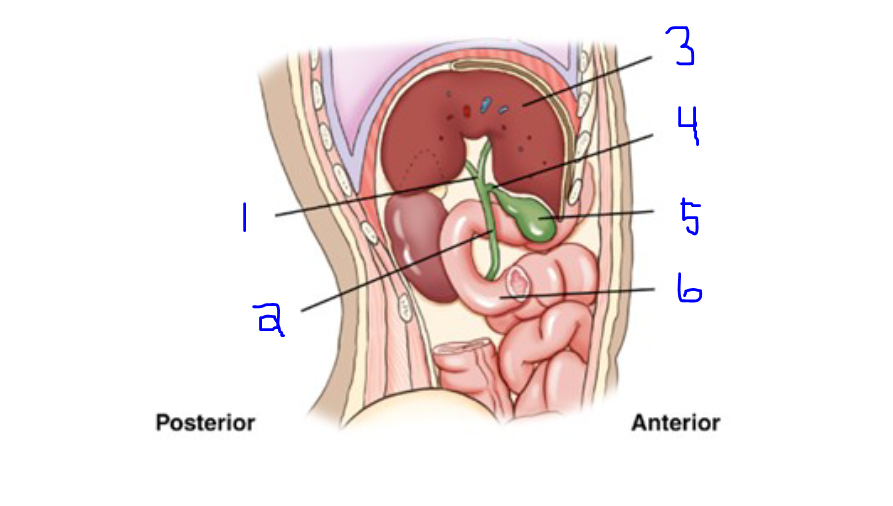
Label 1-6
Common Hepatic Duct
Common Bile Duct
Liver
Cystic Duct
Gallbladder
Duodenum
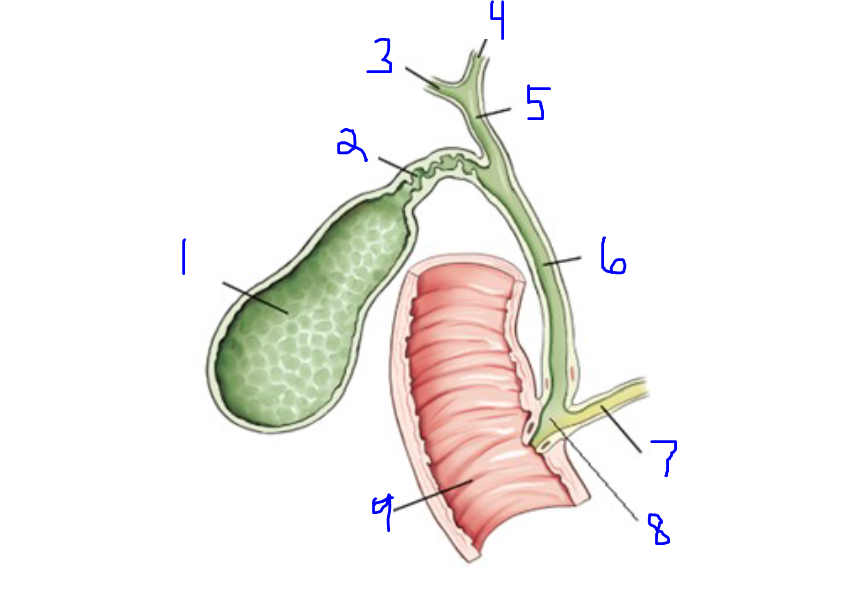
Label 1-9
Gallbladder
Cystic Duct
Right Hepatic Duct
Left Hepatic Duct
Common Hepatic Duct
Common Bile Duct
Pancreatic Duct (Duct of Wirsung)
Hepatopancreatic Ampulla (Ampulla of Vater)
Descending Duodenum
List the 3 primary function of the digestive system:
Intake and Digestion
Absorption
Elimination
Mastication definition:
Act of chewing
Deglutition definition:
Act of swallowing
Peristalsis definition:
Wave-like involuntary muscle contractions that propel solid materials
List and describe the 3 salivary glands:
Parotid
Submandibular
Sublingual
This covers the opening of the larynx during swallowing:
Epiglottis
List the 3 parts of the pharynx (superiorly to inferiorly):
Nasopharynx
Oropharynx
Laryngopharynx
The esophagus is about ___ inches in length and ___ in diameter.
10 inches
½ inch
Where is the esophagus located in relation to the trachea? To the C-Spine?
Posterior to the trachea
Anterior to the C-Spine
The opening between the esophagus and the stomach is the:
Also referred to as the:
Esophagogastric junction
Cardiac orifice
Vertebral level of Upper margin of larynx:
C3
Vertebral level of Cricoid cartilage of larynx:
C5-C6
Vertebral level of Larynx-Trachea junction:
C6
Vertebral level of Carina:
T4-T5
Vertebral level of Esophagogastric junction:
T11
Vertebral level of Iliac Crest:
L4-L5
Vertebral level of Thryoid cartilage:
C4-C5
Vertebral level T6 can be found by palpating ___ inches _________ inferior to the jugular notch.
2”
Inferior
The stomach has 3 main subdivisions:
Fundus, Body, Pylorus
The gastric air bubble is typcially found in this subdivision:
Fundus
Define Rugae
Stomach is empty and internal lining is thrown into muscosal folds.
Where is rugae most evident?
Lower body of the stomach alond the greater curvature.
The head of the pancreas is located where?
C-loop of the duodenum
The only portion of the duodenum considered intraperitoneal is:
Duodenal bulb (first portion)
The longest portion of the duodenum where the opening for the common bile and pancreatic ducts is located:
Second portion (duodenal papilla)
The duodenum and jejunum join at the:
Duodenojejunal flexure
The small intestine has three main sections (list in order):
Duodenum
Jejunum
Ileum
Haustral churining primarily takes place in the:
Large intestine
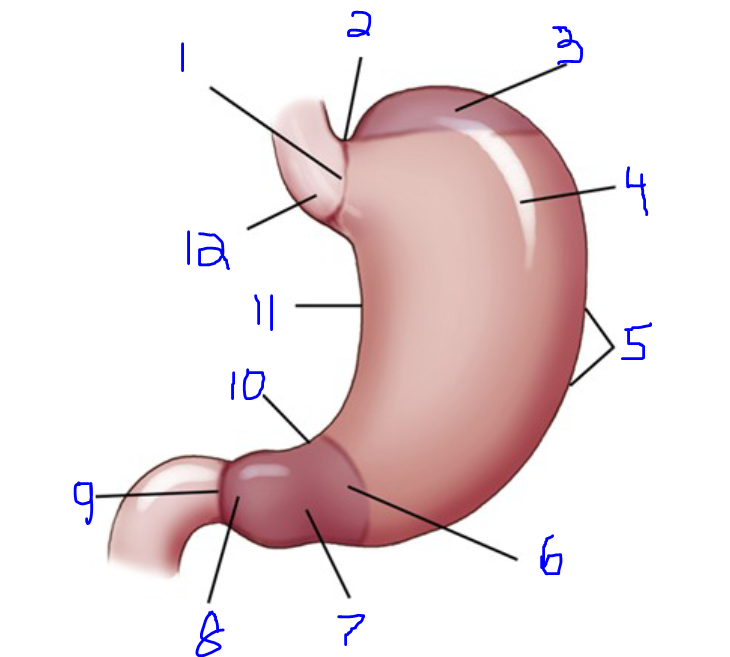
Label
Esophagogastric junction
Cardiac notch
Fundus
Body
Greater curvature
Pyloric portion
Pyloric antrum
Pyloric canal
Pyloric orifice
Angular notch
Lesser curvature
Cardiac antrum
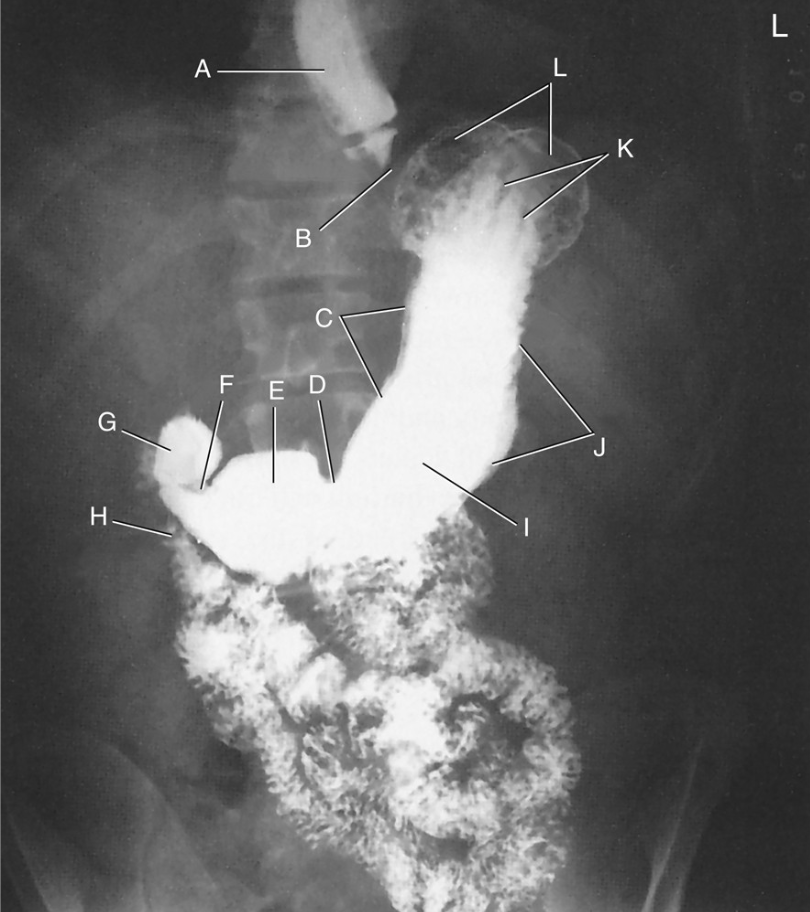
What position is the patient in?
Prone
Describe the orientation of the stomach on an average patient:
J shaped and extends from T11 down to L2
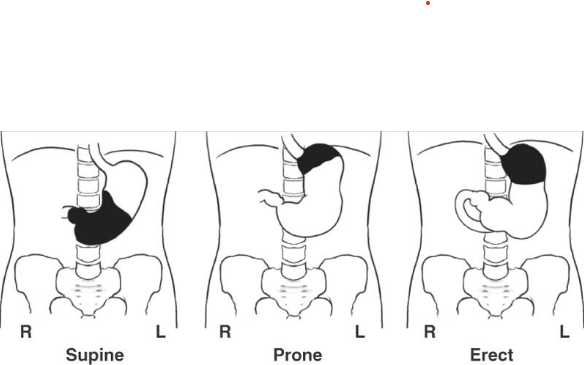
Where would the barium be located (use fundus, body, and pylorus)?
Supine
RAO
Prone
Erect
Supine - Fundus
RAO - Body and Pylorus
Prone - Body and Pylorus
Erect - Body and Pylorus
Describe the location of each organ based on a Hypersthenic Body Type.
Transverse colon
Large Intestine
Gallbladder
Stomach
Duodenal Bulb
Transverse colon: High
Large Intestine: Extends to the periphery of the abdominal cavity
Gallbladder: High and almost transverse
Stomach: High and assumes a transverse position
Duodenal Bulb: T11 or T12, right of midline
Describe the location of each organ based on a Hyposthenic/Asthenic Body Type.
Large Intestine
Stomach
Gallbladder
Duodenal Bulb
Large Intestine: Down into the lower abdominal and pelvic cavities
Stomach: J shaped and more vertical and low in the abdominal cavity
Gallbladder: Near midline a lvl of iliac crests
Duodenal Bulb: Near midline at lvl L3-L4
Describe the location of each organ based on a Sthenic Body Type.
Stomach
Gallbladder
Large intestine
Duodenal Bulb
Stomach: J-shaped and lower than the hypersthenic
Gallbladder: Less transverse and lies midway b/w lateral abdominal wall and the midline
Large Intestine: High, under the left diaphragm
Duodenal Bulb: lvl of L1-L2, right of midline
List additional factors that may affect the position of the stomach:
Stomach contents, respiration, body position, previous abdominal surgeries, and age.
All abdominal organs tend to drop ____ inches in an ______ erect position.
1-2”
Erect
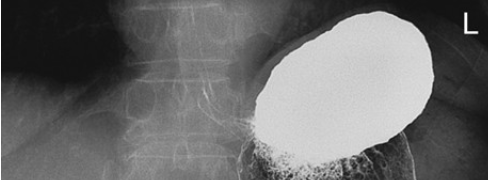
Radiolucent:
Negative (black/dark on image)
Air, CO2 gas crystals
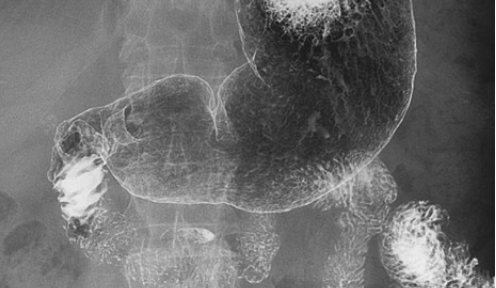
Radiopaque:
Positive (white/light on image)
Barium sulfate, Water-soluble Iodinated
Higher atomic number
Thin Barium Ratio:
1 part Barium to 1 part Water
Thick Barium Ratio:
3-4 parts Barium to 1 part Water
What should the temperature of Barium be when administered to a patient?
Oral - cold water is best
Rectal - Warm water (85-90)
List common Reasons for Esophagram (6):
Esophageal varices
Cancer
Dysphagia
Foreign bodies
GERD
Barrette Esophagus
Common Reasons for UGI (5):
Diverticula
Cancer
Gastritis
Hiatal Hernia
Ulcers
Common Reasons for SBS (5):
Enteritis
Crohn Disease
Celiac
Neoplasms
Ileus Obstruction
Common Reasons for BE (5):
Colitis
Diverticula
Intussusception
Polyps
Volvulus
Where should the CR be at for Scout/Post Image UGI on an average pt?
L1
Where should the CR be at for Scout/Post Image UGI on a hypersthenic pt?
2” above L1 (more rotation for oblique)
Where should the CR be at for Scout/Post Image UGI on an asthenic pt?
2” below L1 (less rotation for oblique)
Where should the CR be at for Post Images SBS?
First 30 min - L1 (2” above iliac crests)
Following - at iliac crest (L4/5)
3 types of barium include:
tablets
powder; needs to be mixed with water
pre-made suspension
What is used when barium is contraindicated?
Water-Soluble Iodinated Contrast (Iodine)
True or False:
Iodine has no contraindications
False.
Iodine also has contraindications (allergies)
True or False:
Barium is least likely to cause an allergic reaction compared to all other imaging contrast agents
True.
Single-Contrast exams use which kind of contrast?
Positive contrast only
Double-Contrast exams use which kind of contrast?
positive and negative contrast
True or False:
Barium cannot be dissolved in water, it is considered an insoluble suspension.
True, barium cannot be dissolved
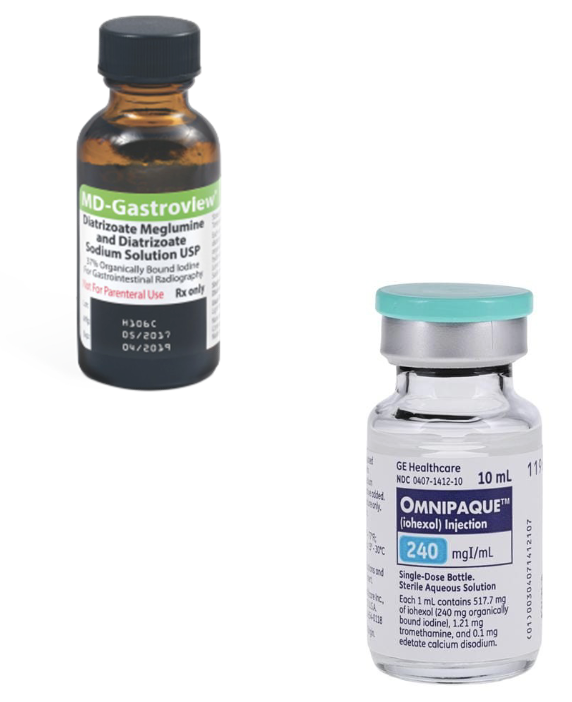
Is Gastroview / Gastrografin Ionic or non-ionic?
Ionic
An example of a non-ionic, water-soluble iodinated contrast agent is:
Omnipaque
A Small Bowel Follow-Through exam consists of ___ and ___
UGI
SBS
True or False:
Post-exam instructions after the administration of barium sulfate include to limit water intake.
False.
Increase water intake
A small bowel series requires all of the following: (Select all that apply)
The patient rotates from supine to prone
Time stamps on all images
That the technologist monitors the progress of the contrast through the intestines
Images every 90 minutes
2 and 3 only
True or False:
Non-Ionic (Omnipaque) is less likely to give patients an allergic reaction
True.
What projection is best for visualizing the loops of the bowel in the abdomen?
PA
What are all of the exam prep guidelines for a small bowel series?
NPO since midnight or 8 hours
No gum or smoking for the past 8 hours
Low-residue diet for 48 hours (limits fiber)
Which of the following devices reduces scatter radiation exposure during fluoroscopy?
Bucky slot shield/cover
What is the SID for an erect RAO esophagogram?
72”