Growth L6
0.0(0)
Studied by 0 people Call Kai
 Learn
Learn Practice Test
 Spaced Repetition
 Match
Match Flashcards
 Knowt Play
Card Sorting
1/91

There's no tags or description
Looks like no tags are added yet.
Last updated 10:16 PM on 10/5/26
Name | Mastery | Learn | Test | Matching | Spaced | Call with Kai | Chat |
|---|
No analytics yet
Send a link to your students to track their progress
92 Terms
1
New cards
What does microbial growth refer to
An increase in the number of cells, not the size of individual cells
2
New cards
What are the two types of requirements bacteria need for growth
Chemical requirements and physical requirements
3
New cards
What are the four main chemical requirements for bacterial growth
Carbon, N/P/S and other nutrients, oxygen, and organic growth factors
4
New cards
What are the three main physical requirements for bacterial growth
Temperature, pH, and osmotic pressure
5
New cards
Why is carbon required by bacteria
Carbon is required to build all organic compounds
6
New cards
Where do chemoheterotrophs obtain their carbon
From the same organic molecules they use as an energy source
7
New cards
Where do photoautotrophs and chemoautotrophs obtain their carbon
From inorganic carbon in the environment
8
New cards
What are macronutrients
Nutrients required in relatively large amounts for bacterial growth
9
New cards
What are the main macronutrients bacteria require
O, H, N, S, P, C, K, Ca, Mg, and Fe
10
New cards
What is the difference between macronutrients and micronutrients
Macronutrients are needed in large amounts; micronutrients are needed in trace amounts
11
New cards
What roles can K, Ca, Mg, and Fe play in bacteria
They are cations that can act as enzyme cofactors and help stabilize membranes
12
New cards
What are the six micronutrients listed in the lecture
Mn, Zn, Co, Mo, Ni, and Cu
13
New cards
Why are micronutrients called trace elements
They are required by bacteria in very small amounts
14
New cards
How are micronutrients often supplied to bacteria
They are often supplied through water or components of the growth medium
15
New cards
What are micronutrients commonly used for
They serve as parts of enzymes and cofactors
16
New cards
Do all microbes require exactly the same nutrients
No. Some microbes require unique substances, such as silicic acid in diatoms
17
New cards
What are the five categories of bacterial oxygen tolerance
Obligate aerobes, obligate anaerobes, facultative anaerobes, microaerophiles, and aerotolerant anaerobes
18
New cards
Why can oxygen be dangerous to some bacteria
Oxygen produces highly reactive metabolic by-products that can damage cells
19
New cards
What allows bacteria to tolerate oxygen
They must have enzymes that break down harmful oxygen by-products
20
New cards
Which two enzymes are important for oxygen tolerance
Superoxide dismutase (SOD) and catalase
21
New cards
What are examples of organic growth factors
Amino acids, vitamins, purines, and pyrimidines
22
New cards
Why do bacteria need growth factors
They need them when they cannot synthesize these essential organic compounds themselves
23
New cards
Do all bacteria require the same growth factors
No. The required growth factors vary between different types of bacteria
24
New cards
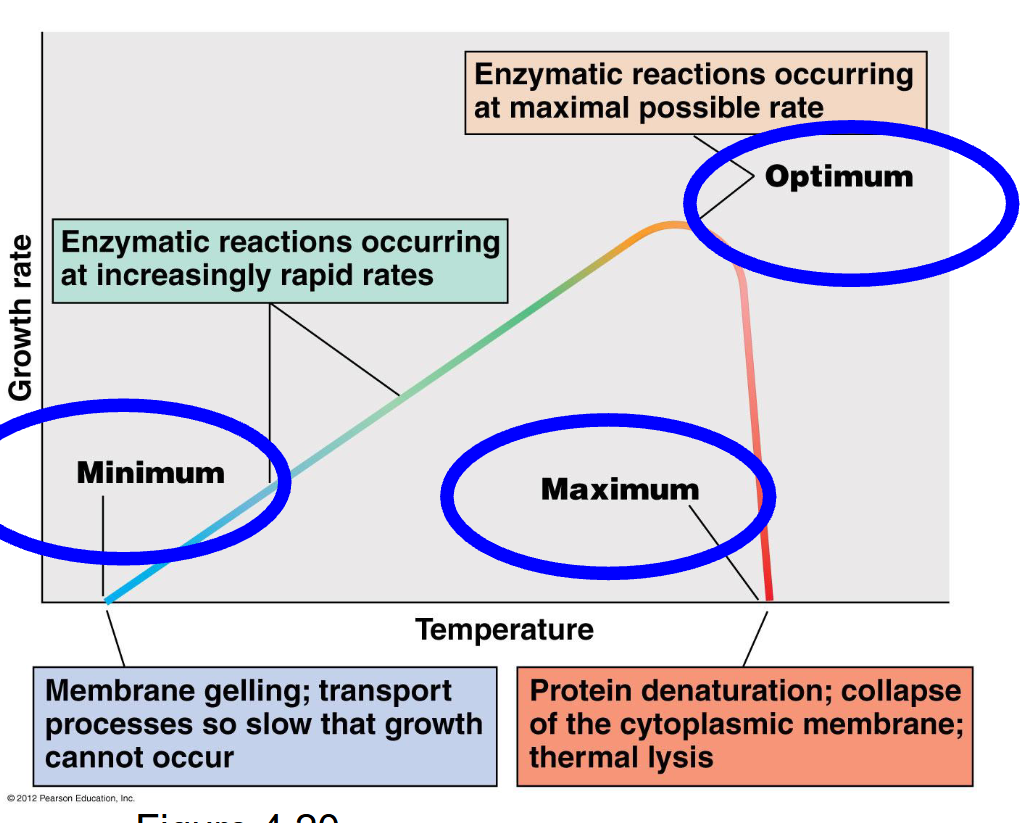
What are cardinal growth temperatures
The minimum, optimum, and maximum temperatures at which an organism can grow
25
New cards
Can bacteria grow outside their optimum temperature
Yes, but their growth rate is reduced
26
New cards
Why is temperature important for bacterial growth
Temperature affects membrane viscosity and enzyme activity, which affect cell functions
27
New cards
What are psychrophiles
Microorganisms that have an optimum growth temperature of about 4°C
28
New cards
What temperature range can mesophiles grow between
About 10°C to 50°C
29
New cards
What are mesophiles commonly associated with
Most common microbial spoilage and many pathogens
30
New cards
What temperature range can thermophiles grow between
About 40°C to 75°C
31
New cards
What is a key molecular adaptation of psychrophiles to cold temperatures
Their enzymes have greater flexibility, allowing them to function at low temperatures
32
New cards
How are psychrophile membranes adapted to cold temperatures
They contain more polyunsaturated and shorter-chain fatty acids to maintain membrane flexibility
33
New cards
What are cold shock proteins
Proteins that help protect cellular proteins during exposure to cold temperatures
34
New cards
What are cryoprotectants
Substances such as glycerol or sugars that prevent damaging ice crystal formation
35
New cards
Does freezing necessarily kill microbial cells
No. Freezing can stop microbial growth without killing the cells
36
New cards
How are enzymes and proteins of thermophiles adapted to high temperatures
They are more heat-stable and contain structural features that increase stability
37
New cards
What type of bonds can help thermophile proteins remain stable at high temperatures
More ionic bonds between basic and acidic amino acids
38
New cards
How are thermophile membranes adapted to high temperatures
They have increased saturated fatty acids, which help maintain membrane stability
39
New cards
What are heat shock proteins
Proteins that help protect and stabilize cellular proteins during high temperatures
40
New cards
How are archaeal membranes adapted to extreme heat
They use repeating isoprene units and can form a lipid monolayer, increasing stability
41
New cards
What are the three main pH categories of microorganisms
Acidophiles, neutrophiles, and alkaliphiles
42
New cards
What pH do acidophiles grow best at
Below pH 5.5
43
New cards
What pH do neutrophiles grow best at
Between pH 5.5 and 8.0
44
New cards
What pH do alkaliphiles grow best at
Above pH 8.0
45
New cards
Why do microorganisms have a specific optimum pH
Their cellular components, such as enzymes and membranes, function best at that pH
46
New cards
Is the internal pH of most bacterial cells the same as their preferred environmental pH
No. Their internal pH is usually near neutral
47
New cards
Why is maintaining the correct water balance important for bacteria
Bacteria need water to obtain dissolved nutrients and maintain normal cell functions
48
New cards
What happens to a bacterial cell in a hypotonic environment
Water enters the cell, but the cell wall usually prevents it from bursting
49
New cards
What happens to a bacterial cell in a hypertonic environment
Water leaves the cell, causing the plasma membrane to shrink away from the cell wall. The loss of water means the cell also loses nutrients

50
New cards
What is plasmolysis
The shrinking of the plasma membrane away from the cell wall due to water loss
51
New cards
What is a nonhalophile
A microorganism that cannot tolerate high concentrations of salt
52
New cards
What is a halotolerant microorganism
A microorganism that can tolerate higher salt concentrations but does not require salt for growth
53
New cards
What is a halophile
A microorganism that requires salt for growth
54
New cards
What is an extreme halophile
A microorganism that requires very high concentrations of salt for growth
55
New cards
Why can high salt concentrations affect bacterial growth
They cause water to leave the cell, disrupting water balance and nutrient availability
56
New cards
Where do many microorganisms grow in nature instead of freely suspended in liquid
They often grow attached to surfaces in biofilms
57
New cards
What is a biofilm
A community of microorganisms attached to a surface and enclosed in a complex protective matrix
58
New cards
Why are broth cultures not always representative of how microbes grow in nature
Many microbes naturally grow attached to surfaces in biofilms rather than freely suspended in liquid
59
New cards
What is a growth medium
A nutrient-containing material used to provide bacteria with the conditions needed for growth
60
New cards
What is an inoculum
The bacteria introduced into a growth medium to start a culture
61
New cards
What are the two physical forms of bacterial growth media
Solid and liquid
62
New cards
What is agar
A complex polysaccharide used as a solidifying agent in growth media
63
New cards
Why is agar useful for growing bacteria
It can solidify the growth medium without being metabolized by many microorganisms
64
New cards
At what temperature is agar liquid
About 100°C
65
New cards
At what temperature does agar become solid
About 40°C
66
New cards
What is a chemically defined medium
A growth medium in which the exact chemical components and amounts are known
67
New cards
Why are chemically defined media useful
They can be specifically tailored to provide the requirements of a particular microorganism
68
New cards
What is a disadvantage of chemically defined media
They can be complicated and time-consuming to prepare
69
New cards
What is a complex medium
A growth medium made from extracts or digests of materials such as yeast, meat, or plants
70
New cards
Why are the exact amounts of nutrients in complex media not known
The composition of the extracts or digests is not precisely known and can vary between batches
71
New cards
What are common examples of complex media
Nutrient agar and nutrient broth
72
New cards
What is the difference between selective and differential media
Selective media allow some microorganisms to grow while preventing others; differential media distinguish microorganisms based on characteristics such as growth, color, or appearance
73
New cards
What is selective media used for
To allow certain microorganisms to grow while preventing others from growing
74
New cards
What is differential media used for
To distinguish or identify microorganisms based on differences in growth, color, or appearance
75
New cards
What is Mannitol Salt Agar (MSA)
A medium that is both selective and differential
76
New cards
Why is Mannitol Salt Agar selective
Its high salt concentration allows Staphylococcus and other salt-tolerant microorganisms to grow while inhibiting many other bacteria
77
New cards
Why is Mannitol Salt Agar differential
It differentiates bacteria based on whether they can ferment mannitol
78
New cards
What is blood agar used for
It is a differential medium used to distinguish bacteria based on hemolysis
79
New cards
What are the three types of hemolysis seen on blood agar
Beta hemolysis, alpha hemolysis, and gamma hemolysis
80
New cards
What is beta hemolysis
Complete destruction of red blood cells around the bacterial growth
81
New cards
What is alpha hemolysis
Partial destruction of red blood cells around the bacterial growth
82
New cards
What is gamma hemolysis
No hemolysis of red blood cells
83
New cards
What are the basic requirements for culturing bacteria in the laboratory
Bacteria need a suitable temperature, pH, osmotic pressure, chemical nutrients, and oxygen conditions
84
New cards
How can the correct temperature for bacterial growth be provided in the laboratory
Using equipment such as an incubator or refrigerator
85
New cards
How can the correct pH and osmotic conditions be provided in a growth medium
By using buffers and adding the appropriate chemicals
86
New cards
How can the chemical requirements of bacteria be provided in a growth medium
By supplying the necessary nutrients and other required chemicals
87
New cards
Why are aerobic bacteria generally easier to culture than anaerobic bacteria
Oxygen is readily available for aerobic bacteria, while anaerobic bacteria require oxygen-free conditions
88
New cards
How can anaerobic bacteria be cultured in the laboratory
Using reducing media, anaerobic jars, or anaerobic chambers
89
New cards
Why are special methods needed to culture anaerobic bacteria
They cannot tolerate oxygen, so oxygen must be removed or prevented from reaching the culture
90
New cards
What is an anaerobic jar used for
It creates an environment without oxygen so anaerobic bacteria can grow
91
New cards
What is an anaerobic chamber or glove box used for
It allows anaerobic cultures to be handled and maintained in an oxygen-free environment
92
New cards
What are the basic steps for culturing bacteria in the laboratory
Provide the required nutrients and physical conditions, sterilize the growth medium, and introduce the bacteria using an inoculum