Art History Exam
 Call Kai
 Learn
Learn Practice Test
 Spaced Repetition
 Match
Match Flashcards
 Knowt Play
1/35

There's no tags or description
Looks like no tags are added yet.
Name | Mastery | Learn | Test | Matching | Spaced | Call with Kai | Chat |
|---|
No analytics yet
Send a link to your students to track their progress
36 Terms
Neolithic
roughly 10,000 to 2,000 BCE
Also known as the New Stone Age. A global phenomenon not specific to one areaThis era marks the shift of human civilisation from nomadic hunter-gatherer lifestyles to settled communities. This shift introduced pottery, weaving, and permanent architecture.
stone henge
Neolithic
Location: Salisbury Plain, Wiltshire, England
Date: c. 2550 - 1600 BCE
An example of post-and-lintel architecture, which is a system where two upright stones (posts) support a horizontal stone (lintel) placed across the top
To make the structure, they used mortise and tenon joints, which is a peg-in-hole woodworking technique adapted to stone. They used this to lock the lintels into the posts.
The lintels were slightly curved to form a perfect circle
The monument is aligned with the solar calendar:
On the summer solstice, the sun rises directly over the “heel stone”, as seen from the centre of the circle, which indicates a ritual, spiritual, or calendrical purpose
The construction lasted about 1500 years, starting as a simple ditch and bank enclosure ( henge) used for burials, and then transformed into the full structure
The burials were mostly young men, thus raising the question of whether there was some hierarchy, honouring, or other reason for who was buried here

Figurine of a Woman from Syros
Neolithic Era
Location: Cyclades, an island chain in Greece, found on the island of Syros
Date: c. 2500 - 2300 BCE
The figurine was from the Cycladic culture, a Neolithic culture in the Aegean Sea.
The figurine shows clear geometric abstraction, emphasising clean triangles, straight lines, and simplified planes
The body is flat, the arms are tightly folded across the abdomen (always left over right), the feet point downward (it could not stand on its own), and the face is blank except for a prominent wedge-shaped nose.
Emphasis on pubic triangles, and emphasized beasts/bellies; thus believed that they served as a sign of fertility or representation of a goddess meant to accompany the deceased in the afterlife
Most Cycladic figurines were found in graves, always women
They look pristine white marble, but chemical traces suggest they may have been painted with bright pigments; eyes, jewellery, tattoos, and hair were added.

ANCIENT MESOPOTEMIA, architecture and artworks
4000 BC to 539 BC → covers current day iraq, syria, turkey
home to some of the world's earliest urban societies
Architecture:
Massive, stepped pyramid towers that served as artificial mountains - served as a bridge between the heaves and earth = Ziggurats
Early utilization of the true arch, barrel vaults, and buttressed walls to support large structures
Elaborate surface ornamentation using polychrome bricks
Artworks:
Most art was made to honour Gods or show power to kings
Important figures were larger than less important to show hierarchical status
Head of an Akkadian ruler (Sargon I?)
ANCIENT MESOPOTEMIA, 2300-2200 BCE.copper, 30 cm
Life-sized copper sculpture
debate whether it depicts Sargon of Akkad or his grandson Naram-Sin
Hollow-cast using advanced metallurgy with empty eye sockets that used to be filled
intentional damage to the eyes, ears, and beard

Stele of Hamurabi, King of Babylon
ANCIENT MESOPOTEMIA, (1700 BCE)
2.25 meters tall - black basalt monolith with ancient legal code
Depicts King Hammurabi standing on the left in a respectful posture before Shamash, the seated sun god and god of justice on the right
Shamash extends a rod and a ring to the king, visually establishing that the laws are divinely inspired
Regulates daily Babylonian life

NEO-ASSYRIAN and art
911-612 BCE
This was the height of the militaristic, centralised Neo- Assyrian empire, ruling over Mesopotamia, the Levant, Egypt, and parts of Anatolia, Persia, and Arabia. The empire collapsed after several civil wars, allowing a coalition of the Median Empire and Neo-Babylonian Empire to destroy and conquer the empire.
Art:
Usually a state of propaganda, imperial power, and royal ideology
Designed to intimidate foreign dignitaries, project authority, and celebrate triumphs of the king
Nimrod Palace, The Lion Hunt
NEO-ASSYRIAN,
Location: Northwest palace, Nimrud, (ancient Kahlu, modern-day Iraq)
Date: c. 8th-9th BCE
Low relief, thus sculptures only slightly coming out from the background.
The walls of the palace were lined with orthostats (large upright stone slabs carved in relief). The panels were arranged like continuous strips to illustrate a chronological narrative of military victory and royal hunts.
The rleifs document a highly ritualised state specttale; captured Asiatic lions were kept in cages and released into a controlled, soldiers-walled arena for teh king to execute safely from his chariot using arrows and spears
In Mesopotamia culture teh lion represented cosmic chaos, wilderness, and threat to civilization. Therefore, the picture of the Assyrian king slaughtering lions shows his divine mandate to mainatn order on behalf of teh gods.
Neo-Assyrian art mixes strict stylsist choices with intense naturalism.
Humans, especially teh king, are depicted with rigid, idelased conventions: stoic expressions, tightly graided and geometric beards, and exaggerated muscular arms
Animals are carved with naturalims, depicting teh muscles, jaws,a nd againzing deaths of pierced and bleeding lions

NEO-BABYLONIAN and architecture
626 BC to 539 BC
→ current day iraqArchitecture:
Made of massive mud bricks
relied heavily on sun-dried mud bricks for core structural mass
polychrome glazed-brick surfaces
featured bright, enameled blue and yellow glazed bricks
Ishtar Gate of Babylon
NEO-BABYLONIAN, c. 550 BCE
Giant archway into ancient babylon (now iraq)
Covered in cobalt blue pigment designed to imminent lapis lazuli
Jewel like sheen
Lined with animal motifs used to protect the city
Roof and doors were made of cedar wood

ETRUSCAN, and sculptures/statues
900 BCE to 27 BCE → pre rome - lived as an independent league
sculptures/statues:
Most made from terracotta and bronze (never really used marble)
Meant to be lively and intimate - showcase everyday human emotions
Often religious or funerary
Sarcophagus of the Spouses
ETRUSCAN,c. 520-510 B.C.E
Painted terracotta
Meant for funeral
Constructed from multiple pieces (hence the split down the middle)
Display archaic smile and almond eyes
Highlights the elevated social status, visibility, and equality of women in estruscan art vs. ex. Classical greek art
Women were often seen out and about and were apart of everyday life
shows intimacy between amle and female, not often displayed either

ARCHAIC GREEK, sculptures/statues and architecture
800 BCE to 480 BCE
Sculptures/statues:
life-sized freestanding statues
Male figures (kouroi) were nude and athletic
female figures (korai) were clothed
Rigid
Symmetrical poses with one foot forward → borrowing proportions from Egyptian art
Archaic smile often present
Nudity
Males → nudity served as a symbol of civic status, heroic virtue, and athletic achievement for men,
Women → nudity served as a symbol of prostitution etc. - societal norms required women to maintain strict modesty and privacy
Architecture:
monumental stone temples
Types of cololums:
Doric columns - bigger at the base
Ionic columns - slender entire way
(male) Kroisos, from Anavysos, Greece
ARCHAIC GREEK ca. 530 BCE
Made of Parian marble - originally painted
Nude - Stands in a rigid, frontal stance with the left foot slightly advanced.
Displays the characteristic archaic smile
→ Base includes an inscription asking passersby to stop and mourn Kroisos

(female) Peplos Kore
ARCHAIC GREEK ca. 530 BCE
Made of fine-grained Parian marble - originally painted
Clothed - Stands rigid in a fixed, frontal pose
Displays the characteristic archaic smile

CLASSICAL GREEK, sculptures/statues and architecture
480 BCE to 323 BCE
Move away from rigid archaic style - pieces have more movement/naturalistic elements to them
“Controposto” – Sculptors introduced this relaxed, natural stance with an asymmetrical weight shift on one leg → life like movements
Often tried to depict idealised/”perfection” in their statues
Blend of physical anatomy with idealised values
Attention to harmony of anatomy
Architecture:
Monumental civic and religious structures → parthenon on acropolis
Introduction of Corinthian columns
decorative and elaborate
slender columns and bell-shaped capitals
Kritios Boy
CLASSICAL GREEK, ca. 480 BCE
Made of Parian marble
Controposto - bent knee, hips displaced etc.
Realistic musculature, rib cage, and pelvic alignment
No smile / facial expression

Iktinos and Kallikrates, Parthenon, Acropolis, Athens, Greece,
CLASSICAL GREEK, 447- 432 BCE
Ikitnos and kallikrates are architectures that worked on the parthenon
Built under the statesman Pericles using Delian League funds to honor Athena Parthenos
Columns were doric → easy on eyes
→ pediments
East end
birth of Athena from the head of her father, Zeus
Very idealised bodies
Shows 3 goddesses (Hestia, Dione and Aphrodite?)
Helios and his horses, and Dionysos (Herakles?)
West end
competition between Athena and Poseidon for the patronage of Athens
Poseidon is naked → demonstrates his status
All females are clothed

Lapith versus centaur, metope from the south side of the Parthenon
CLASSICAL GREEK, (447 BCE - 438 BCE)
Demonstrates triumph
Made from Pentelic marble

Capitoline Venus, 2nd century CE, marble, Roman copy of the Aphrodite of Knidos, a 4th century BCE Greek original by Praxiteles
CLASSICAL GREEK, remake 2nd century BCE, orginal 4th cnetury BCE
Original = Aphrodite of Knidos in the late classical greek period
Remake = Capitoline Venus roman remake
Carved from high quality white marble
Subject is aphrodite stepping out of her bath
Her pose is deemed “modest” where she is covered her private areas
Broke taboo and become the first fully nude female statue
Nuditity prior was only meant for male gods etc.
Controposto with bent knees, more fluid stance
Free standing figures, like this one, are usually carved standing next to something to help distribute weight

The Hellenistic Period
323 - 31 BCE
The period was initiated by the death of Alexander the Great. This stylistic period is characterised by the demonstration of more complex dynamic movement and very draped clothing. It is seen as a downgrade from the Classical period. Hellenistic art tried to show the intensity fo human experience.
The Alexander Sarcophagus
The Hellenistic Period
Location: Royal necopolic of Ayaa, near Sidon, Lebanon
Date: c. 312 BCE
The object is shaped liek a greek temple but is used for Near Eastern funeral tradition.
Use of high relief, the loing sides depict teh battle of Issus, where ALexander defeated teh Persians, as well as a peaceful hunt acne. The movement is complex with twisting dynamiacally in overlapping combat layers that show chaos and spatial depth.
We can tell who alexander is by the lion-skin helmet, a reference to mythological hero Heracles, presenting him as divine. The Greeks are not wearing shoes and have very drapery clothing, characteristic to Greek conventions as well as hellinistic art.
Persians wore turbans, fully clothed, and shoes.
Traces of bright yellow, red, purple, and blue pigments remain visible showing again hyper realistic ancient sculpture

The Pergamon Altar
The Hellenistic Period
Location: Acropolis of Pergamon, Asia Minor, modern- day Turkiye, now seen in Pergamon Museum in Berlin
Date: c. 200-150 BCE
Teh monument’s base is wrapped ina 113 meter long frieze capturing the Gigantomachy, teh mythical battle for universal supremacy between teh olympian gods and ginats
The figures have exaggerated muscular anatomy, contorted poses, and expressions fo extreme agony. There are deeply carved shadows that give the composition a cinemnatic quality
The figures come out of the base, high relief, and thus in teh space of teh audience. The figures battle along teh stairwell, crawling onto the actual steps therefore blurring teh boundary between art, architecture, ad real space
The monument was commissioned by King Eumenes II, and serves as state propaganda. It displays a cosmic victory of the orderly greek gods over th egianst and thus serves as a methapor for Pergamon’s real worl military triumps over teh Celtic tribes

ANCIENT EGYPT - OLD KINGDOM
2686 to 2181 BCE or 2575–2130 BCE
Mortuary architecture was grandiose and extravagant
Period of great confidence, stability, organisation and administrative control
Demonstrates the stability and wealth that resulted from the success of the storehouse-based economic system
Role of the king became closely connected with the deities Horus and Ra
Great pyramids of Giza built during this period
Elites serving the kinds were honored with extravagant tombs
Artists wanted to display what they saw and knew
Laid out the body to show its distinguishing features, like when you press plants
The Seated Scribe
c. 2620-2500 BCE, Ancient Egypt
Painted limestone, with much of the reddish-brown skin pigment still preserved
Cross legged, unrolled papyrus scroll on stretched kilt, right hand posed to write
Unlike idealised pharaoh statues, he has asymmetrical featured, slightly hunched posture and overall looks more naturalistic
Life like eyes create and illusion that the gaze is for the audience
Name is a mystery

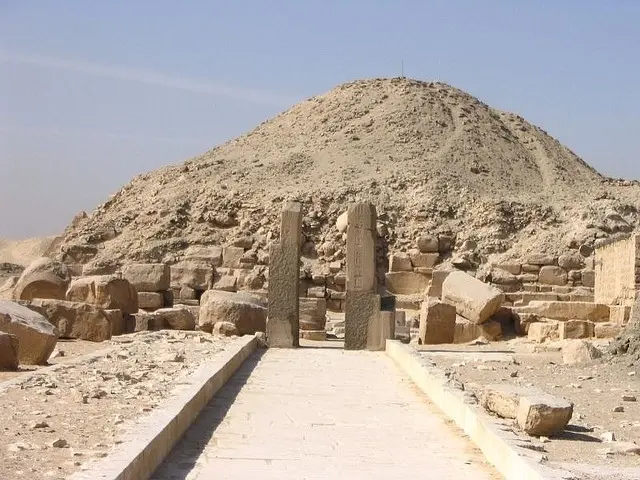
Pyramid of Pharao Teti I
Saqqara, 2400 BCE, Ancient Egypt
Teti was the first king of the Sixth Dynasty
The core is small blocks of local limestone and debris fill, originally cased in fine limestone
Gold stars on a dark blue background, reflect the tomb as a microcosm of the universe
Rituals and recitations cover the end of the corridor, the antechamber and the burial chamber
Planned decoration was never finished and suggests that he died unexpectedly
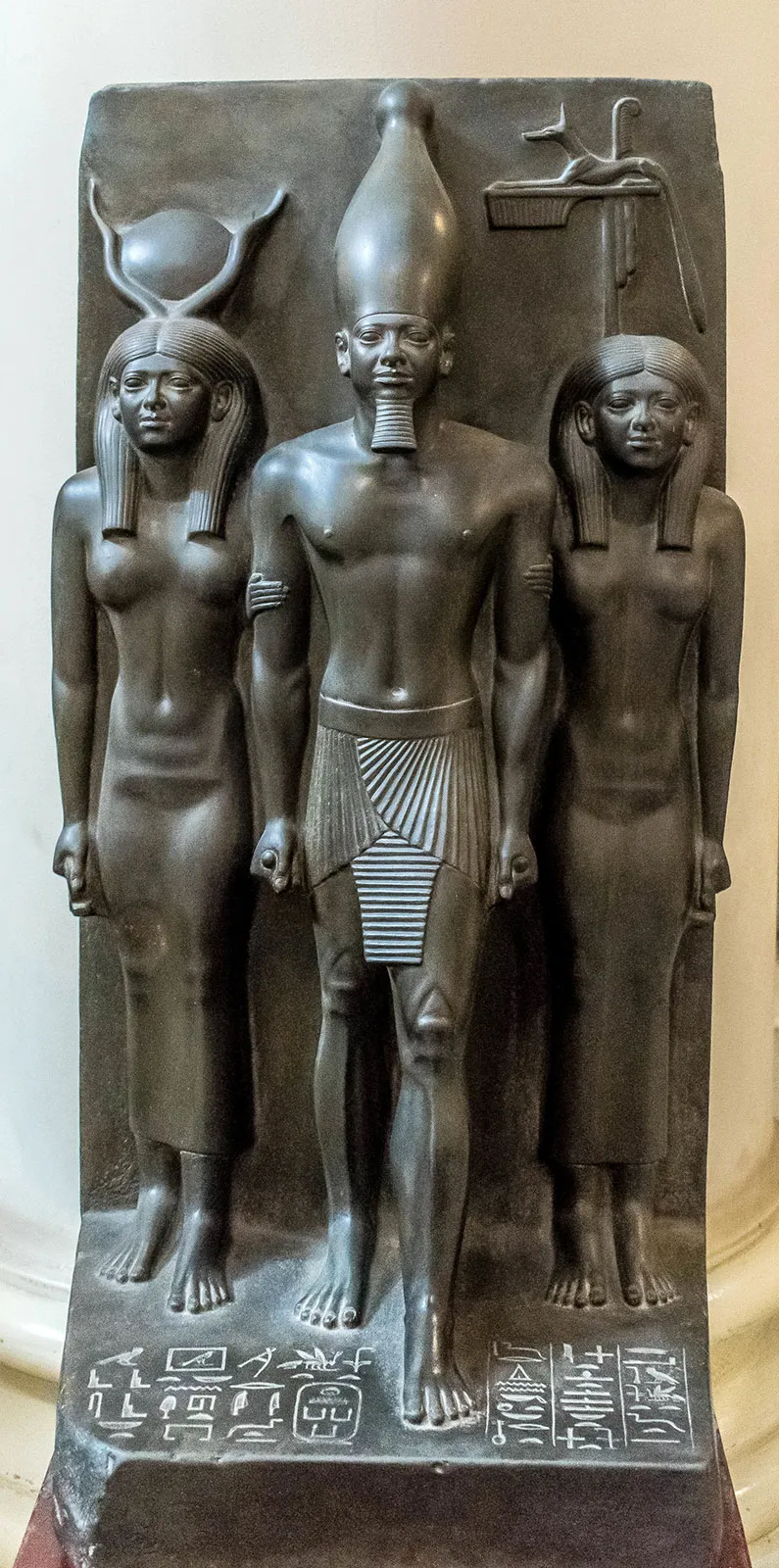
Pharao Menkaure (Mycerinus), Son of Cheops, grandson of Chefren, flanked by two goddesses.
2500 BCE / Old Kingdom Ancient Egypt
Smooth, dark greywacke, polished to a silky finish that conveys eternity and immortality
Menkaure wears the striped nemes headdress, a false beard and a pleated kilt, and holds cloth rolls in his clenched fists.
His body is broad-shouldered and eternally youthful, but his face is individualized, with prominent eyes, a fleshy nose, rounded cheeks and a full mouth.
Her body is similar to his, broad stance, foot forward, quite unnatural position
To ensure the king's rebirth in the afterlife and to serve as a focus of worship in his funerary cult.
Symbolises eternal royal authority, marital unity and the divine partnership required to sustain pharaonic rule
Posture is hallmark of ancient Egyptian art
MINOAN CRETE
3000 BCE to 1100 BCE
Love for nature: animals and plants are dominant subjects
Flowy, naturalistic shapes
Liked to fill the whole available surface
Connected to the sea: absorbed Near Eastern, Babylonian and Egyptian ideas through trade, turned them into something distinctive
Art was mostly for the ruling elite and could carry political meaning, such as palace paintings showing rulers in their religious roles
Strongly influenced the Cyclades and Mycenaean Greece and the double axe imagery may have helped inspire the labyrinth and Minotaur myth
Snake Goddess
from the palace at Knossos (Crete), Greece, 1600 BCE, MINOAN Art
Wearing a tight fitting bodice that completely exposes her breasts: linked to fertility or mourning (?)
Stands rigidly forward with arms outstretched
Grabbing live snakes that coil around her arms
Hat with a cat
Snakes represent underworld connections, household protection and rebirth

ANCIENT EGYPT - NEW KINGDOM
1570-1085 BCE
Imperial expansion brought Egypt into closer contact than before with the Bronze Age civilisations of the Aegean and West Asia
No more pyramids
Kings buried in rock-cut tombs hidden in desert - to deter grave robbers
Queen Hatshepsut is the largest and best preserved tomb
Massive imperial wealth funded enormous expansion of cult and mortuary temples (Hatshepsut among of them)
Columns and capitals heavily integrated organic plant designs like papyrus, lotus and palm motifs
Instead of traditional raised relief, artists perfected sunken relief, carving lines deep into the stone surface that created dramatic shadows
Life like proportions
Under pharaoh Akhenaten: extreme realism and stylised informality, depicting the royal family with elongated heads
Book of the Dead of scribe Hunefer
Thebes, ca 1300 BCE, New Kingdom Egypt
One of the most structurally pristine, highly illuminated, and well-preserved examples of ancient Egyptian art
Red, blue, green, white and yellow pigments
Captures explicit details of the human form
Red ink: denotes titles, spell headers
Given Hunefer's professional elite standing as a scribe, historians suggest that he may have drafted or directly supervised the masterful brushwork himself

Temple of Khonsu
1150 BCE ca, New Kingdom Egypt
Built to honour Khonsu, who was the ancient Egyptian mood god and healer, who was the son of Amun and Mut in the Theban triad
Massive trapezoidal gateway entrance decorated with carved reliefs of the pharaoh making offerings to deities
Inner columned hall with closely spaced columns supporting the roof, leading deeper into sacred spaced
Floor levels gradually rise and ceilings lower as you move closer to the dark, private sanctuary

Capitoline Wolf
5th century B.C.E. or medieval, bronze
Famous bronze sculpture of a she-wold nursing the legendary twin founders of Rome, Romulus and Remus (is a legend, is disputed)
Cast as a single piece in the Middle Ages, though the debate remains
The figures were added later duing the Renaissance (late 15th century) by Antonio del Pollaiuolo
The wolf: tense, alert posture with an exaggerated, long neck, visible ribs and muscular forelegs
Twins: lower, vulnerable position, reaching upward to feed while completely unaware of their surroundings

Roman Empire
Timeline:
753 BCE to 509 BCE, the Regal period of Rome with King and Senate
509 BCE to 27 BCE, the Republic with elected magistrates
27BCE to 330 CE, the Empire
The Pantheon
Roman Empire, c. 125 CE, Rome
Before it stood surrounded by buildings so the sphere was not visible, now it is
In the centre a full perfect sphere fits
Hole in the centre so rain can get in=oculus
Largest unreinforced concrete dome in the world
The cement ceiling gets lighter and thinner as it goes up
Geometric coffered ceilings
Single columns (so not built in pieces) and imported from Egypt
Many different purposes: temple of gods, church
Inspired by greek art
And now many have copied the Pantheon architecture all over the world
Ionic/corinthian columns

Augustus of Primaporta
Roman empire, 1st century C.E
A marble copy of bronze
Portrays Augustus in a military/commanding form
Idealised body depicting youth, strength and athleticism
Contro posto with knee bent - modeled after the spear bear
Clothed with armored
Depicts a fight between the romans and the parthians where the romans won
Shows a god holding up the sky
Earth goddess tellus with babies → sign of fertility
Cupid on a dolphin - signifies relations to Gods/Goddess (Venus) and the winning of a navel battle
