Definitions For Exam #3 Real Analysis
 Call Kai
 Learn
 Practice Test
 Spaced Repetition
 Match
 Flashcards
 Knowt Play
1/9

There's no tags or description
Looks like no tags are added yet.
10 Terms
Sequence
Let X be a set. A sequence in X is a function
x : N→X.
We usually write xn =x(n)
And denote it by {xn}∞ n=1 or simply {xn}

Bounded Sequence
Let (X,d) be a metric space. A sequence {xn} in X is said to be bounded if its range
{xn : n ∈ N} is a bounded subset of X
Equivalently, there exist p ∈ X and R > 0 such that xn ∈ B(p,R) for every n ∈ N

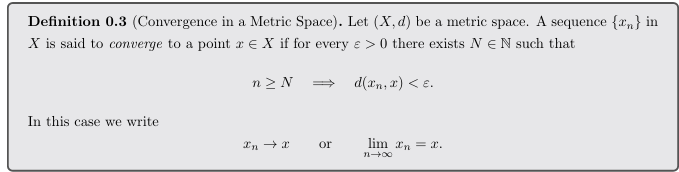
Convergence in a Metric Space
Let (X,d) be a metric space. A sequence {xn} in X is said to converge to a point x ∈ X if for every ε > 0 there exists N ∈ N such that
n ≥N =⇒ d(xn,x)<ε
So we write xn →x or lim n→∞ xn =x
Neighborhood Characterization
Let (X,d) be a metric space. Then xn →x if and only if every neighborhood of x contains all but finitely many terms of the sequence

Failure to Converge to x
A sequence {xn} does not converge to x if there exists ε0 > 0 such that for every N ∈ N, there exists n ≥ N for which
d(xn,x) ≥ ε

Convergence in the Discrete Metric
Then a sequence {xn} converges to x ∈ X if and only if the sequence is eventually equal to x
That is, xn →x ⇐⇒ ∃N∈N such that xn=x for all n≥N

Uniqueness of Limits
Let (X,d) be a metric space. If xn →x and xn→y,
then x =y.

Convergence and bounded
Every convergent sequence in a metric space is bounded.
The converse is false. A bounded sequence need not converge. For example xn =(−1)^n is bounded in R but does not converge.

Sequential Characterization of Limit Points
Let E ⊆ X, where (X,d) is a metric space, and let p ∈ X. Then p ∈E′ if and only if there exists a sequence {pn} in E\{p} such that pn →p

Sequential Characterization of Closed Sets
Let E be a subset of a metric space X. Then E is closed if and only if every convergent sequence {xn} in E has its limit in E.
