microbio exam review mod 5
 Call Kai
 Learn
 Practice Test
 Spaced Repetition
 Match
 Flashcards
 Knowt Play
1/69

There's no tags or description
Looks like no tags are added yet.
70 Terms
Which of the following microorganisms have peptidoglycan in their cell walls?
a)Parasites
b)Fungi
c)Bacteria
Viruses
bacteria
Which of the following microorganisms have lipopolysaccharide in their cell walls?
a)Parasites
b)Fungi
c)Gram-negative bacteria
d)Gram-positive bacteria
Gram-negative bacteria
Which of the following characterizes bacteria?
a)They contain a protein shell around their nucleic acid called the capsid
b)They contain a smaller ribosome compared to eukaryotes
c)They can be classified as Gram-negative or positive based on the peptidoglycan in their plasma membrane
They contain a smaller ribosome compared to eukaryotes

Which of the following thioglycolate broth solutions likely contains a colony of obligate anaerobic microbes?
A
How would you classify bacteria that, under Gram staining, appear circular, pink-reddish, and arranged in chains?
a)Gram-positive, Staphylococci
b)Gram-positive, Streptococci
c)Gram-negative, Staphylococci
d)Gram-negative, Streptococci
Gram-negative, Streptococci
Which of the following is the method of bacterial cell multiplication?
a)Conjugation
b)Binary-fission
c)Schizogony
Binary-fission
In bacteria, what part of the cell wall appendages is responsible for conjugation?
a)Pili
b)Cell membrane
c)Cell wall
d)Flagella
Pili
DNA transfer from one bacterium to another through bacteriophages is termed as…
a)Transduction
b)Transformation
c)Conjugation
Transduction
Which of the following antibiotics inhibits the first step in the central dogma of microbiology?
a)Macrolides
b)Rifampin
c)Fluroquinolones
d) Metronidazole
Fluroquinolones
(first step = DNA replication)
Which of the following is absent in enveloped viruses?
a)A capsid
b)Genome
c)Ribosomes
Ribosomes
According to the Baltimore Classification, Class V has viruses that…
a)have a DNA genome
b)have an RNA genome
c)have reverse transcriptase activity
have an RNA genome
A chiropractor attends a continuing education seminar discussing emerging viral diseases. Which feature most contributes to the rapid emergence of new viral variants and outbreaks?
a) RNA viruses
b) DNA viruses
c) Reverse transcribing viruses
RNA viruses
RdRP is prone to replication error (b/c its multitasking)
Which viral enzyme is a common target of therapies used against Baltimore Groups VI and VII viruses?
Reverse transcriptase
Which Baltimore virus groups are most commonly associated with latent or persistent infections?
a) Groups 1&2
b) Groups 6&7
c) Groups 3, 4, 5
d) Groups 1&2 and 6&7
Groups 1&2 and 6&7
When a virus enters a cell, and replicates in it, this cell is considered to be susceptible, but not permissive to the virus.
True
False
False
A cell is susceptible to a virus if..
a)It has receptors to the virus
b)It allows the virus to replicate in it
c)It has the same nucleic acids as the virus
It has receptors to the virus
What are the cell wall structural components of fungi? Choose all that apply
a)Peptidoglycan
b)Cholesterol
c)Chitin
d)Glucans
e) Ergosterol
c)Chitin
d)Glucans
Yeasts differ from Molds in lacking cell wall
a)True
b)False
False
Regarding the relationship of parasites and hosts, choose from the given list what suits the following description: The parasite affects unusual hosts
a) Opportunistic
b) Permanent
c) Accidental
d) Intermediate
e) Definitive
f) Facultative
Accidental
Regarding the relationship of parasites and hosts, choose from the given list what suits the following description: The parasite is capable of producing disease in immunocompromised host.
a) Opportunistic
b) Permanent
c) Accidental
d) Intermediate
e) Definitive
f) Facultative
Opportunistic
Regarding the relationship of parasites and hosts, choose from the given list what suits the following description: The host harbors the larval stages or asexually reproducing form
a) Opportunistic
b) Permanent
c) Accidental
d) Intermediate
e) Definitive
f) Facultative
Intermediate
Regarding the relationship of parasites and hosts, choose from the given list what suits the following description: The host harbors the adult stages or sexually reproducing forms of the parasite
a) Opportunistic
b) Permanent
c) Accidental
d) Intermediate
e) Definitive
f) Facultative
Definitive
Mention whether the following parasites reproduce sexually or asexually or both:
a) Flagellates
b) Sporozoa
c) Amaoeba
d) Ciliates
a) Flagellates -asexually
b) Sporozoa - both
c) Amaoeba - asexually
d) Ciliates - asexually
transplacental transmisison of infection is considered:
a) vertical transmission
b) horizontal transmission
c) diagonal transmission
vertical transmission
Match the type of microorganism to the method of reproduction:
Bacteria – yeasts – Ciliates – Sporozoa- molds
•Asexual budding
•Binary fission
•Schizogony
Sporulation
asexual budding = yeasts
binary fission = bacteria & ciliates
schizogony = sporozoa
sporulation = molds
during the course of an infectious disease, which periods show no symptoms/signs? choose all that apply
a) incubation
b) prodromal
c) illness
d) decline
e) convalescence
incubation & convalescence
Virulence factors help the bacteria to…
a)invade the host
b)cause disease
c)evade host defenses.
d)All of the above
All of the above
Pathogenicity of an organism is affected by its virulence, infective dose, and LD50
true
false
true
Endotoxins are more antigenic than exotoxins.
true
false
false
Exotoxins are produced only by Gram-positive bacteria.
true
false
false
Which of the following is NOT a mechanism for the action of exotoxins?
a)Inhibition of protein synthesis
b)Inhibition of peptidoglycan synthesis
c)Interference with neurotransmission
Inhibition of peptidoglycan synthesis
Name the exotoxin/enzyme that has the following mechanism of action: Inhibition of acetylcholine secretion from the motor neuron end
botulinim toxin
Name the exotoxin/enzyme that has the following mechanism of action: Inhibition of GABA release from spinal neurons
tetanus toxin
Name the exotoxin/enzyme that has the following mechanism of action: Increased activity of adenyl cyclase in intestinal cells
cholera toxin
Name the exotoxin/enzyme that has the following mechanism of action: Decreased synthesis of protein
diphtheria toxin
Name the exotoxin/enzyme that has the following mechanism of action: Formation of a blood clot around the bacteria
coagulase
Name the exotoxin/enzyme that has the following mechanism of action: Degradation of Hyaluronan
hyaluronidase
Name the exotoxin/enzyme that has the following mechanism of action: Degradation of the collagen between the endothelial cells
collagenase
Which of the following is a definition of local infection?
a)An infection confined to a small region of the body.
b)Widespread infection in many systems of the body.
c)Infection that serves as a source of pathogens for infections at other sites in the body.
d)A disease that has recently appeared in a population or has existed but is rapidly increasing in incidence or geographic range.
An infection confined to a small region of the body.
Choose the Right Scientific Term
a) pandemic b) endemic c) sporadic d) epidemic
A disease pattern in which the number of new cases is increasing beyond what is expected, not just in a limited geographic area or population, but on more than one continent
a) pandemic
Choose the Right Scientific Term
a) pandemic b) endemic c) sporadic d) epidemic
Constant presence of a disease or infectious agent within a given geographic area.
b) endemic
Choose the Right Scientific Term
a) pandemic b) endemic c) sporadic d) epidemic
A disease pattern in which occasional cases are reported at irregular intervals in random locations
c) sporadic
Choose the Right Scientific Term
a) pandemic b) endemic c) sporadic d) epidemic
When the disease occurrence among a population is in excess of what is expected in a given time and place
d) epidemic
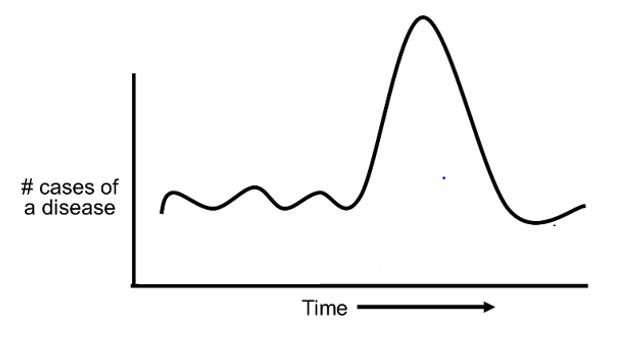
What disease pattern do you see?

Choose the Right Scientific Term
a) elimination b) eradication c) extinction
Permanent reduction to zero of the worldwide incidence of infection caused by a specific agent as a result of deliberate efforts
b) eradication
Choose the Right Scientific Term
a) elimination b) eradication c) extinction
The specific infectious agent no longer exists in nature or in the laboratory.
c) extinction
Choose the Right Scientific Term
a) elimination b) eradication c) extinction
Reduction to zero of the incidence of infection caused by a specific agent in a defined geographical area as a result of deliberate efforts
a) elimination
The reservoir of a pathogen is either an animal or a human only
true
false
false
which antibiotics attack the peptidoglycan component in the bacteria cell wall? Select all that apply
a) B lactams
b) 30S inhibitors
c) fluroquinolones
d) glycopeptides
a) B lactams (i.e. penicilin)
d) glycopeptides (i.e. vancomycin)
what is released when gram-negative cells die and the bacterial cell wall undergoes lysis?
a) exotoxins
b) endotoxins
c) B lactams
b) endotoxins (lipid portion of LPS)
what antibiotics attack the LPS-endotoxin portion of the gram-negative bacterial cell wall?
a) B lactams
b) polymixins
c) 50S inhibitors
d) sulfonamides
b) polymixins
which microorganism best fits the description?
a) prokaryotes b) eukaryotes c) viruses
1) acellular, no organelles, DNA in a capsid
2) membrane-bound organelles, unicellular/multicellular, DNA in chromosomes
3) no membrane-bound organelles, unicellular, DNA in circular nucleoid
a) prokaryotes — 3) no membrane-bound organelles, unicellular, DNA in circular nucleoid
b) eukaryotes — 2) membrane-bound organelles, unicellular/multicellular, DNA in chromosomes
c) viruses — 1) acellular, no organelles, DNA in a capsid
are the following characteristics required in DNA replication of eukaryotes or prokaryotes or both
a) telomeres
b) DNA gyrase
c) replication takes place in the nucleus
d) only one origin of replication
e) small amount of DNA
f) fast & continuous process
g) end up with 2 circular chromosomes
a) telomeres — EUK (pro DNA is circular, no telomeres)
b) DNA gyrase — PRO
c) replication takes place in the nucleus — EUK (pro is in cytoplasm)
d) only one origin of replication — PRO (euk has multiple origins)
e) small amount of DNA — PRO (euk DNA is 50x more than pro)
f) fast & continuous process — PRO (euk is slow & and only in S phase)
g) end up with 2 circular chromosomes — PRO (euk = 2 sister chromatids)
you have a test tube with a high concentration of O2 at the top and low [O2] at the bottom. the bacteria follow this pattern: growth only occurs near the top of the tube
what kind of bacteria are they?
a) obligate aerobes
b) facultative aerobes
c) obligate anaerobes
d) aerotolerant anaerobes
e) micro-aerophiles
a) obligate aerobes
you have a test tube with a high concentration of O2 at the top and low [O2] at the bottom. the bacteria follow this pattern: growth mostly occurs at the top of the tube, but it is present throughout the entire tube
what kind of bacteria are they?
a) obligate aerobes
b) facultative aerobes
c) obligate anaerobes
d) aerotolerant anaerobes
e) micro-aerophiles
b) facultative aerobes
you have a test tube with a high concentration of O2 at the top and low [O2] at the bottom. the bacteria follow this pattern: growth only occurs at the bottom of the tube
what kind of bacteria are they?
a) obligate aerobes
b) facultative aerobes
c) obligate anaerobes
d) aerotolerant anaerobes
e) micro-aerophiles
c) obligate anaerobes
you have a test tube with a high concentration of O2 at the top and low [O2] at the bottom. the bacteria follow this pattern: growth occurs evenly throughout tube
what kind of bacteria are they?
a) obligate aerobes
b) facultative aerobes
c) obligate anaerobes
d) aerotolerant anaerobes
e) micro-aerophiles
d) aerotolerant anaerobes
you have a test tube with a high concentration of O2 at the top and low [O2] at the bottom. the bacteria follow this pattern: growth occurs in a small section of the tube, in a low-concentration area
what kind of bacteria are they?
a) obligate aerobes
b) facultative aerobes
c) obligate anaerobes
d) aerotolerant anaerobes
e) micro-aerophiles
e) micro-aerophiles
How would you classify bacteria that, under Gram staining appear long, purple, and arranged in clusters?
a) gram-positive staphylococci
b) gram-negative streptobacilli
c) gram-positive staphylobacilli
d) gram-negative streptococci
c) gram-positive staphylobacilli
purple = GP
long = bacilli
clusters = staphylo
which of the following describes the process of sex pilli helping bacteria send a copy of plasmids to another bacteria?
a) conjugation
b) binary fission
c) schizogony
a) conjugation
describe the process of binary fission
1) bacteria duplicates its genome
2) bacteria elongates, separating 2 DNA groups (theta DNA)
3) bacteria splits & cross wall forms between 2 cells
4) 2 identical daughter cells
which antibiotics will inhibit protein synthesis? select all that apply.
a) aminoglyosides
b) tetracyclines
c) macrolides
d) antifolates
e) fluoroquinolones
a) aminoglyosides — 30S inhibitor
b) tetracyclines — 30S inhibitor
c) macrolides — 50S inhibitor
name 4 different ways bacteria make themselves resistant to antibiotics
1) inhibition of drug uptake — modified cell wall protein so AB can’t enter the bacteria
2) efflux pumps — pump AB back outside after it enters the bacteria
3) inactivation by enzymes — enzymes inside the bacteria deactivate the AB when it enters
4) modified drug target — receptors inside the bacteria change, AB doesn’t work
what are some reasons why antibiotic resistance exists/spreads?
over-prescription
over-use of ABs in livestock
lack of new ABs beind developed
poor infection control in hospitals/clinics
lack of hygiene/sanitation
patients not finishing dose (sub-therapeutic)
where does translation of virus proteins occur?
a) ribosomes of the virus
b) nucleus of the virus
c) ribosomes of the host cell
d) nucleus of the host cell
c) ribosomes of the host cell
replication of virus mRNA inside the host’s ribosomes bc the virus doesn’t have ribosomes
which group(s) of viruses can disrupt the central dogma?
groups 3, 4, 5, 6, 7
(RNA viruses and reverse transcribing viruses)
what are the steps in the life cycle of a virus from attachment to release
1) attachment
2) penetration
3) uncoating
4) synthetic phase (replication, transcription, translation)
5) assembly
6) egress/release
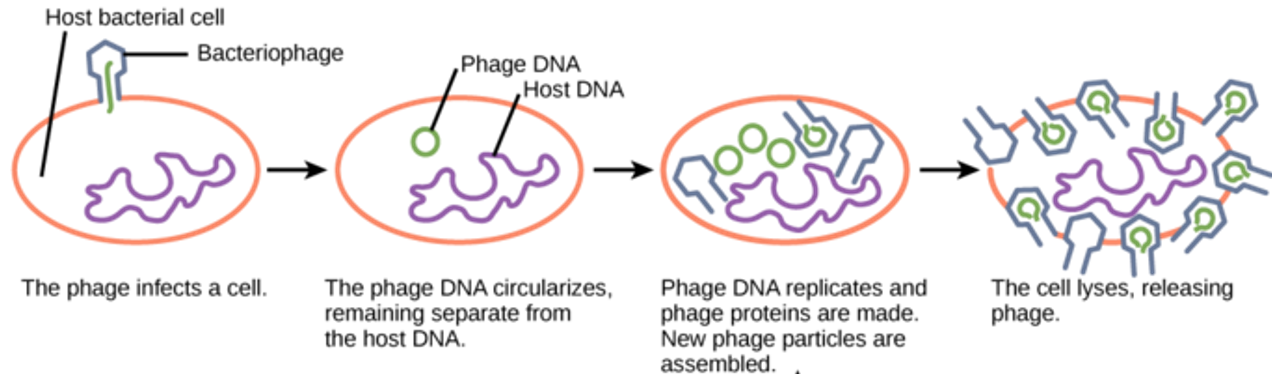
what is this picture describing?
the lytic cycle of a bacteriophage
what is true about the lysogenic cycle of a bacteriophage?
a) the phage DNA infects the cell and immediately starts replicating
b) the phage incorporates itself into the cell wall of the bacteria
c) the phage DNA incorporates itself into the host cell DNA
d) the phage DNA will enter the lytic cycle randomly (without any external stimuli)
c) the phage DNA incorporates itself into the host cell DNA
then cell divides and phage DNA is passed down to daughter cells
under stressful stimuli (i.e. UV light), phage DNA is excised and enters lytic cycle