CAMS - Final Exam
 Call Kai
 Learn
 Practice Test
 Spaced Repetition
 Match
 Flashcards
 Knowt Play
1/51

There's no tags or description
Looks like no tags are added yet.
52 Terms
Oppositional Defiant Disorder (ODD) [DSM]
A) Pattern of angry/irritable mood, argumentative/defiant behaviour for ≥ 6mo. ≥4 sx from any category: (angry/irritable mood; argumentative/defiant behaviour; vindictiveness) + present during interaction w/ someone other than sibling
B) Causes distress in self/others or causes functional impairment in social'/educational/occupational area(s)
C) Not due to substance use or other psychotic disorders
ODD Specifiers (DSM)
Mild: sx only present in one setting
Moderate: sx present in ≥ 2 settings
Severe: sx present in ≥ 3 settings
Course of ODD
Typically begins during preschool yrs, sx evident by 8
Behaviours first observed at home
Defiant behaviours then extend to school and other settings
In adolescence: remission or persistence
Most children enter remission, but:
30-40% develop conduct disorder in adolescence
30-40% of adolescents w/ conduct disorder develop antisocial personality disorder in adulthood
ODD Myths
Myths:
Naughty child
Disobedient
Behavioural Problem
Reality:
→ Emotional dysregulation

Maintenance of OCD - Escalation Cycle
The coercive cycle → the trap both sides build
A negative feedback loop where adult demands and child escalation feed into each other, reinforcing defiant reactions
Breaking Cycle in ODD
Behaviour modification - reinforce adaptive behaviour and decrease defiant behaviour
Treatments:
Parent training and family-focused interventions
Psychotherapy
Parent Management Training (ODD)
Highly effective
Caregivers learn skills to reward positive behaviour and set calm, consistent consequences instead of harsh punishments
Increase wanted behaviour:
Attention top ups (special time, positive attention, attending skills)
Descriptive praise (“I love how you are playing quietly”)
Rewards (for wanted behaviour; bigger reward for continued behaviour)
Decreasing unwanted behaviour:
Planned ignoring (for annoying/interrupting)
Redirect (give small instruction then praise)
2-step Process
1) Get down to eye level, say name, give instruction in neutral voice
2) If complies → praise/reward. If doesn’t → repeat instruction. If still doesn’t comply, give logical consequence or time out
Psychotherapy (ODD)
Emotion regulation strats, problem solving, coping skills
Address negative thought patterns contributing to defiance
Address co-occurring mental health struggles
Ask:
How does it feel when you fight w/ parent/teacher? Do you like this feeling? What can we do next time you feel you’re about to yell?
Regulation activities (traffic light → stop, take 3 breaths, choose what to do next; wall push; box breathing)
Co-regulation activities (breathe/sit quietly together; play together; squish sandwich)
Major Depressive Disorder (MDD) [DSM]
A) ≥ 5 sx in same 2-week period and represent change from previous functioning. at least one sx (1) or (2)
(1) depressed mood nearly every (*in youth, can be irritable mood)
(2) diminished interest in activities
(3) significant weight loss
(4) insomnia/hypersomnia
(5) pyschomotor agitation/retardation
(6) feelings of worthlessness/guilt
(7) diminished ability to concentrate
(8) recurrent thoughts of death
D) Major depressive disorder not due to schizophrenia spectrum and other psychotic disorders
E) No history of manic/hypomanic ep
Clinical Presentation of MDD
DSM criteria don’t differ for youth
Often irritability instead of sadness
Somatic complaints
Often academic decline
Failure to reach expected weight instead of weight loss, or increased/decreased appetite
Prevalence of MDD
Preschool children: ~1%
Early childhood: ~2%
Adolescents: 4-8%
/
Equal gender prevalence in childhood, female predominance emerging after puberty (~2:1)
Rising rates of depression since COVID-19
Clinical Course of MDD
90% of children and adolescents w/ MDD go into remission 1-2 yrs after onset but…
~50% relapse within 2 mos of partial remission
Recurrence common
Within 2 yrs: 20-60% have sx again
After 5 yrs: 70% have sx again
Clinical Course of MDD [Cont.]
Partial remission: no significant sx of depression for up to 2 mos OR some sx but full criteria of MDE not met
Full remission: no significant sx for > 2 mos
Relapse: return of depressive sx in first 2 mos of partial remission
Recurrence: Return of depressive sx after complete recovery
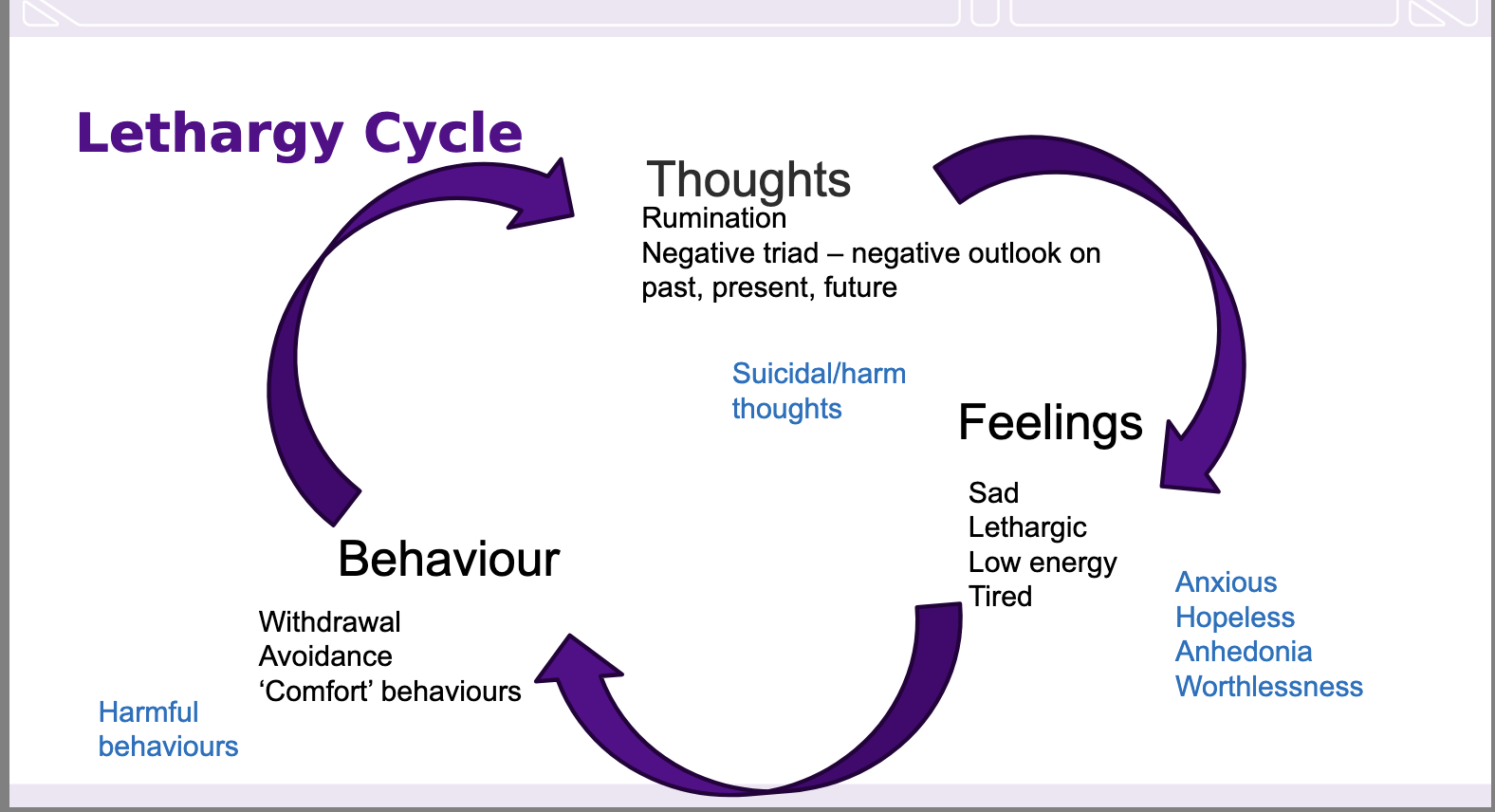
Maintenance of MDD
Lethargy Cycle
Suicidal/harm thoughts lead to negative feelings (anxious, hopeless, anhedonia, worthlessness), which lead to harmful behaviours, repeat
Assessing MDD
Common validated instruments for youth: Mood and Feelings Questionnaire (MFQ [ages 8-18]; Patient Health Questionnaire — Adolescent [ages 12-18]
MFQ:
Child & parent self-report survey that assess core depressive sx over 2 week period
Items scored 0 (not true), 1 (sometimes), 2 (true)
Score range 0-26 (0-7 = minimal; 8-11 = elevated; 12+ = severe)
Bipolar Disorder - Manic Episode (DSM)
A) Period of abnormally elevated, expansive, or irritable mood and increased goal-directed activity/energy for at least 1 week (or any duration if hospitalised)
B) During period of mood disturbance and increased energy/activity, > 3 sx (> 4 sx if mood only irritable) present to a significant degree and represent noticeable change from usual behaviour
Inflated self-esteem or grandiosity
Decreased need for sleep
More talkative
Flight of ideas
Distractibility
Increase in goal-directed activity or psychomotor agitation
Excessive involvement in activities w/ potential for painful consequences
Clinical Presentation of Manic Episode
In extreme cases, mania can include delusions or hallucinations
Impairment: causes significant disruption in social work or daily functioning
Psychotic sx
Bipolar Disorder - Hypomanic Episode (DSM)
Similar criteria to manic episode except:
Lasts 4 consecutive days (instead of 1 week)
Ep not severe enough to cause marked impairment in social/occupational functioning, or does not require hospitalisation
No psychotic features
> 3 of manic sx (or > 4 if only irritable mood)
Bipolar I Disorder (DSM)
At least one lifetime manic ep (not due to other psychotic disorder)
Major depressive eps common but not required for dx
Bipolar II Disorder (DSM)
At least one hypomanic ep and one major depressive ep
No history of manic ep
More time spent depressed than hypomanic
Bipolar I or Bipolar II Disorder
Mania and some depressive sx → bipolar I disorder
Hypomania and major depressive eps → bipolar II disorder
Many children fall into a subthreshold or “bipolar spectrum” category, and later develop BPD I or II
Disorder onset typically during late adolescence
Cyclothymic Disorder (DSM)
*Classified as a bipolar disorder in DSM
A) For ≥ 1 yr for children and adolescents (2 yrs for adults), numerous periods of hypomanic sx not meeting full criteria for hypomanic eps and numerous periods of depressive sx not meeting full criteria for MDE
B) During this time, sx present at least 50% of time, never w/o sx for more than 2 mos at a time
C) Criteria for MD, manic, hypomanic eps never met
Assessment of Bipolar Disorders (DSM)
Child Mania Rating Scale
21-item parent report tool → evaluates mania sx in children and adolescents (9-17 yrs)
Items scored on 4-point Likert scale (never, sometimes, often, very often) to differentiate b/w bipolar disorders or ADHD
Score ≥ 20 often = diagnosis
Treatment of Major Depressive Disorder and Bipolar Disorders
Psychotherapy or combined psychotherapy + medication for more intense sx profiles
Psychotherapy (primarily CBT)
Medication
For MDD: SRRIs
For Bipolar Disorders: mood stabilisers or antipsychotics
CBT for MDD
Challenges lethargy cycle (thoughts, feelings, behaviours) → how these interact to trap you in a negative cycle
Thoughts: cognitive restructuring/detective thinking
Feelings: emotion regulation strats, coping skills, psychoeducation around feelings and emotions (breating/relaxation techniques, weather report: heavy feelings = temporary weather patterns)
Behaviours: behavioural activation (schedule small daily enjoyable tasks), behavioural experimentation (test negative predictions)
Cognitive Challenging (Detective Thinking)
Child-friendly way to teach cognitive restructuring—critically examining thoughts
Shift thinking from “my first must be true” to “my thought is something i can test”
What is Anxiety?
Normal emotion characterised by feeling tense, having worried thoughts, and physical changes
Physical sx: tense muscles, breathing faster, trembling, nausea, racing heart
Mental sx: constant worry, fear of catastrophe, unease
A little anxiety necessary/helpful
adaptive response to threat → trigger fight-or-flight response
motivates performance, learning, and safety behaviours
Anxiety Disorders in Children
Children may not recognise fears as unreasonable
In younger children, more physical sx described
In adolescents, more verbal worry
Behaviours that might indicate anxiety: physical aches and pains, difficulty falling asleep, avoidance of leaving house or doing activities, need for reassurance
Prevalence of Anxiety Disorders
Most common psychiatric condition in adolescents
Girls more likely than boys to report anxiety disorders (~2:1)
Untreated anxiety increases risk of: other anxiety disorders, depression, education underperformance, and substance use
Clinical Course of Anxiety Disorders
Anxiety disorders among earliest onset psychiatric disorders
Sx may wax and wane
One anxiety disorder may evolve into another
Many children improve w/ treatment, but w/o intervention, anxiety often persists
Panic Attacks
Sudden, intense eps of fear/discomfort, often peaking within mins, that trigger physical sx
Common
Lasts 5-30 mins, triggered by stress, trauma, or occur unexpectedly
Panic attacks alone aren’t disorder — panic disorder = recurrence of unexpected panic attacks
Some Anxiety Disorder in DSM
Separation Anxiety Disorder
Specific Phobia
Social Anxiety Disorder (Social Phobia)
Generalised Anxiety Disorder (GAD)
Separation Anxiety Disorder (DSM)
A) Developmentally inappropriate and excessive fear or anxiety concerning separation from those to whom individual in attached. > 3 sx
recurrent distress when anticipating or experiencing separation
worry about losing attachment figures
worry about events leading to separation
reluctance/refusal to go to school or elsewhere
fear of being alone or w/o attachment figures
refusal to sleep away from home/ w/o caregiver nearby
nightmares abt separation
physical sx during separation
B) Fear, anxiety, or avoidance persistent, lasting ≥ 4 weeks in children and adolescents and ≥ 6 mos in adults
C) Disturbance causes clinically significant distress or impairment in social/academic/occupational areas
D) Disturbance not to another mental disorder
Separation Anxiety Disorder - More Info
Affected children tend to come from closely knit fams
Prevalence estimates ~ 4% in children and adolescents
Excessive worry abt own or parent’s safety and health when separated
Sx include difficulty sleeping alone, nightmares w/ themes of separation, somatic complaints, school refusal, concerns abt death/dying
Commonly earliest age of onset among anxiety disorders
Specific Phobia Disorder (DSM)
A) Marked fear or anxiety about a specific object or situation
B) Almost always provokes immediate fear/anxiety
C) Actively avoided or endured w/ intense fear/anxiety
D) Out of proportion to the actual danger posed and the sociocultural context
E) Persistent, typically lasting for 6 mos of more
F) Clinically significant distress or impairment in social/occupational/other areas
G) Not due to another mental disorder
Specific Phobia Specifiers (DSM)
Animal (e.g., spiders, dogs)
Natural Env. (e.g., heights, storms, water)
Blood-injection-injury (e.g., needles, invasive medical procedures)
Situational (e.g., airplanes, elevators)
Other (e.g., situations that may lead to choking or vomiting)
Avoidance Cycle
Maintains phobias
Anxiety → Avoidance → Short-term relief from anxiety → Long-term anxiety growth →
Social Anxiety Disorder (SAD) [DSM]
Marked fear/anxiety about social situations in which individual exposed to possible scrutiny by others
social interactions (having a convo)
being observed (eating)
performing in front of others (giving a speech)
*In children, anxiety must not occur exclusively in interactions w/ adults
Individual fears that they will act in a way or show anxiety sx that will be negatively evaluated
Social situations almost always provoke fear/anxiety. They are avoided or endured w/ intense fear/anxiety. Fear/anxiety out of proportion

Maintenance of SAD
Development of negative cognitive biases (mind reading, catastrophising)
Attention bias to threat
Safety behaviours: rehearse speech, avoid participation, avoid eye contact
These maintain disorder
Generalised Anxiety Disorder (GAD) [DSM]
Excessive anxiety and worry occurring most days for ≥ 6 mos about a number of events/activities
Individual finds it difficult to control the worry
The anxiety and worry associated w/ following sx (> 1 for children; > 3 for adults)
restlessness
being easily fatigued
difficulty concentrating
irritability
muscle tension
sleep disturbance

Maintenance of GAD
Worry as cognitive avoidance
Intolerance of uncertainty
Overestimation of threat
Underestimation of coping ability
Assessment of Anxiety Disorder
Consider physical, behavioural, cognitive sx
Common validated instruments:
Screen for Child Anxiety Related Emotional Disorders (SCARED)
Spence Children’s Anxiety Scale (SCAS)
Treatment for Anxiety Disorders
Typically involves psychotherapy or combined psychotherapy + medication for more severe cases
Psychotherapy:
CBT - cognitive restructuring
Mindfulness - breathing exercises
Exposure therapy
Medication
SSRIs
For moderate-severe

CBT Model for Anxiety Disorders
Challenge harmful thoughts, feelings, behaviours using top down and bottom up therapy strats
1) Thoughts: cognitive restructuring/detective thinking
2) Feelings: mindfulness activities
3) Behaviours: exposure therapy strats
Exposure and Response Prevention (ERP)
Specialised form of exposure therapy used to treat anxiety disorders by gradually exposing individuals to fearful stimulo
Goal: learn that anxiety decreases on its own and that feared outcomes unlikely to happen
Build a fear ladder by ranking exposure activities from least scary to most scary
Gradual exposure to fear-eliciting stimuli + abstinence from escape/avoidance behaviours
Top Down Therapeutic Strategies
Use thinking and logic to influence emotions and feelings (e.g., detective thinking)
Bottom Up Therapeutic Strategies
Use the body and nervous system to help regulate the mind (e.g., breathing exercises)
Obsessions vs. Compulsions
Obsessions: recurrent and persistent thoughts, urges, or images that are intrusive and unwanted
Obsessions are NOT infatuation, fantasies, over-thinking, upsetting memories, worrying, intrusive thoughts
Compulsions: repetitive behaviours or mental acts that an individual feels compelled to engage in
Compulsions are NOT tidiness, habits, impulses, addictions, or superstitious behaviours
Obsessive-Compulsive Disorder (OCD) [DSM]
A) Presence of obsessions, compulsions, or both
B) Obsessions/compulsions are time-consuming or cause clinically significant distress or functional impairment
C) Obsessive-compulsive sx not due to substance use or another medical condition
D) Disturbance not due to another mental disorder
Obsessions
In DSM, defined by (1) and (2)
1) Recurrent and persistent thoughts, urges, or images that are experienced as intrusive or unwanted and that cause marked anxiety/distress
2) Individual attempts to ignore or suppress such thoughts, urges, or images, or neutralise them with another thought/action
Common obsessions: contamination (germs), aggression (fear of hurting others), sexual content (having perverse sexual thoughts), superstitions (step on crack, break mom’s back), scrupulosity (“religious OCD”)
Compulsions
In DSM, defined by (1) and (2)
1) Repetitive behaviours (e.g., hand washing, ordering) or mental acts (e.g., praying, counting) that person feels driven to perform
2) Behaviours or mental acts aimed at preventing/reducing anxiety/distress or preventing some dreaded event; but these behaviours/mental acts excessive or unrelated to the event
Common compulsions: contamination (ritualistic handwashing), aggression (no actual intent. compulsions may be rituals to neutralise thoughts), sexual content (no actual intent, compulsions rituals to neutralise thoughts), superstitions (counting, tapping), scrupulosity (excessive praying)