AGR + FPR
 Call Kai
 Learn
 Practice Test
 Spaced Repetition
 Match
 Flashcards
 Knowt Play
1/11

There's no tags or description
Looks like no tags are added yet.
12 Terms
Area of Greatest Restriction (AGR) Screening — Steps
NOT on practical but could be on written
Patient seated (feet on floor) AND standing.
Stand beside patient.
One hand on head (cervical) or shoulder (thoracic/lumbar).
Other hand palpates paraspinal soft tissues.
Cervical: monitor AP
Thoracic: use thenar eminence/thumb + finger pads across spine
Induce sidebending, rotation, flexion/extension bilaterally.
SB + N, SB + F, SB + F + Rotate, SB + E, SB + E + Rotate.
Find greatest restriction → diagnose segment → treat FIRST.
Rescreen and repeat until no significant improvement.
Remember: Less motion standing = suspect lower extremity dysfunction.

AGR — How to Identify the Dysfunction?
Upper extremity: Tight thoracic band medial to scapula.
Thoracic: Restriction worsens medially.
Ribs: Restriction worsens laterally → evaluate key rib.
Lower extremity: Unilateral tight band along lumbar spine.
Sacrum: Seated flexion test more positive.
Innominate: Standing flexion test more positive.
Memory: Medial = Thoracic | Lateral = Ribs
FPR — General Rules to Remember
Indirect technique
NEUTRALIZE spinal curve first.
Add facilitating force (usually axial compression, if not then torsion).
Position toward ease/freedom to relax tissue.
Hold 3–5 seconds.
Release compression BEFORE returning to neutral.
RETEST.
Memory: Neutralize → Compress → Ease → Hold → Release → Retest
Cervical FPR — Suboccipital Hypertonicity (Right Example)
Patient supine; sit at head.
Right hand supports occiput/upper cervical spine. Index finger across cervical level OR pincer grasp on the AP
Left hand on head → slight flexion to neutralize.
Apply ~1 lb caudad axial compression.
Maintain compression → extend + SB RIGHT + rotate RIGHT (toward tight muscles).
Find maximal tissue relaxation.
Hold 3–5 sec → release compression → neutral.
Retest.

Cervical FPR — Flexion Dysfunction (C4 FSRRR Example)
Patient supine; sit at head.
Right hand supports cervical spine.
Left hand on head → slight flexion to neutralize.
Apply ~1 lb axial compression.
Position into FLEXION + SB RIGHT + rotate RIGHT (freedoms).
Find maximal relaxation.
Hold 3–5 sec → release compression → neutral.
Retest.

Cervical FPR — Extension Dysfunction (C4 ESRRR Example)
Patient supine; sit at head.
Left hand supports cervical spine.
Right hand on head → slight flexion to neutralize.
Apply ~1 lb axial compression.
Position into EXTENSION + SB LEFT + rotate LEFT (as written in handout).
Find maximal relaxation.
Hold 3–5 sec → release compression → neutral.
Retest.

Thoracic FPR — Superficial Hypertonicity (Left Example)
Patient seated; stand on LEFT (tight side).
Right hand monitors tight paraspinal muscle.
Left forearm on patient's left shoulder.
Left hand on patient's right shoulder.
Patient sits tall → neutralize kyphosis.
Apply caudad + posterior compression → extend + SB LEFT (toward tight side).
Hold at maximal relaxation 3–5 sec.
Release → neutral → retest.
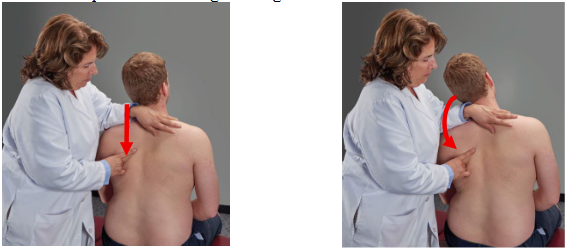
Thoracic FPR — Flexion Dysfunction (T3 FSLRL Example)
Patient seated; stand on LEFT.
Right hand monitors T3 transverse process.
Left forearm on left shoulder; left hand on right shoulder.
Patient sits tall to neutralize kyphosis.
Apply caudad compression → SB LEFT + rotate LEFT.
Patient drops head forward → induces FLEXION.
Find maximal relaxation → hold 3–5 sec.
Release → neutral → retest.

Thoracic FPR — Extension Dysfunction (T6 ESRRR Example)
Patient seated; stand on RIGHT.
Left hand monitors T6–T7 spinous processes + right T6 TP.
Right forearm on right shoulder; right hand on left shoulder.
Patient sits tall → neutralize kyphosis.
Apply caudad compression → EXTEND + SB RIGHT + rotate RIGHT.
Find maximal relaxation.
Hold 3–5 sec → release → neutral.
Retest.

Lumbar FPR — Soft Tissue Hypertonicity (Right Example)
Patient PRONE, pillow under abdomen.
Stand on RIGHT (tight side). You can put your knee by their ASIS to stabilize when you lean back.
Right hand monitors tight lumbar paraspinals.
Left hand grasps distal thigh of LEFT leg (opposite leg).
Extend + adduct LEFT leg (lean back) until tissue tension decreases.
Find maximal relaxation.
Hold 3–5 sec → return to neutral.
Retest.

Lumbar FPR — Flexion Dysfunction (L4 FSRRR Example)
Patient PRONE, pillow under abdomen; right leg near edge. Have pt grab onto the table w/ their opposite arm.
Sit on RIGHT.
Left hand monitors right L4 transverse process.
Right hand lowers flexed RIGHT knee/thigh off table. Have pt knee rest on your knee.
Flex RIGHT hip until motion felt at L4.
Use your knee to adduct patient's RIGHT knee toward table.
Slightly internally rotate RIGHT leg. You can bring the ankle out.
Hold 3–5 sec → neutral → retest.

Lumbar FPR — Extension Dysfunction (L4 ESLRL Example)
Patient PRONE, pillow under abdomen + under mid-thigh.
Stand on LEFT (rotation side).
One hand monitors LEFT L4 transverse process.
Other hand abducts LEFT leg → lumbar SB LEFT.
Hold LEFT ankle → internally rotate lower leg until motion felt at L4. (Turn toes toward table)
Flex hip by pushing leg downward until motion felt.
Find maximal relaxation → hold 3–5 sec.
Release → neutral → retest.
