Bacterial Genetics Exam II
 Call Kai
 Learn
Learn Practice Test
 Spaced Repetition
 Match
Match Flashcards
 Knowt Play
1/93

Earn XP
Description and Tags
Lectures 7, 8, 9, 10, 11, and 12
Name | Mastery | Learn | Test | Matching | Spaced | Call with Kai | Chat |
|---|
No analytics yet
Send a link to your students to track their progress
94 Terms
What is Lamarckian Inheritance?
Adaptive changes acquired in response to the environment that are passed on
What is Darwinian inheritance?
Random mutation in a species are passes on to offspring due to natural selection

What are the two possible explanations for resistant bacteria?
Directed mutation or change - environment responsible for the mutation
Random mutation - resistant cells existed in population before exposure
What is the Luria Delbruck Experiment?
Luria and Delbrück grew many small, parallel cultures of E. coli starting from a very small initial number of cells. They also set up a single large control culture split into multiple samples. They incubated the cultures and then plated equal amounts from each tube onto agar plates containing the T1 phage. They counted the number of surviving, resistant bacterial colonies on each plate. Discovered number of mutants at the end of experiment is a result of mutation rate AND when mutation occurs (and clonal expansion)

What are the objections to the Luria-Delbruck Experiment?
1) Indirect evidence using statistics, implies clonal expansion
occurring
2) T1 phage used to select mutations (don’t find the mutants
until after exposure to phage)
What are the three experiments that provide support for random mutation in bacteria?
Newcombe – mutant cells are clonal
Lederberg – direct evidence for random mutation without
exposure to a selective agent; replication technique
Luria-Delbrück - different cultures, exposed to phage similarly,
greatly different frequency of mutants supports random hypothesis
What is the Newcombe Experiment?
More mutants in the spread plate, demonstrating clonal
expansion of the few resistant cells that existed in the
population before being challenged with phage
Experiment supports the idea that mutations pre-existed before
exposure to the phage

What is the Lederberg’s experiment?
Step 1: spread plates, allow to grow, then:
Step 2: REPLICA PLATE to plates with and without streptomycin
Find the location of the resistant colony. Goes back to control plate
Pick that area, grow bacteria and repeat--what happens? All colonies are now strep resistant!

How do mutation rates vary?
Loss of function mutation is more common than an altered function mutation.
What is Mutation Rate?
the probability that any one cell will mutate to a given phenotype (such as T1 phage resistance) during a given period of time. Time interval is usually cell generation time. Typically expressed as number of mutations per cell generation
Does the number of genes for a function affect mutation rates for a given phenotype?
Yes, typically the more genes involved the higher the mutation rate is, because it is “easier”.
Why can true mutation rates be difficult to determine?
Timing of mutational events – the number of mutants may come from growth of one mutant or from several individual mutational events
Ability to distinguish independent mutational events (siblings vs. independent mutants)
Phenotypic lag – delay between the time a mutation occurs and the time a change in phenotype becomes evident
How do you isolate mutants?
A Selection is a growth condition that allows for the selective propagation of genetically marked cells.
A Screen is a growth condition where both mutant and wild type are able to grow but can be distinguished phenotypically
Mutations can be caused by?
Replication errors, error repairs, spontaneous, chemicals, irradiation, or biological agents (foreign DNA or transposons)
Mutation Rates are effected by?
Genetic background, growth conditions (oxygen, toxic metals), spontaneous mutations (2×10^-8 mutations per nucleotide per generation)
To mutagenize or not in a screen vs selection?
Need to mutagenize in a screen. Not necessary in an overnight culture.
What are the types of mutations?
Single base pair mutations - changed, deleted, inserted
Large insertions
Large deletions (irrevocable loss)
Inversions
Duplications
What are base analogs?
Class of mutagen, mimic normal bases and get incorporated in the DNA but mispair
What are alkylating agents?
Class of mutagen, directly alter the DNA so that mispairing results
upon replication (ex: EMS)
What are intercalating agents?
Class of mutagen, planar molecules that distort DNA and usually cause frameshifting
What are super mutagens?
Class of mutagen, mutagens that damage DNA beyond recognition (specific
base pairing not possible) then SOS repairs but often introduces
mistakes) (ex: UV light or carcinogens)
What are the consequences of mutations in coding regions for a protein?
Nonsense (introduce stop codon)
Missense (substitute an new amino acid)
Silent (no change in function of the product)
Frameshift (shifts the reading frame)
Dominant negative: makes an altered protein that interferes with the wildtype protein. Usually indicates an interaction
What is a microlesion?
Transitions or transversion mutations
What is a transition point mutation?
Replacement of one pyrimidine by a purine or a purine by a pyrimidine (ex: T to C or a A to G)
What is a transversion point mutation?
replacement of a pyrimidine by a purine or a purine by a pyrimidine (ex: A to T or C)
What is the alkylation of DNA?
GC to AT transition. Can occur naturally (methyl urea) or from environmental mutagens (MMS, EMS, NTG)
What is trans-lesional synthesis (TLS)?
DNA damage-tolerance mechanism that allows the replication machinery to switch polymerases at template lesions that would otherwise stall pol III. An A base is usually inserted to repair, “error prone”, these risky polymerases are usually only expressed under certain conditions (i.e. UV repair)
What events can lead to permanently damaged DNA?
UV exposure or chemical mutagenesis
Mutator vs Antimutator Strain?
Mutator – more mutations than normal; low nuclease to
polymerase activity
Antimutator – fewer mutations than normal, high nuclease to
polymerase activity
What are indicator plates?
Used to detect phenotypes and can be used in identification or screens. Often have indicators that are colorless substrates that will produce a color indicating an activity (ex: Xgal)
What are papillae?
They are microcolonies within colonies:
example Lac- colonies (white on indicator Xgal) → Lac+ pinpoints (blue)
What occurs to the cell in the absence of cell repair?
Mutations accumulate, leads to cell death as you will eventually effect essential cell functions.
What is methyl-directed mismatch repair (MMR)?
Major repair mechanism in E. coli, which results in faithful template-driven repair, recognizes mispaired bases that occur during replication. MutS, MutH, and Mut L are the main proteins involved, causes a DNA loop.
What are the steps of MMR

Role of MutS in MMR?
DNA binding protein, recognized distortion in DNA
Role of MutH in MMR?
Recognizes hemimethylated GATC
Role of MutL in MMR?
Bridges MutS to MutH
What is a deamination mutation?
Loss of a NH2 group. These are common mutations that can be spontaneous or induced by chemicals.

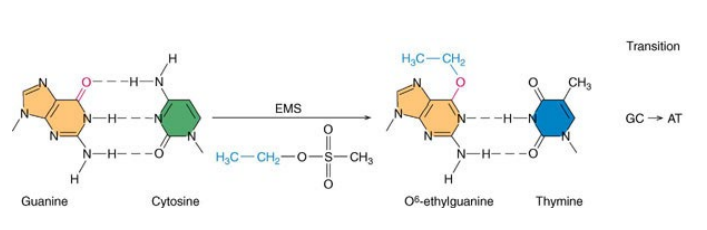
What is a alkylation mutation?
Alkylating agents are compounds that work by adding an alkyl group
to the guanine base of the DNA molecule, preventing the strands of
the double helix from linking as they should
What are the base excision repair mechanisms?
Deaminated bases
specific DNA glycosylases recognizes unusual deaminated bases and clip off the nucleoside base
then nucleases nick the site and gap is filled by pol I and ligase
Alkylation damage
specific glycosylase removed alkylated base then sites are excises by a nuclease and pol I fills in and ligase glues
or alkyl transferase enzymes that restore the base
Nucleotide excision repair mechanism?
UV light often causes crosslinks (e.g. pyrimidine dimers)
Induced by UV exposure
Nonspecific system and handles lots of different lesions that distort DNA (mismatches, dimers, crosslinks)
UvrABC endonuclease complex nicks both sides of the distortion and removes it and then Pol I and ligase repair
What is very short patch repair?
Very Short Patch (VSP) repair enzyme specficially recognizes TG mismatches and nicks the DNA at the T, and Pol I (and ligase) moves in to fill in and correct
5-methyl cytosines are hotspots for mutations and convert to
thymine resulting in TG mismatches
Reactive oxygen damage control mechanisms?
Aerobic organisms have enzymes to destroy or scavenge :
Superoxide dismutase (SOD) – reduces superoxide to peroxide
SOD O2- to H2O2 and O2
Catalase – reduce H2O2 to water and O2
ROS induce DNA repair enzymes (MutM, MutY, and MutT)
8-oxo-G repair enzymes?
8-oxo-G is one of the mist common DNA lesion resulting from ROS
MutT degrades free 8-oxo-G
MutM excises 8-oxo-G from DNA: recognizes and eliminates bad base
MutY removes 8-oxo-G paired with A (or G with A); recognizes weird mispair

UV induction of SOS repair?
UV induces ~30 genes to help manage DNA damage (din genes, damage inducible)
delays cell division
urvABD (repair enzymes)
recF, recA (recombination proteins)
error prone DNA pol
Mechanism: repressor LexA, keeps transcription off, UV damage inactivates LexA repressor and system gets turned on
Consequence of a dominant negative mutation?
Makes an altered protein that interferes with the wildtype protein. Usually indicates an interaction.
Isolation of a division mutant

What is a complementation test?
Always want to complement the mutation, i.e., provide a good copy in
trans and demonstrate you can correct (or “rescue”) the mutant
phenotype.
if a mutation works in cis (chromosome) in cannot be complemented in trans (plasmid)
2 mutations in the same gene cannot rescue each other
Why can there be a failure to complement?
Mutation causing phenotype not in gene provided in trans
Mutation is polar (so need the entire operon)
Mutation is cis-acting
Mutation results in a dominant phenotype (poisoning the wt copy, usually indicates multisubunit interaction).
What is polarity in a gene?
A genetic mutation that affects not only the gene where the mutation happens, but also the expression of other genes located further down the line (downstream) in the same group or operon. Occurs when genes are translationally coupled.
What can synthetic phenotypes reveal?
They can reveal functional redundancy, other genes can compensate for the loss of another. A gene may be essential when another gene is disrupted.

What is a reversion mutant?
Reverse mutations restore the gene product to wt function.
Types of reversions:
• (true) Reversion – mutation happens in the same site to restore the original sequence
• (pseudo) Second site reversion (suppressor mutation) – a second mutation happens masking effect of original mutation

What is a suppressor mutant?
Second-site compensatory mutation that “restores” original phenotype.
Intragenic - change in the same gene as the primary mutation
frameshifts or missense
Extragenic - change occurs in another gene which is called a suppressor gene
provides another gene pdt to compensate for deactive protein, alters gene pdt so they can interact again
Define synergism?
When two mutations combined have a stronger effect that each separately.
What is allele specificity?
Allele-specific means that if one particular nucleotide or codon is at a specific site in a gene, another particular nucleotide or codon must be at a precise second site in that gene product or in a gene product it interacts with to produce a functional phenotype.
What is epistasis?
Epistasis is a circumstance where the expression of one gene is affected by the expression of one or more independently inherited genes often “downstream” in the process. Gene is epistatic to another if the phenotype “wins”.
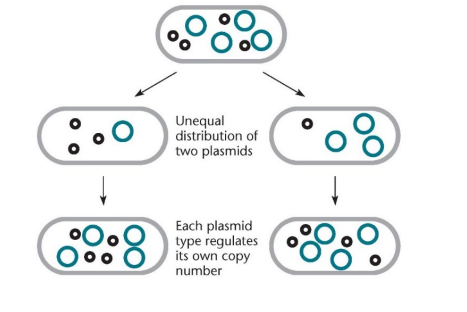
What is plasmid incompatibility?
Some plasmids cannot both exist in the same cell, controlled by origin of replication, inc or incompatibility groups (plasmids in same inc group cannot coexist). This occurs due to regulation of replication and partioning.
Conjugative vs non-conjugative plasmids
Conjugative: ability to directly transfer from cell to cell
Carry tra genes that encode proteins for transfer of the plasmid from one cell to another (F+ is an example)
Non-conjugative plasmids do not carry these genes, although some can be “mobilizable”
What are the two mechanisms of plasmid replication?
Theta replication – as described for E. coli. But can be uni or bi-directional.
Rolling circle model of replication
also plays a role in conjugation and some phage replication cycle
What is the host range of a plasmid?
Bacteria in which a plasmid can replicate. This is one of the functions often determined by the oriV.
What determines host range and plasmid copy number
Determined by the oriV. Most (-) regulate their copy number.
How and what is necessary for broad host range?
Promoters and ribosome binding sites of the plasmid must be recognized by host
Functionality of ori. A broad-host-range plasmid often encodes the proteins required for initiation of replication, so they are not dependent on the host for these functions.
Copy number control mechanisms of plasmids?
small interfering antisense RNAs
interfere with production of initiating RNA primer for replication
inhibit translation and production of a protein required for initiation
Protein required for initiation of replication
also autoregulates (represses) its own transcription or translation
binds to a single ori at low copy number, but at high copy number will bind and sequester two origins (handcuffing by using 2 domains, DNA binding and oligomerization)
What is R1 partitioning?
1) ParR binds at parC site on plasmid
2) ParM binds to ParR
3) After replication additional ParM subunits nucleate to form a filament that pushes the plasmids toward the cell poles.
4) After plasmids are separated, ParM dissociates and filaments disappear
What is the plasmid addiction system?
Some plasmids selectively kill cells that cure the plasmid.
Plasmid encodes a toxin (stable) and antitoxin (unstable)
If plasmid is lost, antitoxin degrades quickly and the toxin kills the cell.
What is plasmid incompatibility?
Refers to the inability of certain plasmids to coexist in the same cell
If plasmids are incompatible, then one of the other will become lost (cured) as cells divide.
If the plasmids have the same Par function, one or the other will be distributed to the daughter during division.
What is a cloning vector?
an autonomously replicating DNA (replicon) into which other DNA can be
inserted. So, a cloning vector is a specially engineered plasmid.
What are restriction endonucleases? Their role?
Recognize and cut specific DNA sequences.
Made exclusively by bacteria to degrade foreign DNA introduced into the cell
Bacteria often methylate their own DNA at bases in recognition sequences so they can distinguish self DNA from unmodified foreign DNA
Describe Type II Restriction Endonucleases?
Type II systems consist of methylases and endonucleases that are separate proteins
Cut DNA at defined positions close to or within their recognition sequences
cleavage can produce sticky or blunt ends
Type II enzymes are highly diverse and are named according to the organism from which they were isolated
EcoRI Escherichia coli
HindIII Haemophilus influenzae
What is gibson assembly?
an exonuclease nonspecifically chews back the ends to yield the staggered ends for reannealing. super useful for synthetic cloning of large things (like a whole chromosome)
what is restriction cloning?
a specific enzyme cuts ends to yield the compatible staggered reannealing
Gibson vs restriction cloning scheme?

Features of plasmid cloning vectors?
ori of replication
selectable gene (drugR)
unique restriction sites for cloning
insertional activation
relatively small size
variable copy number
no promotor or strong promotor
strong ribosome binding site for high level protein production
Difference between suppression and complementation
Complementation occurs when two separate mutations in different genes are combined, and the wild-type (normal) alleles from each genome make up for the defective copy in the other, restoring a normal (wild-type) phenotype.
Suppression occurs when a second mutation (a suppressor mutation) happens at a different site or gene, correcting or masking the phenotypic defect of the original mutation without fixing the original DNA sequence itself
Gene editing using recombination?
RecA mediated
Single crossover integration events
Double crossover events
Plasmid based: First event (single crossover), then second event (another crossover)
Transformation or transduction with fragment
Lambda Red recombination system
Outcomes of gene editing?

What makes a vector a suicide vector?
cannot replicate in the recipient
suicide is conditional - replicates in its cloning host and dies in recipient
narrow host range
ts origin
Single crossover outcome of gene editing?
A single crossover integrates the whole plasmid - frequent, but reversible unless you keep selection.
An internal fragment of a gene on a suicide plasmid → disrupts the gene, often polar (impacts genes downstream)
Inactivates the gene - if internal fragment is cloned on plasmid
makes a good copy plus a second copy - if the whole gene is cloned on the suicide plasmid

Two crossover outcome of gene editing?
Two crossovers forced by counter selection
allows you to control the mutation you are making
need: vector can’t replicate in recipient; positive selection for integration (antibiotic resistance), negative selection for loss of integrated plasmid

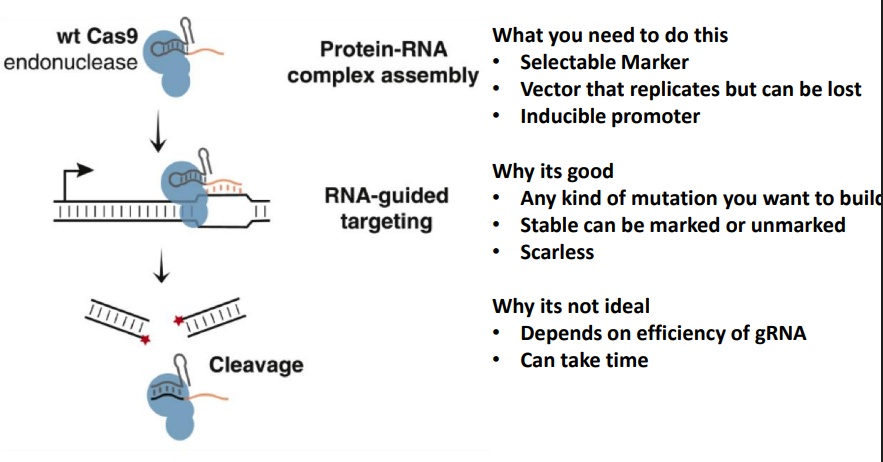
How does CRISPR for genetic engineering work?
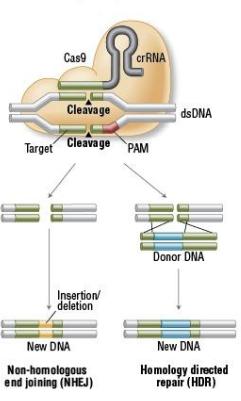
Cas9 cuts where the guide matches, next to a PAM.
What is the role of I-Scel?
Induces site specific DSBs. Counterselectable marker (I-SceI acts as a counterselectable marker by generating lethal chromosomal double-strand breaks (DSBs) that eliminate cells still harboring the marker. Isolates only the mutants)

How does CRISPR/Cas9 work as a counterselectable marker?
It uses lethal double-strand DNA breaks to targetedly kill off unedited, wild-type cells. This leaves only the successfully modified cells alive. The guide RNA (gRNA) is specifically programmed to recognize and bind to the original, unedited wild-type sequence or its adjacent PAM site.
Gene editing using Lambda Red?
One step irreversible replacement
About 60 bp of homology on a PCR fragment replaces a gene in one step - no plasmid integration required.
RecA independent
Three phage λ genes: exo, bet and gam
commonly used to make indels
λ Red Genes Roles?
Gam inhibits RecBCD so incoming DNA not immediately degraded
Gam must physically bind RecBCD, a protein-protein contact, so it is host-specific
Exo exonuclease (works like RecBCD) degrades 5’ end and produces 3’ overhang for strand invasion
Bet produces a protein that works like RecA
ssDNA binding protein
Promotes strand invasion and synapse formation (strand exchange)
Genetic engineering with ssDNA: only Bet gene?
Only λ Bet for ssDNA recombineering is suitable for introducing point mutations, short deletions, or minor insertions directly at the replication fork, whereas it is unsuitable for dsDNA substrates or large genomic insertions that require λ Exo and Gam to process duplex ends and inhibit host nucleases
Role of CRISPRi?
CRISPRi silences transcription instead: the gene stays, expression is turned down. Reversible. Controls: known-phenotype guide, nontargeting guide, uninduced strain. Verify by RT-qPCR: you measure message, not genotype

Cons to CRISPRi?
polarity
need RNA guide
getting DNA is hard - conjugation, competence, electroporation, conjugation dodges it
Which method of gene editing should you choose? (5 options)

What is the purpose/steps of phage absorbtion?
Mix Phage with Cells
Centrifuge down cells
If phage bind cells the number of phage in the supernatant will decrease
If no receptors are present phage numbers in supernatant will remain unchanged
Plaque supernatant on sensitive cells
Used to see of phage are binding to the cellls
How do bacteria block phage absorption?
Hide the receptor: capsule or surface glycans occlude it; another protein masks it
Change the receptor: mutations that abolish binding, or glycosylation of the binding site
Lose or down-regulate the receptor — the route our T4-resistant mutants took
Decoy the phage: outer-membrane vesicles carrying the receptor soak up particles
Role of FtsW and FtsI?
FtsW = glycosyltransferase (extends the chains)
FtsI = Transpeptidase (crosslinks the chains)
Target of β-lactams
Also called Penicillin-binding protein 3 (PBP3
FtsWI form a complex
FtsQLB switches on FtsWI peptidoglycan synthesis
Suppressors and Revertants can be used to understand?
Nature of original mutation and identifying interacting proteins
Dominant negatives report on?
Report on proteins acting within a complex
Complementation distinguishes?
distinguishes same-gene from different gene mutations