DIGITAL MARKETING (W 1.6)
 Call Kai
 Learn
 Practice Test
 Spaced Repetition
 Match
 Flashcards
 Knowt Play
1/21

Earn XP
Description and Tags
ONBOARDING & LOYALTY
22 Terms
what’s the definition of a customer lifetime value (CLV)?
it’s the total average revenue value of a customer (from a certain segment)
it’s the sum of all future profits (revenue - costs) of a customer → that which is an average customer during the period that he is or could be a customer of the company
how do we calculate the CLV (2 ways)?
GROSS customer lifetime value (the one we’ll be calculating)
average order value × average order frequency × number of years of customer
NET customer lifetime value
total customer value = (T×A×P) - K
T = number of (estimated) transactions
A = number of purchases per transaction
P = average price per purchase
K = customer acquisition costs
what is a way to grow our e-commerce?
instead of focusing on only one metric, we can improve several customer-value metrics a bit and the combined effect can create much larger business growth (double the business)
on the slide it’s suggested to monitor:
number of customers in period
average order size in €
order frequency per year
if we increase each component only by 30%, we get cca. 220% of the original revenue

what’s the formula for the e-commerce sales growth driver?
number of customers × order frequency × average order value
what’s the formula for the e-commerce conversion rate %?
(number of orders ÷ number of visits) × 100%
what’s the formula for online sales?
traffic × conversion % × average order value
what’s the formula for the average order value?
turnover ÷ number of orders
what’s the formula for order frequency?
number of orders per year ÷ number of customers per year
why is customer loyalty important?
it has a strong correlation with repeat purchases (retention)
satisfied customers recommend the brand to other customers (they act as ambassadors)
(marketing) costs for repeat purchases are lower (we can have a higher margin)
customer interaction with loyal customers is higher (through reviews, interaction, feedback)
they need less help/guidance in the purchase process
loyal customers often spend more & are open to new products
what resources did the martial arts store use to increase customer loyalty?
savings programme
automatically save points for a discount
registration required
the more spent, the higher the discount
periodic promotion for extra discounts on purchases
none-transferable & customer-specific
marketing automations
automated & personalised email flows based on specific triggers
extra discounts & promotions during the flow
onboarding programme aimed at turning new customers into more loyal customers
professionalisation standard/system mails & landing pages
what could be some examples of automations or base of triggers?

which two automation flows did we find especially important?
abandoned cart flow
automation flow after first order
tell more about the abandoned cart flow.
trigger after email address has been entered → then we keep sending it 3-5 times:
30 min after (no discount)
24 hours after (no discount)
3 days after (5% discount to try to recover the customer)
recovery rate: 17%
mail address is immediately captured → ”system” mail - something goes wrong (we need permission from the customer)

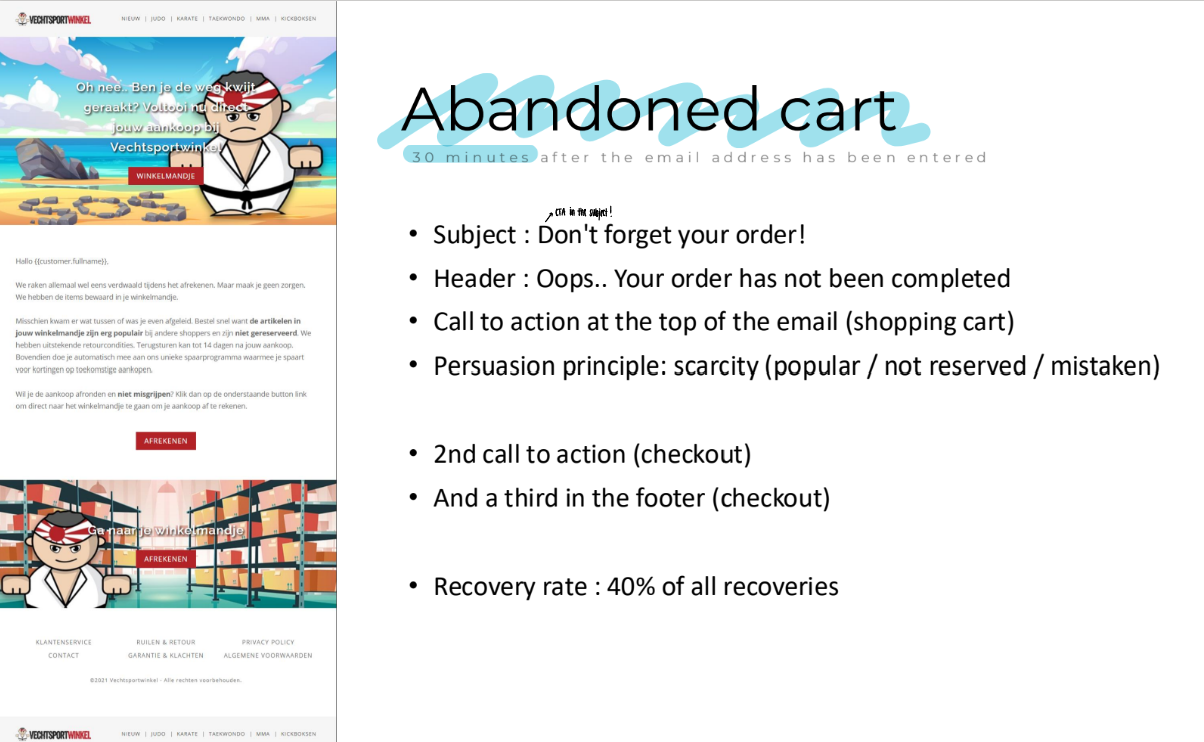
what could the first abandoned cart email (30 min after the email’s been entered) look like?
subject (it’s helpful if we include CTA in it): Don’t forget your order!
header: Oops…Your order has not been completed
CTA at the top of the email (shopping cart)
persuasion principle: scarcity (popular/not reserved/mistaken)
2nd CTA (check-out)
and the third in the footer (check-out)
recovery rate: 40% of all recoveries
what could the second abandoned cart email (24 hours after the email’s been entered) look like?
subject: You forgot something
header: Oops…Your order has not been completed
CTA at the top of the email (view your shopping cart)
persuasion principle: communicate loyalty programme benefits
2nd CTA (check-out)
and the third in the footer (check-out)
recovery rate: 20% of all recoveries

what could the third abandoned cart email (3 days after the email address’s been entered) look like?
subject (you add discount because you don’t want to lose the customer): 5% discount on items in your shopping cart
header: Oops…Your order has not been completed
CTA at the top of the email (direct check-out)
persuasion principle: scarcity (discount valid for 24 hours) & reciprocity (discount)
introduction to the loyalty programme (discount on the future purchases)
2nd CTA (check-out)
and the third in the footer (check-out - claim your discount)
recovery rate: 40% of all recoveries

and what does the automation flow after first order look like?
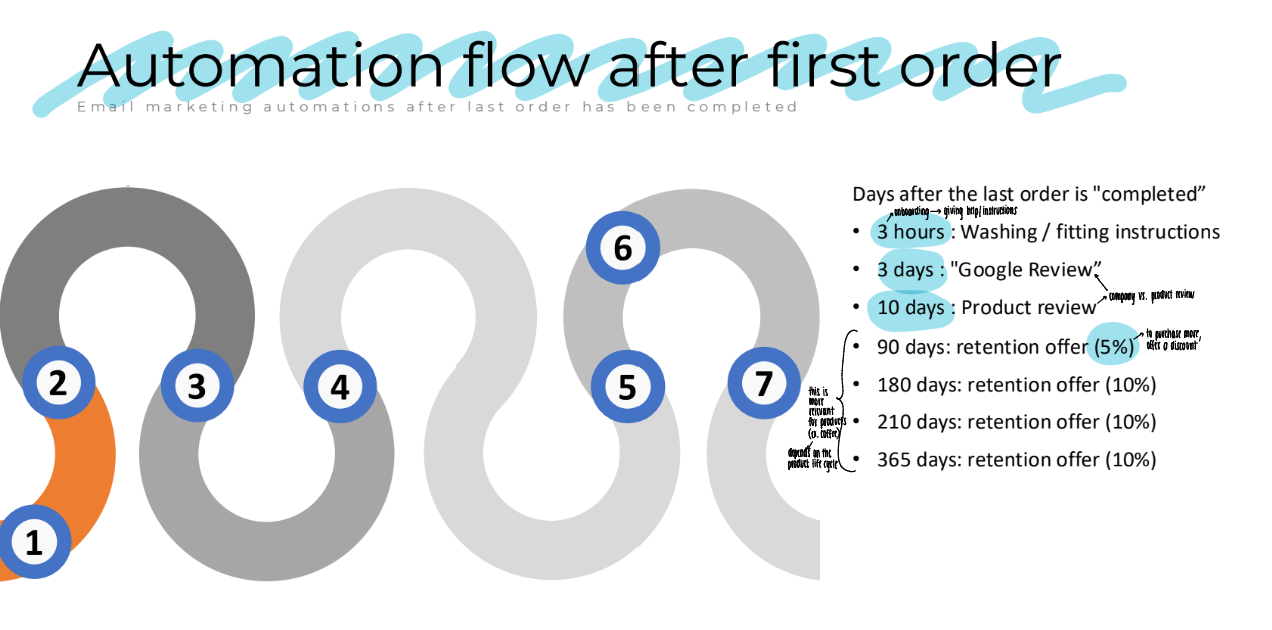
here are some email marketing automations after last order has been completed → days after the last order is “completed“:
3 hours (this is onboarding - giving help & instructions): Washing/fitting instructions
3 days: “Google Review“ (company review)
10 days: Product review (different than company review)
90 days: retention offer (5% - add a discount so they can purchase more)
180 days: retention offer (10%)
210 days: retention offer (10%)
365 days: retention offer (10%)
from 90-365 days emails depend on the product’s life cycle (ex. coffee needs to be repurchased more frequently than a computer)
what can the first email for automation flow after the first order (3 hours after the product is shipped - WASH/FIT INSTRUCTIONS) look like?
it’s an onboarding email, because it offers help (information, instructions) → it has to be perfect: backlinks & everything has to work seamlessly
it should contain a short header with links to most important pages
personalised
fitting & washing instructions
footer with the possibility to delve into the loyalty programme
footer with links to main pages
this also helps reduce the return rate of products (no data)

what’s the definition of benchmarking?
it means measuring your performance against a standard or competitor to see how well you’re doing & where you can improve
what’s the definition of email marketing?
it’s a discipline that traditionally falls under direct marketing, but nowadays email marketing is more of a separate field
in short, an organisation uses email channel to interact with all its target groups; such as prospects/leads, customers, employees & other actors
for email marketing it’s important that there’s permission from the receiving party (telecommunications legislation)
because communication with customers about their order (& the different phases in it) is allowed, email marketing is often used for abandoned cart mails, loyalty & retention goals
so in-short, what’s email marketing? what is an application for email marketing?
it’s a form of direct marketing in which the email channel & the email address are used so that organisations can interact with their target groups
it’s fast, effective, personal, has a large reach, response & digital conversion, also has segmentation & personalisation capabilities with dynamic profile data
the biggest difficulty is that it can’t help you, unless you have email addresses from your customers; it’s great for loyal ones, though
