Antimicrobial Chemotherapy
5.0(1)
Studied by 1 person Call Kai
 Learn
 Practice Test
 Spaced Repetition
 Match
 Flashcards
 Knowt Play
Card Sorting
1/21

Earn XP
Description and Tags
22 Terms
1
New cards
antibiotic
any
compound produced by one microbial species that could
kill or inhibit the growth of other microbes. also used for synthetic
chemotherapeutic agents, such as sulfonamides, that
are clinically useful but chemically synthesized.
compound produced by one microbial species that could
kill or inhibit the growth of other microbes. also used for synthetic
chemotherapeutic agents, such as sulfonamides, that
are clinically useful but chemically synthesized.
2
New cards
Selective Toxicity
Antibiotic must affect target organism but it must not affect humans. Drug should affect microbial physiology.
3
New cards
Broad spectrum
Effective against many species
4
New cards
Narrow spectrum
Effective against few or a single species
5
New cards
Source of antibiotics
Most discovered as natural products
Often modified by artificial means to:
Increase efficacy
Decrease toxicity to humans
Often modified by artificial means to:
Increase efficacy
Decrease toxicity to humans
6
New cards
Bactericidal antibiotics
kill target organisms
Many drugs only affect growing cells
Ex: inhibitors of cell wall synthesis - Only effective if organism is building new cell wall
Many drugs only affect growing cells
Ex: inhibitors of cell wall synthesis - Only effective if organism is building new cell wall
7
New cards
Bacteriostatic antibiotics
prevent growth of organisms.
Cannot kill organism
Immune system removes intruding microbe
(less likely to develop resistance and only helpful if person is immunocompetent)
Cannot kill organism
Immune system removes intruding microbe
(less likely to develop resistance and only helpful if person is immunocompetent)
8
New cards
factors to consider when deciding which antibiotic to prescribe
for the patient
for the patient
* broad vs. narrow spectrum
* bacteriostatic vs. bactericidal
* The relative effectiveness of different antibiotics on the organism causing the infection
* The average attainable tissue levels of each drug
* bacteriostatic vs. bactericidal
* The relative effectiveness of different antibiotics on the organism causing the infection
* The average attainable tissue levels of each drug
9
New cards
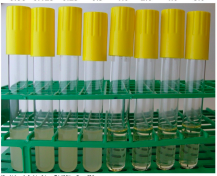
Minimal Inhibitory Concentration (MIC)
The lowest concentration of antimicrobial able to kill all
bacteria in a well (1.0 is the MIC)
bacteria in a well (1.0 is the MIC)
10
New cards
Process of Minimal Inhibitory Concentration
1. swab throat
2. pick suspected disease microbes and culture it
3. make standard suspension in plates or tubes
4. add antibiotic
5. look at what is the MIC
2. pick suspected disease microbes and culture it
3. make standard suspension in plates or tubes
4. add antibiotic
5. look at what is the MIC
11
New cards
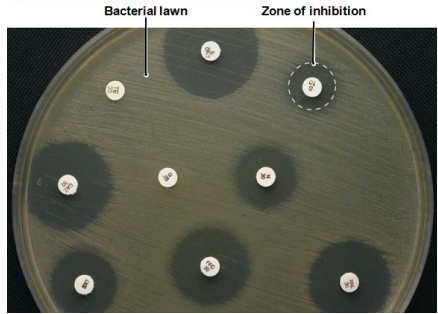
Kirby-Bauer assay
tests strain sensitivity to multiple antibiotics.
- Uses a series of round filter paper disks impregnated with different antibiotics.
- A dispenser delivers up to 12 disks simultaneously to the surface of an agar plate covered by a bacterial lawn.
- During incubation, the drugs diffuse away from the
disks into the surrounding agar and inhibit growth of the lawn.
- Size of cleared zones reflects relative sensitivity
12
New cards
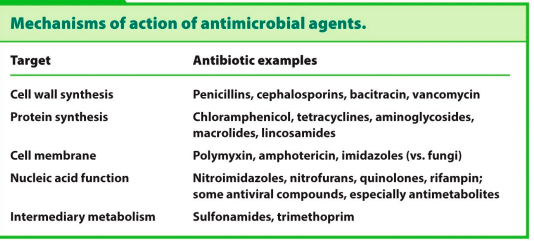
Mechanisms of Action
way that drugs attack target
Ex. Cell wall
- Cell membrane
- DNA synthesis
- RNA synthesis
- Protein synthesis
- Metabolism
you can have drugs with the same target with different mechanisms of actions
Ex. Cell wall
- Cell membrane
- DNA synthesis
- RNA synthesis
- Protein synthesis
- Metabolism
you can have drugs with the same target with different mechanisms of actions
13
New cards
Peptidoglycan synthesis
complicated 8-step synthesis pathway unique to
prokaryotic cells (selective toxicity)
prokaryotic cells (selective toxicity)
14
New cards
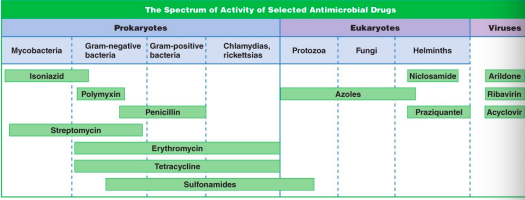
Spectrum of Action
Narrow spectrum vs broad spectrum drugs. Overprescribing broad spectrum drugs fosters
antibiotic resistance
antibiotic resistance
15
New cards
secondary metabolites
Antibiotics are considered secondary metabolites
because they often have no apparent primary use in the producing organism.
because they often have no apparent primary use in the producing organism.
16
New cards
Microbes prevent self-destruction by
• make enzymes to disable antibiotics
• Alter the target of the drug
• Efflux pumps remove drugs from inside the cell
• Tolerance - Slow down metabolism
- Genes encoding some of these drug-resistance
mechanisms have been transferred to pathogens
• Alter the target of the drug
• Efflux pumps remove drugs from inside the cell
• Tolerance - Slow down metabolism
- Genes encoding some of these drug-resistance
mechanisms have been transferred to pathogens
17
New cards
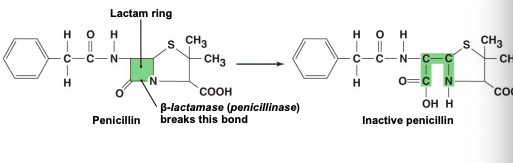
Beta-lactamases
Bacteria can make Beta-lactamases, which denatures Beta- lactam penicillins making them ineffective (Forming an enzyme that destroys or deactivates the drug)
18
New cards
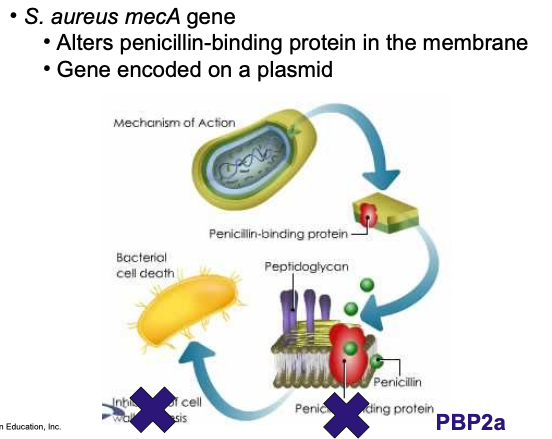
S. aureus mecA gene
Alters penicillin-binding protein in the membrane • Gene encoded on a plasmid (Alter the target of the drug)
19
New cards
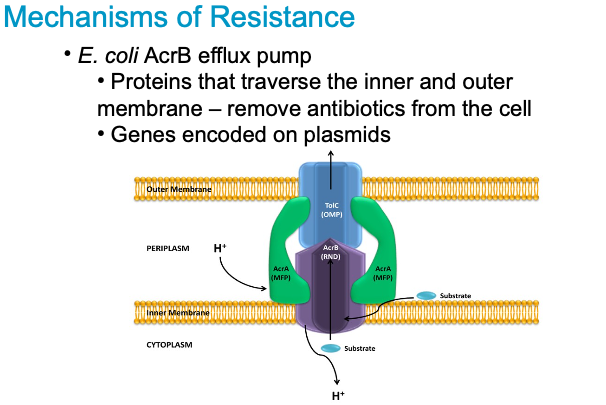
E. coli AcrB efflux pump
Proteins that traverse the inner and outer membrane – remove antibiotics from the cell • Genes encoded on plasmids ONLY GRAM NEG because gram-positive does not have periplasm (Efflux pumps remove drugs from inside the cell)
20
New cards
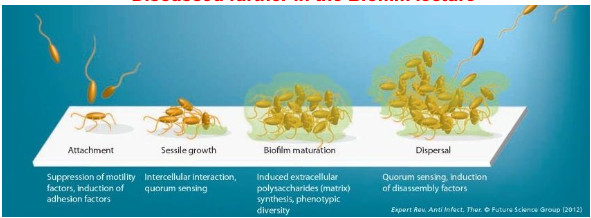
Slow down metabolism
PHENOTYPIC CHANGE
Bacterial cells in biofilm become “sessile”, or metabolically inactive – decreases drug targets available
• If a cell reverts to metabolic activity, becomes susceptible again = transient tolerance
Bacterial cells in biofilm become “sessile”, or metabolically inactive – decreases drug targets available
• If a cell reverts to metabolic activity, becomes susceptible again = transient tolerance
21
New cards
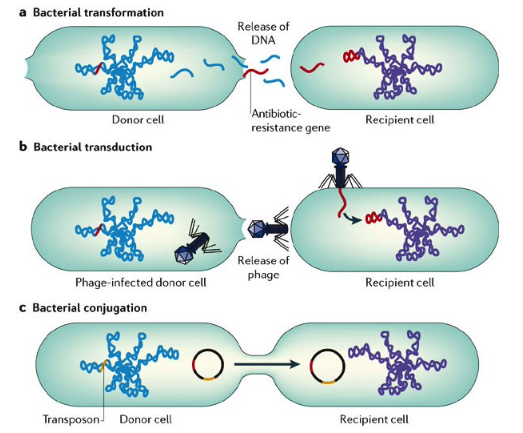
How does drug resistance develop?
Can be acquired via horizontal gene transfer: Conjugation
Transduction
Transformation
Transduction
Transformation
22
New cards
Fighting Drug Resistance
- Dummy target compounds that inactivate resistant enzymes
- Alter antibiotic’s structure so that it sterically hinders access of modifying enzymes
- Link antibiotics together
- Alter antibiotic’s structure so that it sterically hinders access of modifying enzymes
- Link antibiotics together