W1L1: Small Molecules to Emerging Modalities -Setting the Scene
 Call Kai
 Learn
Learn Practice Test
 Spaced Repetition
 Match
Match Flashcards
 Knowt Play
1/5

There's no tags or description
Looks like no tags are added yet.
Name | Mastery | Learn | Test | Matching | Spaced | Call with Kai | Chat |
|---|
No analytics yet
Send a link to your students to track their progress
6 Terms
Traditional small molecules
Low‑molecular‑weight compounds — usually under 900 kDa, enabling membrane permeability and intracellular access.
Chemically synthesised — produced via industrial organic chemistry rather than biological systems.
Structurally simple and well‑defined — allowing precise optimisation of solubility, stability, and target binding.
Interact with specific targets — typically enzymes, receptors, ion channels; act as inhibitors, agonists, antagonists, or modulators.
Orally bioavailability preferred — most can be formulated as tablets/capsules due to good permeability and stability.

Where do drugs come from?
From natural products – plants and animals
Serendipity (“by accident”)
By changing the structure of an existing molecule (structure-activity relationships)
Adapting an existing drug for a new therapy
By computer-aided design
By studying disease processes

Limitations with drug target interactions
Undruggable targets — many proteins lack suitable binding pockets.
Intracellular complexity hinders drug interaction— scaffolding proteins, protein-protein interactions, transcription factors.
Limitations with disease pathways
Genetic drivers of disease - binding a protein cannot fix a defective gene
Non-selective target – binding a protein leads to off-target effects
Disease complexity – binding one target does not fix a multi-factorial disease e.g. cancer, autoimmunity
Resistance – mutations in binding sites or compensatory mechanisms reduce drug efficacy
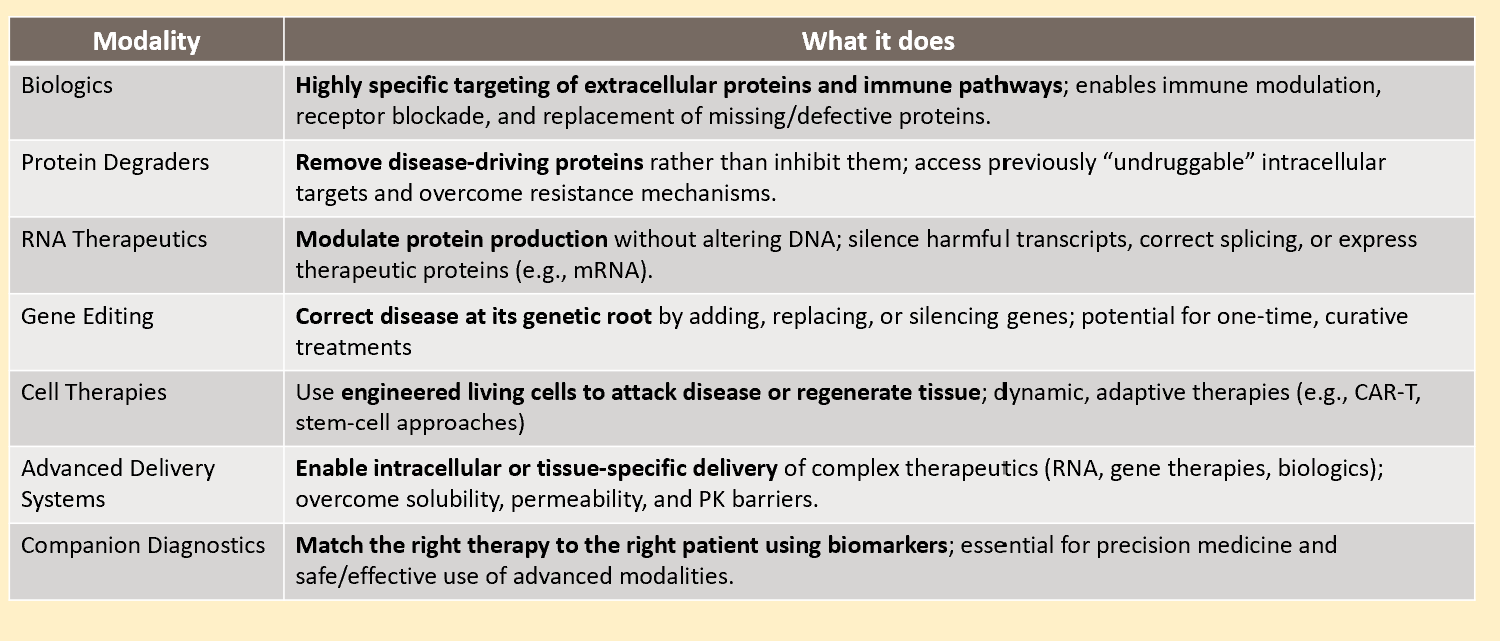
Emerging modalities
Emerging modalities are therapeutic platforms that act beyond classical binding, using molecular engineering to edit, silence, replace, degrade, or reprogram biological systems supported by specialised delivery systems and companion diagnostics to achieve effects that traditional drugs cannot.
Why is ozempic recombinant
Ozempic contains semaglutide, a GLP-1 receptor agonist. It is a peptide medication that mimics the action of the natural hormone GLP-1 (glucagon-like peptide-1), which is released from the gut after eating and helps regulate blood glucose, appetite, and insulin secretion.
It is considered recombinant because semaglutide is manufactured using recombinant DNA technology. Scientists genetically engineer yeast cells to produce a precursor of the peptide, which is then purified and chemically modified to create the final semaglutide molecule.
These structural modifications extend its duration of action allowing once-weekly administration.