biochemical tests
 Call Kai
 Learn
 Practice Test
 Spaced Repetition
 Match
 Flashcards
 Knowt Play
1/14

There's no tags or description
Looks like no tags are added yet.
15 Terms
O/F
purpose
ingredients/reagents
results interpretation
purpose: determine if organism is oxidizer or fermenter or neither, differentiates GN NF strict aerobe from other bact
ingredients: 1% glucose, peptones, bromothymol blue indicator, semi-solid agar, mineral oil
2 tubes both innoculated with bacteria, one topped with mineral oil (anaerobic condition tube). if both tubes yellow = fermenter,
open tube top yellow, bottom green; closed is green = oxidizer
both tubes yellow = fermenter
both tubes green = neither
if tube is blue it means organism used peptones
principle behind lactose fermentation
lactose = glucose + galactose
need 2 enzymes for galactose: beta galactosidase permease and beta galactosidase.
permease permits galactose to enter cell
beta galactosidase is responsible for breaking it down
if have both = LF
if have only pemease = NLF
if have beta galactosidase only = LLF (will mutate to let it in)
if neither = NLF
ONPG Test
purpose
ingredients
result interpretation
purpose: differentiate LLF from NLF by detecting beta-galactosidase activity in organisms with little to no permease.
ingredients: o-nitrophenyl and galactose (in disc form)
o-nitrophenyl is small so doesn't need permease to enter cell.
if beta-galactosidase enzyme present, yellow colour will be produced (due to O-nitrophenyl complex) = LLF
if clear = NLF
TSI test
purpose
ingredients
test interpretation
1. can organism breakdown glucose and sucrose/lactose
2. gas production
3. H2S formation
ingredients: peptones, 0.1% glucose, 1% sucrose, 1% lactose, phenol red indicator
Na thiosulphate in media provides sulfur, will be broken down into H2S by organism (if able). H2S reacts with ferrous sulfate to produce ferrous sulfide (black precipitate) --> favours anaerobic condition
gas production detected via bubbles, cracks, or lifting of media
sugar breakdown: if can break down glucose all tubes will turn yellow initially. if can not break down other sugars, will use peptones on surface (NA/A result = pink/yellow).
if can use other sugars (A/A result = yellow/yellow)
if cant ferment = NA/No change
MRVP test (mixed acid vs 2,3 butanediol)
purpose
ingredients/reagents
result interpretation
purpose: to determine which fermentation pathway organism uses, mixed acid or butanediol.
aliquot 2 tubes one for MR , second for VP
MR does not require reagents bc strong Acid production overcomes broth's buffering ability
--> add phenol red indicator, if red = positive
VP requires reagents:
6 drops 5% alpha Naphthol, 2 drops KOH, shake for oxygenation, --> if red = positive
theory: pathway produces acetoin which produces diacetyl when oxidized that reacts with KOH and naphthol for red complex
Decarboxylation Test
purpose
ingredients/reagents
result interpretation
purpose: see if organism has decarboxylase enzyme for lysine or ornithine
ingredients: bromocresol purple indicator, amino acid (lysine/ornithine), glucose, and mineral oil
amino acids will initially ferment glucose, produces acidic environment, turns tube yellow.
if organism has the enzymes will try to neutralize environment pH and will release them. turns tube purple and turbid
why is the control tube important in decarboxylase test
shows whether the organism is glucose fermenter which is needed to produce an acidic environment. decarboxylase enzymes only released in acidic environments
XXXXXXXXXXXXXXXXXXXXXXXXXXXXXXXXXXXXXXXXXXXXXXXXXXXXXXXXXXXXXXXXXXXXXXXXXXXXXX
arginine dihydrolase test
purpose
inregredients
result interpretation
purpose: detect if organism has ability to break down arginine
ingredients: bromocresol purple, glucose, arginine (amino acid)
arginine broken down by arginine dihydrolase into citrulline, ammonia, inorganic phosphate.
citrulline broken down by ureidase into ornithine and other alkaline products
key enzymes: arginine dihydrolase, ureidase
will turn yellow before purple like decarb, also 3 tubes
purple = positive , yellow = negative
phenylalinine deaminase test (PPD/PPA)
purpose
ingredients
result interpretation
purpose: detect whether orgnanism can make phenylalanine deanimase enzyme as source of carbon/energy
ingredients: NaCl, 10% ferric chloride (reagent), L-phenylalanine, agar
if phenylalanine deanimase enzyme present, will break down phenylalanine into phenylpyruvic acid and ammonia
add the 10% ferric chloride
it will react with phenyl pyruvic acid (if its present) and turn green --> positive result
if yellow --> negative as it wasnt able to break down phenylalanine
Citrate Utilization Test
purpose
ingredients
result interpretation
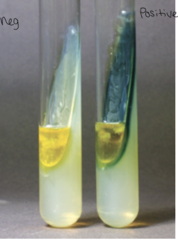
purpose: is the organism able to use citrate as sole source of energy in presence of oxygen
ingredients: sodium citrate, ammonium salts (source of nitrogen), bromothymol blue indicator
breaking down citrate results in ammonia so alkaline.
NH3 enhances the development of blue colour because its also alkaline. therefore positive = growth and blue, negative = green no growth)
note* doesnt have to change colour, main thing is growth
Gelatin Test
purpose
ingredients
result interpretation
determine if organism has gelatinase enzyme
ingredients: peptone-peptic digest of beef extract, gelatin
stab to innoculate
if has enzyme it will hydrolyze it into smaller amino acids that can be used by the organism. if the gelatin is broken down it will no longer solidify. check everyday for liquification.
immerse in ice bath to confirm media is liquid
Indole test
purpose
ingredients
result interpretation
to see if organism can be tryptophanase enzyme
ingredient: peptone digest (contains tryptophan)
tryptophan broke down by tryptophanase into indole, pyruvic acid, ammonia.
add kovac's reagent which contains paradimethyaminolbenzaldehyde which reacts with indole to produce a red ring
red ring = positive, colourless ring = negative
Sim test
purpose
ingredients
result interpretation
purpose: indole test, motility test, H2S test
ingredients: tryptophan, semi-solid agar, sodium thiosulphate, ferrous sulfate
stab innoculum into tube
read motility results first: if turbid = motile, else non motile
then add kovacs reagent which contains: paradimethylaminobenzaldehyde
and read indole.
nitrate reduction
purpose
ingredients
test interpretation
to detect if organism can break down nitrate using nitrate reductase enzyme
ingredients: peptones, potassium nitrate (nitrate source), durham tube.
reagents: dimethyl alpha napthylamine & sulfanillic acid, zinc dust
interpreting results:
after incubation.
if gas bubble present and non-fermenter --> positive for nitrate reduction
if no gas add reagents dimethyl alpha napthylamine and sulfanillic acid. --> if red then positive
now add zinc dust --> if red then NEGATIVE, if colourless then positive
urea test
to see if organism can break down urea using urease enzyme
. christensens media is most common
ingredients:
urea
glucose
peptone
phenol red
if urease present it breaks down urea to ammonium carbonate and releases ammonia and co2, all alkaline products --> alkaline shift. positive = pink/red/fuchia, negative = orange