Lab Study Guide
 Call Kai
 Learn
 Practice Test
 Spaced Repetition
 Match
 Flashcards
 Knowt Play
1/29

There's no tags or description
Looks like no tags are added yet.
30 Terms
2CoCl2*6H2O + 2NH4Cl + 8NH3 + H2O2 → 2[Co(NH3)5Cl]Cl2 + 14H2O
This is a redox-reduction reaction. What is being reduced?
The H2O2 is the oxidizing agent that is being reduced.
- reaction side = -1 ox state
- product side = -2 ox state
The cobalt is being oxidized from +2 to +3
2CoCl2*6H2O + 2NH4Cl + 8NH3 + H2O2 → 2[Co(NH3)5Cl]Cl2 + 14H2O
Could the redox-reduction reaction be performed in pure water with no NH3?
No, the Ecell potential is -0.07 eV. The negative cell potential implies Gibbs Free energy is positive, and the reaction is non-spontaneous.
- Ecell = Ered + Eox
2CoCl2*6H2O + 2NH4Cl + 8NH3 + H2O2 → 2[Co(NH3)5Cl]Cl2 + 14H2O
In aqueous NH3 _______.
the cell potential is positive, meaning it’s a spontaneous process
2CoCl2*6H2O + 2NH4Cl + 8NH3 + H2O2 → 2[Co(NH3)5Cl]Cl2 + 14H2O
The combination of NH4Cl and NH3 form what type of aqueous solution?
Forms a buffered solution
- What happens if it becomes too acidic? Protons will complete with Cobalt ion forming NH4Cl
- What happens if it becomes too basic? Too much OH- present → will complete with NH3 and form Co(OH)3 → high insoluble and will remove Cobalt(III) from reaction medium
For the synthesis of the [Co(NH3)5Cl]Cl2, the following reagents were added in this order: ammonia to dissolve the NH4Cl, and 30% H2O2 followed by the 12M HCl. What is the significance of this order of the reagents?
1. The NH4Cl dissolving in the 15 M NH3 creates a buffer. It ensures an optimal pH for the binding of the NH3 ligand to the cobalt ion.
2. 30% H2O2 oxidizes the cobalt ion in the coordination complex from Co2+ to Co3+. Adding the H2O2 after the binding of ammonia to the cobalt ion increases the oxidation potential, as the new complex wants to lose another electron more readily, thus allowing the oxidation of the cobalt ion to occur.
3. 12M HCl is added last, as it neutralizes any remaining excess ammonia and drives the substitution of the chloro ligand
What were the different reaction conditions for [Co(NH3)5Cl]Cl2 and their relevance to the final product?
Temperature of 80-85℃ for 25 minutes in a water bath and then was cooled to room temperature for filtration
- Due to the reaction mixture being heated, the Cl- ion is able to displace the weakly bound water molecule from the complex. This locks the chloro ligand inside the complex to form the final product.
For the synthesis of the cobalt complexes what is the role of the 30% H2O2?
Acts as an oxidizing agent to oxidize cobalt from the +2 oxidation state to the +3 oxidation state
What is the white vapor formed when the concentrated HCl is added to the reaction mixture containing ammonia?
Ammonium Chloride
For the filtration washes, why are the distilled water, ethanol, and acetone kept ice cold?
To minimize product loss due to the dissolution due to the washing steps, as [Co(NH3)5Cl]Cl2 is slightly soluble in water at room temperature.
Why is [Co(NH3)5Cl]Cl2 specifically washed with water, then ethanol, and finally acetone?
1. Ice-cold water removes water-soluble ionic impurities (like excess NH4Cl and HCl)
2. Ethanol removes residual water.
3. Acetone removes residual ethanol and evaporates very quickly under vacuum due to its high volatility, helping dry the product faster.
Point group of the cation in [Co(NH3)5Cl]Cl2 and [Co(NH3)5H2O]Cl3
C4v
What were the different reaction conditions for [Co(NH3)5H2O]Cl3 and their relevance to the final product?
- The reaction occurred at room temperature during the aspiration of the excess ammonia.
- The reaction mixture was cooled in an ice bath before and after the addition of 12M HCl.
- The complex is heat sensitive. The lower temperature ensures the water molecule remains in the coordination sphere. Cooling the reaction mixture in the ice bath reduces the heat generated by the reaction with the 12M HCl. Maintaining a lower temperature ensures the correct final product.
Differences in the Synthesis of [Co(NH3)5H2O]Cl3 compared to [Co(NH3)5Cl]Cl2?
1. Temperature is lower
2. Order of addition of HCl (added after excess NH3 is aspirated is removed from reaction mixture and cooled)
3. Quantities of reactants are slightly different
4. Water is used as a reactant
5. No aqueous washing step in the work-up
When two products are possible in a chemical reaction, one is ________.
considered kinetic and the other is thermodynamic
- The kinetic product is the one that forms the fastest, while the thermodynamic product is the more stable product.
Which complex is the thermodynamic product?
[Co(NH3)5Cl]Cl2
It withstood the heating process and is considered more stable than [Co(NH3)5H2O]Cl3
Which complex is the kinetic product?
[Co(NH3)5H2O]Cl3
It formed rapidly at room temperature without heating → has a lower energy of activation
Why was a greater amount of 12M HCl used for the synthesis of the pentaammineaquacobalt(lll) chloride compared to the pentaamminechlorocobalt(III) chloride?
- pentaammineaquacobalt(III) chloride = the charge of the inner coordination sphere is 3+. To balance out the charge, it requires three chloride counter ions. This means the reaction will consume more chloride. Highly soluble in water → requires a greater volume of 12M HCl to force the complex to precipitate out of the solution. A greater volume of HCl can also neutralize the remaining residual ammonia.
- pentaamminechlorocobalt(III) chloride = only requires two chloride counter ions to balance the charge.
For the pentaammineaquacobalt(III) chloride, why was there aqueous wash?
Highly soluble in water and would cause a significant loss of product
The limiting reagent of the cobalt complexes
CoCl2*6H2O
For the pentaammineaquacobalt(lll) chloride, why must the excess NH3 be aspirated?
- Excess NH3 may react with the HCl, forming NH4Cl and contaminating the product.
- Excess NH3 keeps the pH basic → high concentration of OH- ions → strong ligands that compete with water, leading to the formation of [Co(NH3)5(OH)]2+. This results in an unwanted product.
For the molar conductivity investigation, what was the purpose of the experimental set-up (3 test tubes and the water bath)?
two tubes containing the solution of interest were placed on clamps outside of the water bath to rinse the conductance cell with the solution before a measurement is taken → washes away any contaminants that could affect our “main sample”.
The third tube in the 25℃ water bath holds the “main sample” that the conductance will be recorded from → placed into the water bath because electrical conductivity is sensitive to temperature variations → inaccurate results. Thermally equilibrating the sample in the third tube ensures a stable and uniform temperature in the solution.
These factors are important for an accurate conductance measurement.
For the molar conductivity investigation, what was the purpose of the preparation of the cobalt complex solutions?
Samples of the cobalt complexes are diluted in a 250 mL volumetric flask to create a 0.00100M solution.
Electrical conductance relies on the movement of free ions. In the solid forms of the cobalt complexes, the ions in the coordination complex are locked and cannot move.
By dissolving the cobalt solids in a liquid solvent, the complex will dissociate into free-moving cations and anions that will migrate to the conductance probe and generate an electrical current.
Why was the conductance reading of the 0.00100M KCl recorded first and how does it connect to determining the electrolyte type of each cobalt complex?
The rinses and conductance reading of the 0.00100M KCl is performed first as the solution serves as the calibration standard. At 25℃, this solution has a specific recorded conductance value of 1.469 x 10⁻⁴ cm-1Ω-1.
With our experimental conductance value of the 0.00100M KCl solution, we can calculate the cell constant, which helps account for differences between the experimental and standard conductance. It’s also required for the molar conductivity calculations of the cobalt complexes.
Lastly, comparing the calculated molar conductivity values to the standard reference ranges allows us to identify their electrolyte type.
What does the electrolyte type of a coordination compound reveal about the n-coordinate geometry of the cobalt coordination complexes?
The electrolyte type is the ratio of cations to anions in a solution. It tells us the number of ions a compound dissociates into, which correlates to the number of ligands inside the coordination sphere and the outside counterions.
pentaamminechlorocobalt(III) chloride = a 1:2 electrolyte type. Based on this, we know that it has one cation (cobalt and ligands in square brackets) and the two chloride counterions as the anions. By counting the number of ligands within the inner coordination sphere bound to the cobalt, we can determine the n-coordination geometry. It will be 6-coordinate, which means it has an octahedral geometry.
pentaammineaquacobalt(lll) chloride = electrolyte type is 1:3, meaning it has one cation and 3 chloride counterions as the anions. The complex is also 6-coordinate, meaning that it will be octahedral.
CoCl2*6H2O = electrolyte type is 1:2 and is 6-coordinate and will be octahedral
Electrolytic solutions
Aqueous solution that involve ionic compounds → dissolve in water and conduct electricity
why molar conductivity experiment works for cobalt complexes

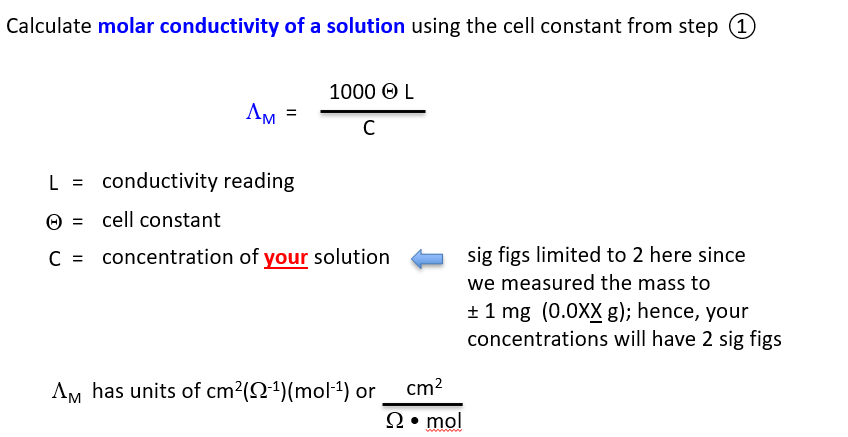
Order of Calculations for molar conductivity experiment
Record conductance values to 10-6 mho for all of the prepared solutions including the calibration standard
Using the conductance reading of the KCl solution, calculate the cell constant. (units = cm-1)
Calculate molar conductivity, AM of the solutions using the cell constant and recorded conductance of each coordination compounds
Compare the experimental molar conductivity values with the standard electrolyte type ranges.
How does molar conductivity distinguish between ions inside versus outside the coordination sphere?
Ligands bonded directly to the metal center aka inside coordination sphere do not dissociate in water and do not carry charge independently.
Counterions outside the coordination sphere dissociate completely in solution and contribute directly to the measured conductance.
For the molar conductivity experiment, why were the solutions prepared at a low concentration, 0.00100M?
Interionic attractions (ion pairing) are minimized, allowing the ions to move independently so the measured molar conductivity approaches its limiting value
For the Spectrophotometric Determination of Cobalt, why do we burn our compounds?