Benign & Malignant Tumors
 Call Kai
 Learn
Learn Practice Test
 Spaced Repetition
 Match
Match Flashcards
 Knowt Play
1/23

Earn XP
Description and Tags
Includes cancer cell characteristics
Name | Mastery | Learn | Test | Matching | Spaced | Call with Kai | Chat |
|---|
No analytics yet
Send a link to your students to track their progress
24 Terms
What are the two process required for normal cell renewal and repair to take place?
Cell proliferation - replacement of old cells
Cell differentiation - cells getting the characteristics of the tissues they make up
What is a neoplasm?
A neoplasm is a new growth that can lead to a tumor
What are some characteristics Benign tumors have regarding growth and differentiated cells?
For benign tumors, growth is usually slow and they are made up of well-differentiated cells
Do benign tumors invade beyond their capsule?
No, benign tumors do not invade beyond their capsule
Do benign tumors metastasize?
No, benign tumors do not metastasize (spread to other parts)
How are benign tumors named? What is an example of this?
Benign tumors are named from the tissues they originate from, ending with “oma”
Ex: lipoma - benign tumor for fat cells
What are some characteristics Malignant tumors have regarding growth and differentiated cells?
Malignant tumors have a rapid growth rate and loss of differentiation of cells (anaplasia). Cells are also pleomorphic (different shapes and sizes)
Do malignant tumors invade beyond their capsules?
Yes, malignant tumors do
Do malignant tumors metastasize?
Yes, malignant tumors metastasize
How are malignant tumors named?
Malignant tumors are named from which tissues they originate from, with the ending carcinoma for epithelial tissue, or sarcoma for bone, muscle or tissue
What are some specialized names for malignant tumors?
Specialized names for malignant tumors include lymphomas from lymphatic tissue and leukemia from blood cells
What is an example of a malignant tumor name?
Adenocarcinomas from glandular tissue
What are the two categories of tumors?
Solid tumors
Hematologic tumors (found in blood/lymph)
What is the most common type of cancer among adult humans?
90% of adult human cancers are from carcinomas of epithelial tissue
What does Carcinoma in Situ mean?
Carcinoma in Situ refers to a growth with malignant characteristics in the epithelial tissue that has not invaded local tissue

What is genetic instability?
Genetic instability is when there is a high frequency of mutations in cancer cells
How can cells becoming independent of external growth signals lead to cancer?
Cells simply are able to grow independently, or they are extremely sensitive to growth factors so they will respond to low levels (a type of breast cancer has more receptors on the cell surface, so response to growth factor is increased)
How does contact inhibition differ between normal cells and cancer cells?
Normal cells would stop growing when they come into contact with each other such as in wound healing, but cancer cells keep pilling on top of each other
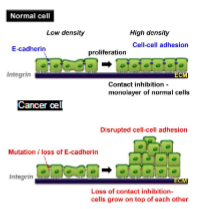
How does cell adhesion differ between normal cells and cancer cells?
Normal cells have membrane structures that allows them to stick together
Cancer cells have less of these, leading them to be easily shed from a tumor, increasing metastasis
How does anchorage dependence differ between normal cells and cancer cells?
Normal cells are anchorage dependent, meaning they need to attach to a surface or extracellular matrix to survive
Cancer cells are anchorage independent, meaning that they can survive and grow under conditions normal cells can’t
What do cancer cells produce that normal cells do not?
Cancer cells can make unusual antigens that normal cells don’t normally make, and can be used as tumor markers
How can cancer cells divide without limit?
Cancer cells can divide without limit due to an enzyme they have called telomerase, which lengthens the telomere

Why do cancer cells use anaerobic respiration?
Cancer cells use anaerobic respiration to support rapid growth. Even though it yields less ATP, the lactic acid can be used to synthesize other molecules for rapid growth
How can anaerobic respiration be used as a tool to detect cancers?
Through the use of a fluorescent compound that accumulates in cells that would take up a lot of glucose
