Special Populations Quiz
 Call Kai
 Learn
 Practice Test
 Spaced Repetition
 Match
 Flashcards
 Knowt Play
1/128

There's no tags or description
Looks like no tags are added yet.
129 Terms
Internalizing
Emotional difficulties that children tend to take out on themselves
What are the 3 components of experiencing emotion?
Private ‘feelings’ - our own subjective experience of the emotion
Bodily reactions and autonomic nervous system arousal (e.g. heart rate increases, start to sweat)
Overt behavioural expressions - anything that a third party would be able to see in the individual (e.g. tapping their foot, shaking)
What is the purpose of anxiety (from an evolutionary perspective)?
The purpose of anxiety is to keep us safe. It makes us alert to possible threats which would have helped us in some area a long time course ago in our evolution.
Emotional reactivity
Excitability of behavioural and physiological systems
How easily and how quickly does your thermometer fill up to the extent that you are feeling an emotion?
How quickly do you get sad, happy, anxious?
Self-regulation
Neural and behavioural processes functioning to modulate underlying reactivity
The extent to which we are able to bring our thermometer back down to baseline
If we’re feeling extremely anxious, how able are we to regulate through that emotion and bring our thermometer back down?
Emotion regulation
Involves monitoring, moderating, and enduring emotions
What is the approach tactic in the context of emotion regulation?
Being able to express and accept your emotions
What is cognitive re-appraisal?
Reframing a situation (e.g. a child may have been scared of walking in the woods but now they’re reframing it to be an adventure, or something exciting)
What do we notice about emotional regulation as children get older?
Individual differences become more apparent
Although everyone moves up in their abilities, some children develop more quickly when it comes to emotional regulation, whereas some children move a lot slower
Distress tolerance
The capacity to withstand negative emotional states and/or other aversive states (e.g. uncertainty)
What are the 2 components of distress tolerance?
Perceived capacity - one’s belief in their ability to endure distress
Behavioural capacity - one’s actual responses to distress
Anxiety
An emotion characterized by elevated apprehension, unease, and lack of control
Typically forward oriented and occurring when outcome is uncertain
Sometimes we feel anxious about things that happen in the past (somewhat forward oriented in that we are thinking about an outcome that is uncertain)
Worry
Thoughts about possible negative outcomes that are intrusive and difficult to control
Falls underneath the umbrella of anxiety → it is a cognition that commonly happens within anxiety
Worry is more commonly experienced by which gender?
Girls
Fear
A reaction to an immediate or present threat (an alarm reaction)
You can start to feel fear as a result of worrying too much
Fear is more commonly experienced by which gender?
Girls (as a result, girls are more commonly diagnosed with anxiety disorders)
Tripartite Model of Anxiety
Anxiety consists of three different areas:
Cognition
Behaviour
Physiology
What signs tell us that anxiety is no longer typical or adaptive in an individual?
It is more intense than is necessary for the given situation
It lasts for a longer duration than is necessary
It is more pervasive over time and situations
What is the most frequently diagnosed category of psychopathology across all age groups?
Anxiety disorders
Does the prevalence of anxiety disorders differ across racial and ethnic backgrounds?
No, prevalence is similar across racial and ethnic backgrounds
What are the implications for children or teenagers who meet the criteria for multiple disorders?
They tend to experience more severe symptoms and have more psychosocial risk factors
What are 4 examples of expressions of anxiety in children?
Crying
Freezing
Tantrums
Clinging
Homotypic continuity
A disorder that is identified early persists as the same disorder (e.g. what starts as separation anxiety stays as separation anxiety)
Heterotypic continuity
Underlying similarity between early and later diagnoses despite differences in emotion, cognition, and behaviour over time (e.g. what starts as one disorder eventually, as the child grows up, turns into a different disorder)
Separation anxiety
Anxiety regarding separation from a major attachment figure and/or home
How does separation anxiety differ in children compared to teens?
For children, they are often worried about the wellbeing of their caregiver, as well as the possible harm that could come to either themself or the caregiver when they are separated
For older children and teens, the worry and anxiety tends to be more surrounding the fear of being away from home rather than the caregiver themselves
Can separation anxiety continue into adulthood?
Yes, however, the symptoms might not be picked up on because they’re more socially appropriate
What does treatment for separation anxiety look like?
Relaxation exercises employed during separation (taught to use self-talk)
Fears about separation are challenged
Frequency and duration of separation increased over time
How can parents help in the treatment of separation anxiety?
Parents can model non-anxious reactions and reinforce non-anxious behaviour
Important that the parent doesn’t give in to the child’s wants just because they’re displaying distress
Kendall et al. randomized controlled trial
Individualized and family-based CBT showed more improvement than education and support alone
Treatment is CBT
Control/placebo is education and support alone
Selective mutism
Persistent failure to speak in specific social settings, but freely in others
Usually they will speak around close family and those they are comfortable with
How are social anxiety and selective mutism related?
Selective mutism is a very extreme form of social anxiety
What 2 pieces of evidence suggest that selective mutism is an extreme manifestation of social anxiety?
Of all the kids with selective mutism, about 90-100% meet the criteria for social anxiety
For kids who have selective mutism, their social anxiety symptoms are more severe than kids who have social anxiety but don’t have selective mutism
How are phobias and social anxiety related?
Social anxiety falls under the overarching category of phobias
In the DSM , social anxiety is also referred to as social phobia
Social anxiety
Persistent fear of acting in an embarrassing or humiliating way in social or performance situations
Why do adolescents tend to care so much about what other people think?
When we become adolescents, we suddenly are able to understand other people’s thoughts and intentions
How does anxiety get passed down through families?
Could be the case that it’s just simply genetics
Could also be the case that shared environment plays a role
Is anxiety a trait that gets passed down?
Not necessarily, it may not be anxiety that gets passed on through genetics or being close to each other, but rather a tendency for high reactivity, especially physiological reactivity
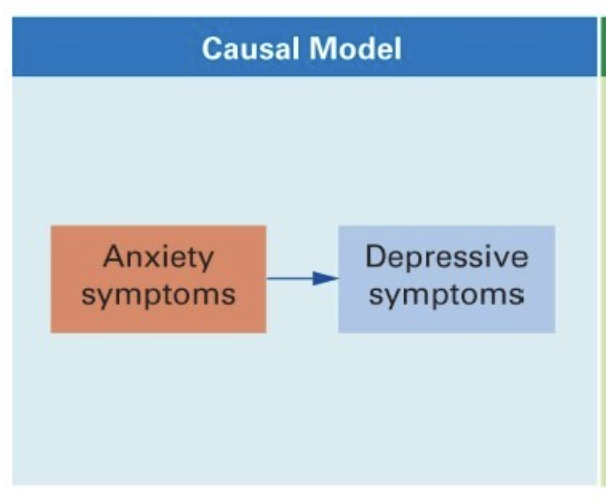
Causal model of depression and anxiety
Anxiety symptoms cause depressive states
Being unable to emotionally deal with the adversity in our lives causes us to feel depressed
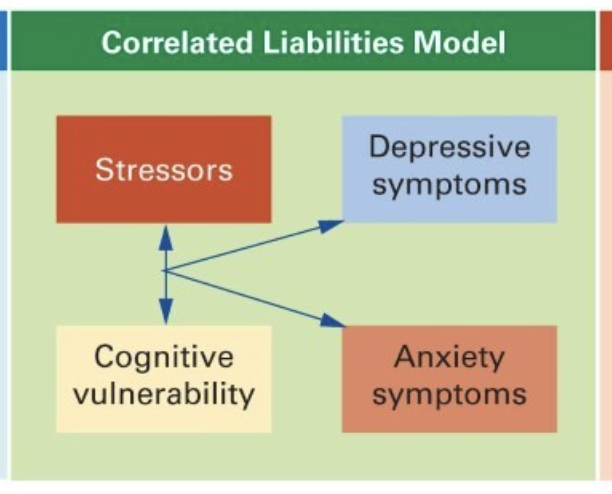
Correlated liabilities model of depression and anxiety
Stressors and cognitive vulnerability both play a role in developing depressive symptoms as well as anxiety symptoms
Stressors are environmental adversity
Cognitive vulnerability is things like being more prone to being self-critical or rumination
Diathesis-anxiety model of depression and anxiety
If high anxiety symptoms are experienced alongside cognitive vulnerabilities then that can cause the emergence of depressive symptoms

Sympathetic nervous system
The “fight or flight” system
Autonomic nervous system
Includes the parasympathetic and sympathetic nervous system
Research on perceptual sensitivity to threat
When two pictures of people show up on a screen in front of people who are prone to anxiety vs. people who aren’t prone to anxiety, the people prone to anxiety tend to be more biased to angry faces when compared to neutral faces, as well as angry faces when compared to happy faces
They are drawn to information in their environment that signals a potential threat, in this case, social threat
In children and adults who are shy, where do they tend to fixate when scanning new faces?
On average, the scanning tends to emerge around the eyes and the mouth
The eyes are important when we think about what is potentially threatening in the environment and they are also a good signal of emotion
What are the ways that children learn to be anxious in Rachman’s three pathway theory?
Classical conditioning
Modeling
Verbal transmission
How can children learn to be anxious through classical conditioning?
How can children learn to be anxious through modeling?
By looking at role models, particularly caregivers, and what they are afraid of and modelling off of that behaviour
How can children learn to be anxious through verbal transmission?
When caregivers or role models tell the child what to be worried about, that will probably stick with the child for a long time
How can over protective parenting of an anxious child be a vicious cycle?
If a parent has an anxious child, they’re more likely to engage in over protective parenting → the more overprotective parenting they engage in, the more anxious the child can end up being
Unipolar disorders
Always in reference to depressive disorders
Bipolar disorders
When there is mania or hypomania
How can negative emotions be helpful for children and teens?
Negative emotions help children and teens acquire coping strategies
What trend do we see in positive affect of girls and boys between the ages of 9 - 17?
Positive affect generally decreases
What trend do we see in negative affect of girls and boys between the ages of 9 - 17?
Negative affect generally decreases around age 11 but it increases again into the teenage years, and then around age 17, it starts to level out
Depression prevalence among boys and girls under 12
Under the age of 12, boys and girls show about the same prevalence of depression
Depression prevalence among boys and girls in the teen years
Girls outnumber boys at a 2:1 ratio
What symptom can replace ‘depressed mood’ for children and adolescents in the DSM?
Irritability
When is depression seen in infants?
Most commonly seen when an infants has been separated from their primary care giver for an extended period of time (with a lack of another caregiver present)
Or, the infant might have a mother who is experiencing depression
At what age does self-awareness develop?
Around 18 months old
What is the rouge test and what does it assess?
In the rouge test, the researcher puts a red (or different colour) dot on the baby/toddler’s face and they have them look in the mirror. Then they instruct them to touch the dot
If the baby is under 18 months old, they will likely touch the dot where they see it (in the mirror)
When they reach about 18 months, they start to understand that the dot may not be where they see it and they have an understanding of where they fit into the world. Therefore, they understand how to touch the dot where it actually is
The rouge test assesses self-awareness
What is the shopping cart study and what does it assess?
Children are instructed to push a shopping cart, but there is a mat attached to the cart that will prevent it from moving when the child is standing on it
Under 18 month-olds don’t have a sense of self so they don’t understand that they need to step off the mat to make the shopping cart move
Around 18 months, children understand that they must step off the mat
The shopping cart study assesses self-awareness
At what age does theory of mind develop?
Around 4 - 5 years old
What is the Sally Anne test and what does it assess?
Sally puts a ball in a basket and walks away. Then Anne moves the ball to her box. When Sally comes back, where will she look for her ball?
It assesses theory of mind
At what age do children develop the ability to envision others’ perspectives?
Around 8 years old
At what age are tantrums most common and in what environment are they most likely to happen?
Most common at age 3
Most likely to happen in the home environment
What factors do we consider when determining whether a child’s tantrums are atypical?
Frequency - more than 5 per week is considered concerning
Intensity - how intense the tantrum is and how long it lasts
Timing - it makes sense that a child is a having a tantrum after a big fight
Destructiveness - a more typical tantrum involves crying, stamping, and flailing (non-destructive). A destructive tantrum involves aggression towards others or oneself or breaking things
How long does it take and how hard is it for the child to recover
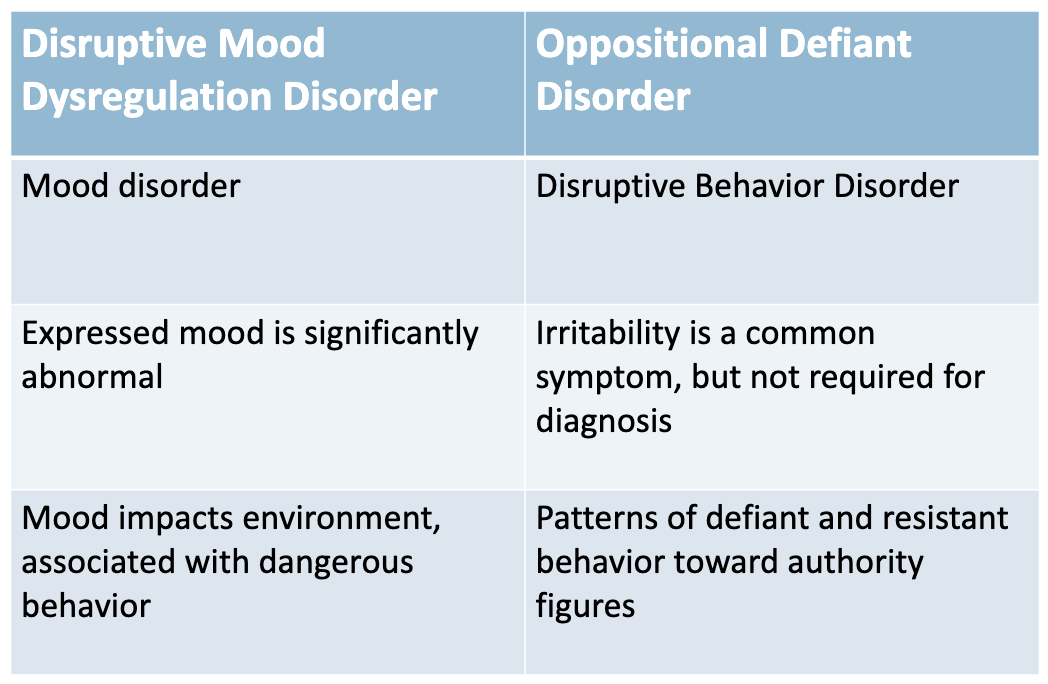
DMDD
Disruptive mood dysregulation disorder
Involves extremely frequent and intense outbursts that look like tantrums
They are out of proportion from what is considered normal and they are caused by seemingly “normal” things (reacting out of proportion)
Angry and irritable mood present even between temper outbursts
Age of symptom onset is before age 10
What were children diagnosed with before DMDD was added to the DSM?
Bipolar
Why does DMDD resemble bipolar?
Children with DMDD struggle to regulate positive AND negative emotions, so they have extreme excitability too → resembled bipolar’s “mood swings.”
Compare and contrast DMDD and ODD
Treatment for DMDD
Exposure Therapy: slowly exposure the child to more and more frustrating situations, increasing their frustration tolerance and adaptive coping strategies
Dialectical Behaviour Therapy (DBT): cognitive and behavioural techniques plus mindfulness
Mania
When a person experiences persistently elevated and irritable mood that causes psychological dysfunction
How does bipolar look different in adults compared to children?
For adults, we tend to see that they experience euthymia (typical everyday mood) in between episodes of depression and hypomania
Children show more chronic mood dysregulation, so they don’t really have this same reprieve (i.e. feelings of euthymia)
How does mania look in children?
The child might be really goofy, really angry, and have difficulty falling asleep
How do we know if a child’s behaviour is manic or within the realm of normative development?
Use the FIND criteria:
Frequency of each behaviour
Intensity of behaviours
Number of behaviours indicating mania/hypomania present
Duration of behaviours
What are the two approaches to diagnosing bipolar in children?
Conservative approach
Manic episodes must be distinct from usual behaviour
Agreement for this across informants
ADHD symptoms must not be used for mania diagnosis
Irritability must not be ‘borrowed’ from other comorbid conditions
Liberal approach
Episodic nature given less weight
Any informant can identify manic symptoms
Symptoms from comorbid conditions should be included
What is the most common anxiety disorder among adolescents?
Generalized anxiety disorder
How does generalized anxiety disorder change as children get older?
Intensity and number of symptoms increase
Fears and worries become more complex
Increases in somatic symptoms
Which group experiences the highest prevalence of social anxiety disorder?
Asian adolescents (higher than white and black adolescents)
What is the prevalence of selective mutism?
Less than 1% of children
Is selective mutism more prevalent in girls or boys or is it the same?
It affects girls and boys to the same degree
How are episodes in major depressive disorder different in children compared to adults?
In children, recovery from episodes is faster and they have higher rates of episode recurrence
What is the most frequently diagnosed mood disorder among children and adults?
Major depressive disorder
Is bipolar more prevalent in boys, girls, or equal?
Equal
What is the peak period of onset of bipolar?
Late adolescence to early adulthood
For persistent depressive disorder to be diagnosed in children, they must have depressed mood for most of the day for more days than not for how long?
1 year or more
How do depressive disorders present in younger children compared to adolescents?
More depressed appearance
More somatic difficulties
More anxiety
More externalizing behaviours
How do depressive disorders present in adolescents compared to younger children?
More feelings of guilt
Hopelessness
More substance abuse
More psychotic symptoms
Neurodevelopmental disorders
Conditions with onset in the developmental period
Overarching disorder category in the DSM 5
Why are neurodevelopmental disorders more commonly diagnosed in boys?
The DSM criteria for ADHD and ASD are created around the presentation that we see in boys
A lot of the time symptoms are more obvious to mental health professionals in boys and therefore a lot of the diagnostic criteria are created around boys
Might not be as obvious in girls because girls are generally more motivated to mask symptoms and better at doing so
Even if girls are struggling a lot, they are better at hiding it
Neurodiversity
A non-medical term used to describe people who function differently than the 'typical’ population
Etiology of neurodevelopmental disorders
All neurodevelopmental disorders have relatively significant genetic components or environmental causes that are developmental in nature (environmental causes occur at very specific developmental periods)
Why wouldn’t depression or anxiety be considered neurodiversity if it’s just a different way of thinking?
If the person is experiencing distress from the disorder itself, it’s most likely we should consider it as a pathology/disorder
This is what we see in depression and anxiety
If they’re not experiencing distress from the symptoms themself and rather how the symptoms fit into the societal context, they are probably neurodivergent
Before ASD became one overarching category, how were the labels “autism” and “asperger’s” used?
If a child was viewed as high functioning in the social area, they would be more likely to be a given a disorder of asperger’s, whereas the children with more support needs were considered autistic
What are the 2 main features that we see in all people with ASD?
Persistent deficits in social communication and interaction
Restrictive, repetitive patterns of behaviour and interests
3 criteria of persistent deficits in social communication and interaction
Social-emotional reciprocity
Non-verbal communication
Social relationships
4 criteria of restrictive, repetitive patterns of behaviour and interests
Repetitive motor movements, use of objects, or speech (e.g. stimming)
Inflexible adherence to routine
Fixated interests
Hyper- or hyporeactivity to sensory input
How are fixated interests related to language skills?
The more a child exhibits fixated interests, the more likely they are to have sophisticated language skills
Overstimulation
Feeling overwhelmed by certain sensory experiences (e.g. noise, smells)