.chapter 2 - carboxylic acids and its derivatives
 Call Kai
 Learn
 Practice Test
 Spaced Repetition
 Match
 Flashcards
 Knowt Play
1/32

There's no tags or description
Looks like no tags are added yet.
33 Terms
what is the functional group of carboxylic acids?
-COOH
properties of carboxylic acids?
they are weak acids, so they only partially ionise water
they will react with carbonates to produce CO2
this can be used as a test for carboxylic acids
esterification of carboxylic acids?
carboxylic acids will react with alcohols
this reaction is called esterification, it produces an ester
usually, sulfuric acid as a catalyst for this reaction
reaction of carboxylic acids with metal oxides?
forms a salt and water
reaction of carboxylic acids with alkalis?
a salt and water
reactions of carboxylic acids with carbonates?
a salt, water and carbon dioxide
functional group of an ester?
-COO
uses of esters?
plasticisers
solvents (ethyl ethanoate)
perfumes
food flavourings (ethyl butrate, pineapple)
what is hydrolysis?
the chemical breakdown of a compound in the presence of water or in aqueous solution
what 2 things can esters be hydrolysed
by aqueous acid or alkali
acid hydrolysis?
acid hydrolysis of an ester is the reverse of esterification
the products are a carboxylic acid and an alcohol

alkaline hydrolysis?
also known as the saponification and is irreversible
if aqueous sodium hydroxide is the alkali, the salt sodium ethanoate is formed during alkaline hydrolysis

what are the products of the hydrolysis of esters?
a carboxylate salt and an alcohol
hydrolysis of polyesters?
polyesters are attacked readily by alkalines but much more slowly by acids
a polyester will react with an alkali to cut the polymer chain and produce an alcohol and a carboxylate salt as with esters
a polyester will also react with an acid to cut the polymer chain and produce an alcohol and carboxylic acids but this process is very slow
how are acyl chlorides formed?
by reacting carboxylic acids with an inorganic compound called thionyl chloride (sulfur dichloride oxide)

where can acyl chlorides be derived from?
carboxylic acids
they are also known as acid chlorides
reactants and products of acyl chlorides
acyl chlorides are produced from a reaction between SOCl2 and a carboxylic acid
hydrogen chloride and sulfur dioxide gases are produced in the reaction
how to remove excess reagents from the acyl chloride?
fractional distillation
hydrogen chloride and sulfur dioxide are given off as gases
what is a derivate of a carboxylic acid?
a compound that can be hydrolysed to form the parent carboxylic acids
carboxylic acid derivates have a common sequence of atoms in their structure, known as an acyl group
acyl group?

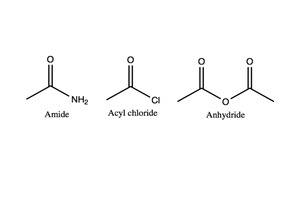
what are the 4 derivatives of carboxylic acids?
ester
acyl chlorides
acid anhydrides
amide

examples of acylated materials?
amide
acyl chlorides
anhydride
what does the nucleophilic addition-elimination reaction happen with?
acyl chlorides and acid anhydrides
it is used to produce amides, carboxylic acids, and ester
mechanism for the nucleophilic addition-elimination reaction with acid anhydrides?
this reaction can also be done with water or ammonia as a nucleophile

how is an acid anhydrides formed?
by the removal of water from 2 carboxylic acids molecules, shown in the formation of ethanoic anhydride

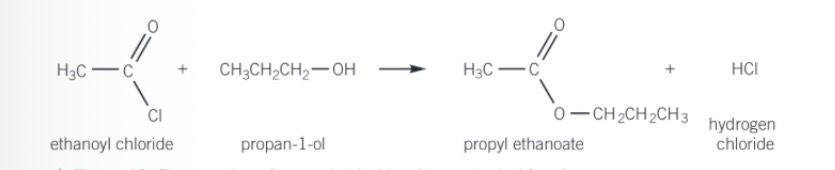
reaction of acyl chlorides with alcohols to form esters?
acyl chlorides react with alcohols to form esters
reaction of acyl chlorides with phenols to form esters?

what forms esters with phenols: carboxylic acids or acyl chlorides/acid anhydrides?
carboxylic acids are not reactive enough to form esters with phenols
acyl chlorides and acid anhydrides are both much more reactive than carboxylic acids and react with phenols to produce phenyl esters
neither reaction needs an acid catalyst
reaction of acyl chlorides with water to form carboxylic acids
formation of carboxylic acids and hydrogen chloride fumes

reaction of acyl chlorides with ammonia?
ammonia can act as a nucleophile by donating their lone pair of electrons
ammonia reacts with acyl chlorides, forming a primary amide

reaction of primary amines with acyl chlorides?
reacts in the same way as ammonia to form a secondary amide

reactions of acid anhydrides?
react in a similar way to acyl chlorides with alcohols, phenols, water, ammonia and amines
they are less reactive than acyl chlorides and used in laboratory preparations where acyl chlorides may be too reactive
equation for the formation of phenyl ethanoate from ethanoic anhydride and phenol?
ethanoic anhydride + phenol —> phenyl ethanoate + ethanoic acid
