L11 - Epithermal Au-Ag Deposits
 Call Kai
 Learn
 Practice Test
 Spaced Repetition
 Match
 Flashcards
 Knowt Play
1/32

There's no tags or description
Looks like no tags are added yet.
33 Terms
What is an example of a Epithermal Au-Ag deposit?
Waihi, Coromandel, New Zealand
What is the Au and Ag grade of the Waihi, Coromandel, New Zealand epithermal deposit?
263 t (8.5 Moz) Au
1252 t (40 Moz) Ag
What are some deposit types related to epithermal deposits?
Porphyry systems - next to the magmatic center
Skarn systems - magmatic metalliferous fluids interact with carbonates
What are the metals found in epithermal deposits?
Au, Ag and some of Hg, Cu, Pb, Zn, Sn, As
What style do epithermal deposits take?
Lode Gold Deposits
What is a Lode Gold Deposit?
a concentrated Au accumulation hosted in veins, faults, shears, or as defined zones of replacement
What are the dimensions of a Epithermal deposit?
<500 - 2000m horizontal extent
<~500m vertical extent
What are the host rocks of epithermal deposits? How might their age relate to the deposit age?
Andesite to rhyolite (basalt) volcanic rocks (typically of similar age to the deposits)
At what depth do epithermal deposits form?
<1km below the water table (shallow)
What temperature do epithermal deposits occur? What temperatures do they mainly occur?
100-320’C
mainly 170-280’C
What are the typical grades for Au and Ag in epithermal deposits?
Au = 2 to >100 ppm
Ag = 100 to >500 ppm
What tectonic environments do epithermal deposits occur?
In convergent zones
similar to porphyry deposits
Do porphyry deposits tend to be older or younger than epithermal deposits? Why?
Porphyry deposits tend to be older than epithermal deposits
Porphyry deposits are typically older b/c they need time to be exhumed and uncovered at the surface.
What is the average age of epithermal and porphyry deposits?
Epithermal ~3 Ma - shallow
Porphyry ~10 Ma - deeper
What is the spatial and fluid difference between HS and LS epithermal deposits?
HS (High S)
are more spatially associated with porphyry deposits
magmatic flu
LS (Low S)
are not always spatially associated/ more distal
meteorical water
How do pH, sulphidation fS2, and redox conditions change between HS and LS epithermal systems?
HS
pH = low/ acidic
Sulphidation fS2= high/ Iron poor
Redox = oxidized
LS
pH = neutral (~7)
Sulphidation fS2= High / Fe rich
Redox = reduced
What minerals represent more acidic and more neutral pH conditions in epithermal deposits?
Acidic = Alunite
Neutral = Adularia
What is the chemical formula for Alunite?
KAl3(SO4)2(OH)6
What is the chemical formula for Adularia?
KAlSi3O8
A type of feldspar
What sulphurs are found in HS epithermal systems?
Py
Bn
enargite-luzonite
covellite
orpiment
native sulfur
Very FeS-poor sphalerite
What sulphurs are found in HS epithermal systems?
Arsenopyrite
loellingite
Pyrrhotite
pyrite
Fe-rich sphalerite (black color)
Does HS or LS have a higher Au grade vs tonnage?
HS is smaller, but much richer in gold

What are volcanic fumaroles?
Acidic condensations and acid alterations produced by injection of magmatic fluids (vapours) rich in acid gases into shallow meteoric water.
What is the progressive alteration zones as you move away from the core of a HS system? Note the pH and indicator mineral for each zone.
Leached silicic (<2, Vuggy qtz)→
advanced argillic (2-4, qtz-alunite to Kaolinitic) →
Argillic (2-4, illite-rich) →
Propylitic (4-6, Montmorillonite-rich rock; >6, chlorite-rich)

What is an example of a HS epithermal deposit?
Lepanto HS deposit, Philippines
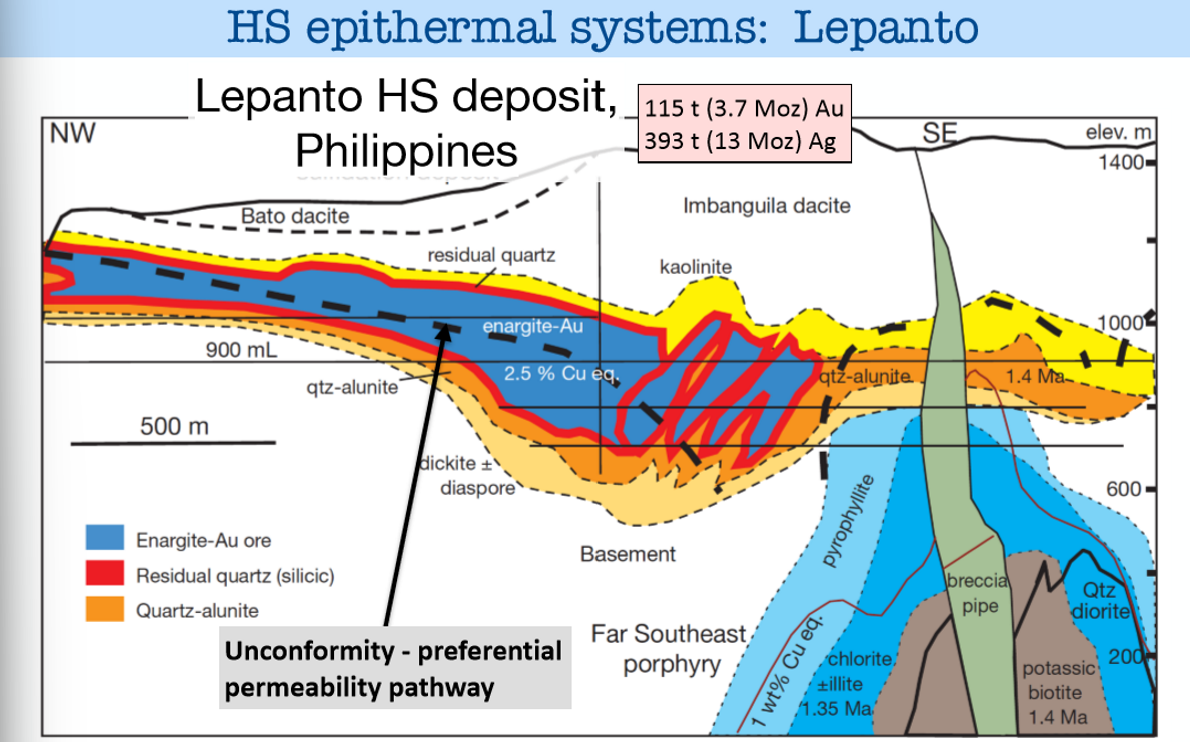
What are the Au and Ag grades of the Lepanto HS deposit, Philippines?
Au = 115 t (3.7 Moz)
Ag = 393 t (13 Moz)

What effect do pressure/depth have on supercritical fluids?
aqueous magmatic supercritical fluid forms at a shallow depth (low P) the supercritical fluid will split into 2 separate supercritical phases (vapour and liquid)
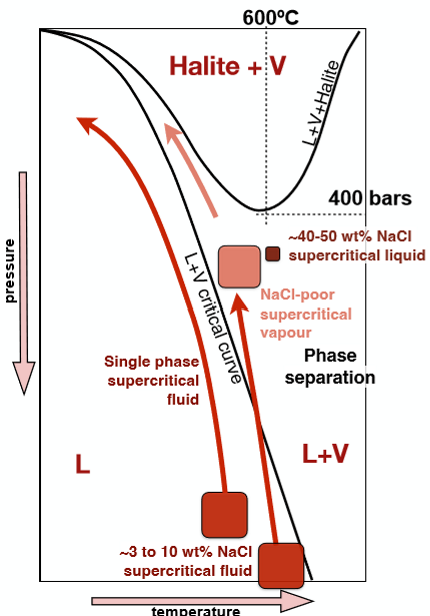
What effect does reduced pressure have on the carrying capacity of metals in the phases?
Reduced P = increased metal carrying capacity (lower density)

What is a lithocap?
A stratabound body of advanced argillic and residual (vuggy) quartz alteration
What is stage 1 of an HS epithermal system?
Stage 1: Early Acid Leach Stage
Hot, acidic, magmatically derived fluids stream upwards and leach soluble components from the host rock. This creates a porous and permeable vuggy silica core surrounded by advanced argillic alteration
What is stage 2 of an HS epithermal system?
Stage 2: Later Ore Deposition Stage
Metal-bearing hydrothermal fluids course through the permeability pathways created during the initial leaching phase. As fluids cool, react with wall rock, and mix with groundwater, metals precipitate out. This forms high-sulphidation-state sulphide and sulfosalt minerals.
What minerals are formed during stage 2 of epithermal deposit formation?
Enargite, luzonite, covellite, and pyrite
some precious metals such as gold and silver
What minerals are formed during stage 1 of epithermal deposit formation?
Alunite, pyrophyllite, kaolinite, and diaspore