Module 2 ECF EXAM
 Call Kai
 Learn
 Practice Test
 Spaced Repetition
 Match
 Flashcards
 Knowt Play
1/56

There's no tags or description
Looks like no tags are added yet.
57 Terms
Creationist View of Human Origin
The belief that God created humans directly, as described in Genesis.
Evolutionary View of Human Origin
The belief that humanity evolved over billions of years from primordial chaos.
Structural View (Image of God)
The view that specific human attributes like rationality or a soul constitute God's image.
Thomas Aquinas on the Image of God
He believed rationality most reflected God's image and separated humans from animals.
Functional View (Image of God)
The view that humans reflect God's image through actions, morality, and dominion over creation.
Relational View (Image of God)
The view that humans reflect God's image through being created for relationships with God and others.
Human Freedom in Christian Theology
The understanding that human decisions are self-determined and individual responsibilities.
Augustine's View on Original Righteousness
Taught that righteousness was created as an inherent part of original human nature.
Aquinas' View on Original Righteousness
Taught that righteousness was a gift given to humans after their creation.
Irenaeus' View on Original Righteousness
Taught that humans were created morally neutral, with potential for both good and evil.
Pelagius' View on Original Righteousness
Taught that humans do not possess original righteousness, but only free will.
Nephesh
The Hebrew term for the human soul, meaning the life principle of a person.
Greek concept of Psyche
A disembodied spiritual entity that animates the physical body and may reincarnate.
Creationist View of Soul Origin
The view that God directly creates a genuinely new soul for every person born.
Traducianism
The view that the human soul is transmitted from parents to children.
Soul Extinction (Soul Sleep)
The belief that at death, the entire person including the soul ceases to exist.
Patriarchal View (Male and Female)
The traditional view deriving order from Adam being created before Eve.
Egalitarian View (Male and Female)
The view that men and women share equally in image, rights, and responsibilities.
Exegetical Egalitarianism
Reinterpreting biblical passages on gender roles that were previously misunderstood.
Reconstructionist Egalitarianism
Reconstructing biblical texts to liberate women from historical patriarchal bias.
Trinitarian Basis for Community
The belief that human social relations reflect the relational nature of the divine Trinity.
Sin (Short Definition)
Missing a target or failing to reach God's intended will and character.
Sin (Full Definition)
Any thought, word, or action offending the righteousness or intentions of God.
Three Categories of Sin
Sin by action, sin by inaction, and sin by ignorance.
Fourfold Alienation of Sin
Alienation from God, one's self, others, and creation.
Mortal Sin
In Catholic theology, a grave sin resulting in spiritual death.
Venial Sin
In Catholic theology, a lesser sin that weakens spiritual well-being.
Concupiscence
Catholic term for a sinful disposition where sensuous appetites overturn reason.
Bondage of the Will
Luther's concept of the enslaving effect of the inherited sin nature.
Total Depravity
Calvin's doctrine that every aspect of human nature is corrupted by sin.
Federal Headship View
The view that Adam sinned as the representative of the human race.
Solidarity View of Sin Transmission
The view that original sin is transmitted physically to Adam's actual descendants.
Unpardonable Sin
Blasphemy against the Holy Spirit, reflecting persistent rejection of God's offered salvation.
Calvin's View of Objective Sin
Sin viewed as explicit transgressions against the objectively stated moral laws of God.
Kierkegaard's View of Subjective Sin
Sin understood primarily as the personal betrayal of a relationship with God.
Social Dimension of Sin
The understanding that all personal sins have broader societal impacts, often manifesting as abuse of power.
Consequences of the Fall for Women
Pain in childbirth and subordination to men, according to Genesis 3:16.
Consequences of the Fall for Adam and Humanity
Toil on the earth to satisfy needs, physical death, and banishment from Eden.
Hebrew Term for Covenant
Berith, meaning a bond or binding agreement made in trust.
Covenant with Noah
God's promise never to judge the world with a flood again, marked by the rainbow.

Covenant with Abraham
God's promise of land, descendants, and blessing to all nations, requiring circumcision.
Covenant with David
God's promise that a descendant of David would reign as king forever.
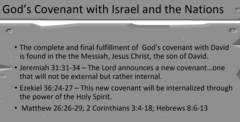
The New Covenant
An internalized covenant promised in Jeremiah and fulfilled through Jesus Christ and the Holy Spirit.

Total Number of Old Testament Laws
613 total laws, consisting of 365 negative laws and 248 positive laws.
Division of the Ten Commandments
The first 4 focus on relationship with God; the last 6 focus on neighbor.

Primary Purpose of the OT Law
To guide Israel into a life of holiness reflecting God's character.
Jesus' Relationship to the Law
Jesus came not to abolish the Law, but to accomplish and fulfill its purpose.
Covenant with Isaac
God confirmed the Abrahamic covenant with Isaac at Beersheba, representing all children of promise.

Covenant with Jacob
God confirmed His covenant with Jacob at Bethel (Genesis 28:13-15; 35:9-15).
Reason Israel Failed the Sinai Covenant
Sin made simple obedience impossible because their hearts were unchanged.
Role of the Holy Spirit in the New Covenant
Internalizes God's law within believers, as prophesied in Ezekiel 36:24-27.
Breakdown of Old Testament Laws
Contains 365 negative laws (prohibitions) and 248 positive laws (commands).
Comprehensive Goal of Salvation
Not merely forgiveness of sins, but living daily in God's presence and manifesting His character.
Sign of the Noahic Covenant
The rainbow, set by God as a confirmation of His promise (Genesis 9:8-17).
Location of Jacob's Covenant Confirmation
Bethel, where God confirmed His covenant with Jacob (Genesis 28:13-15; 35:9-15).
Prophetic Source for the New Covenant
Jeremiah 31:31-34, announcing an internal covenant fulfilled through Jesus Christ.

Jesus' Statement on the Law (Matthew 5:17-18)
He came not to abolish the Law or Prophets, but to accomplish their purpose.