Intro to Healthcare Admin - Midterm Study Guide
 Call Kai
 Learn
 Practice Test
 Spaced Repetition
 Match
 Flashcards
 Knowt Play
1/43

There's no tags or description
Looks like no tags are added yet.
44 Terms
4 main components of the US Healthcare System
1) Government Oversight
2) Patients
3) Healthcare Providers
4) Peripheral entities
Examples of government oversight
U.S. Dept. of Health & Human Services
Individual State Depts. of Health
Examples of types of patients
employer insured
individual market insured
CMS medicare
CMS/State Medicaid
Uninsured
Examples of Healthcare Providers
Acute Care (General Acute Hospitals, Specialty Hospitals, Psychiatric Hospitals)
Post Acute Care (Skilled Nursing Facility, Inpatient Rehab Facility)
Outpatient Care (Physician Offices, Urgent Care Clinics, Diagnostic Imaging Centers, etc.)
Long-Term Care (Assisted Living Centers, Disability Service Centers)
Home Health (In-Home Services, Hospice)
Examples of peripheral entities
Insurance Industry (Commercial Insurance, Managed Care)
3rd Party Organizations (Accreditors, Certifiers, Professional & Advocacy Organizations)
Suppliers & Manufacturers (Medical Devices, Pharmaceuticals, Suppliers)
The U.S. Healthcare Industry faces two primary challenges of ________ and ________.
Access & Cost
The three sides or main responsibilities of the public health sector.
1) Health Policy and Administration
2) Health Education and Behavior
3) Epidemiology
What does the term “Fiduciary” mean and how it applies to the US healthcare industry?
Fiduciary: someone who has special responsibilities in connection with the administration, investment, monitoring, and distribution of property—meaning the charitable or public assets of the institution, as well as intangible assets such as its reputation and role in the community."
they are trusted with the assets of another and legally responsible to act solely in the best interests of the person(s) who owns the assets
A governing board has the fiduciary (trust) relationship with the hospital or other provider organization. A trustee’s fiduciary duties to the organization are: 1) duty of obedience, 2) duty of care, 3) duty of loyalty
Duty of Obedience
Makes sure that they are obeying the laws personally and that the board is obeying the laws
Duty of Care
carry out their duties with prudence and in good faith. If they don't understand their duties, they need to ask questions and act honestly
Duty of Loyalty
Board members will always put the hospital's interests above their own interests.
6 Types of Provider Organizations
1) Hospitals
2) Long-Term Care
3) Ambulatory Surgery Centers
4) Clinics and/or Medical Group Practices
5) Inpatient and/or Outpatient Rehabilitation Facilities
6) Hospice & Palliative Care Organizations, Home Health Agencies
Types of Providers in the Long-Term Care segment and list them in order of acuity (low to high)
the patients’ homes
assisted living centers
nursing homes
skilled nursing facilities
Who belongs in this group?
Governing Board
may include community members, business leaders, physicians, and other individuals with expertise or an interest in the organization's mission. In not-for-profit organizations, board members frequently serve in a volunteer governance role.
The board provides oversight and governance, while hospital executives are responsible for the organization's day-to-day management.
Who belongs in this group?
Hospital Staff
are employed by the hospital or under contract to provide services to the hospital
administrators
nurses
therapists
radiology technologists
registration clerks
medical technologists (laboratory)
housekeepers
dietary
plant operations
medical records
billing
accounting
Who belongs in this group?
Medical Staff
All physicians and Advanced Practice Providers (APP) who have been credentialed and privileged by the Governing Board to practice at the hospital.
Explain the differences in the training and philosophy of MDs vs DOs.
They both attend medical school, do an internship/residency and then either do a fellowship and then become board certified OR they go straight to becoming board certification
MDs - allopathic medicine: focuses on the diagnosis and treatment of human diseases
DOs (Doctor of Osteopathy) - holistic view of medicine, focus on the whole person to reach a diagnosis rather than treating symptoms alone. Believe that all parts of the body influence each other. Learn OMT (osteopathic manipulative treatment). Place more emphasis on prevention of disease.
The difference between credentialing and privileges as it is used in the US healthcare industry.
Credentialing is the ability of the physician to practice in the specific hospital and become part of the medical staff. It’s also mandatory and given by the Hospital Board of Trustees.
Privileges are granted to physicians by the Hospital Board of Trustees. These are also mandatory. These are based off of the criteria of Medical Staff bylaws. Privileges specifically outline the scope of work the physician is allowed to work in at that hospital.
Review physician specialty certification
They can receive their subspecialty through completing a fellowship and passing a subspecialty exam to specialize in a field
They receive their certification through the American Board of Medical Specialties
They can obtain a certificate by taking a Board Certification Exam. There are 24 medical specialty boards. When an individual becomes board-certified, they are only board-certified in one specialty.
_______ licenses healthcare providers
State
Do not-for-profit organizations pay taxes and distribute earnings to stockholders?
No
_______ % of hospitals are not-for-profit entities.
60%
Understand the difference between levels of care (Primary, Secondary, Tertiary and Quaternary) – 4 questions are on this topic
* Primary care: Routine, preventive, and first-contact care.
* Secondary care: More specialized services, often provided through hospitals and specialists.
* Tertiary care: Highly specialized and complex services, such as trauma, advanced surgery, or specialized medical treatment.
Five principal roles and responsibilities of a hospital’s Governing Board.

Explain the difference between a "stockholder" and a "stakeholder."
A stockholder owns a piece of equity or stock in a company.
owners in investor-owned corporations
A stakeholder is any person or group affected by or invested in the company’s activities. (whether they own stock or not)
All parties that have an interest, usually of a financial nature, in the organization
Ex: Board, patients, staff, physicians, suppliers, creditors, community
Which country spends the most money on healthcare?
United States
How healthcare provider organizations may be structured/organized.
Ask Teacher if this is correct
1) Free-standing
2) Part of a multi-hospital system
3) Part of an integrated network
4) Not-for-profit
5) For-profit
Primary Care Clinic → Secondary Care Hospital → Tertiary Care Hospital
What is the purpose of the acute-care as opposed to long-term care?
Acute Care Purpose: Diagnose, Treat, and Cure
Long-Term Care Purpose: Basic and Instrumental ADLs
Primary Care
the lowest form of care
primary care physician ENT
hospital emergency room
obstetrician
pediatrician
very minor surgery
urgent care
Secondary Care
all surgery
any patient who is admitted to a hospital or sees a specialist
ambulatory surgery center
seeing a specialist
Tertiary Care
ICU
Quaternary Care
research/academic hospitals
experimental treatments/drugs
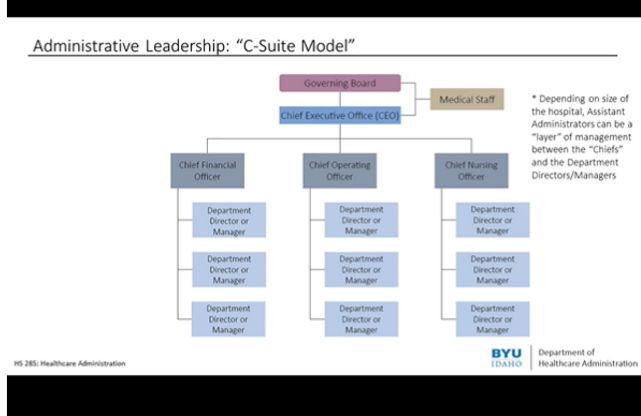
Governing Board: How the group is organized?
There are 3 different models: Traditional Model, Corporate Model, and C-Suite Model
Governing Board: What the group’s responsibilities are?

Governing Board: Whether the group members are employed by the hospital?
They are not.
How the group is organized: Hospital Staff
They are organized into separate departments:
medical/surgical nursing unites
emergency department
intensive care unit
labor and delivery
laboratory
radiology
environmental sciences
plant operations
registration and billing
and more… (not listed in powerpoint)
What the group’s responsibilities are: Hospital Staff
provide services to the hospital
Whether the group members are employed by the hospital: Hospital Staff
YES
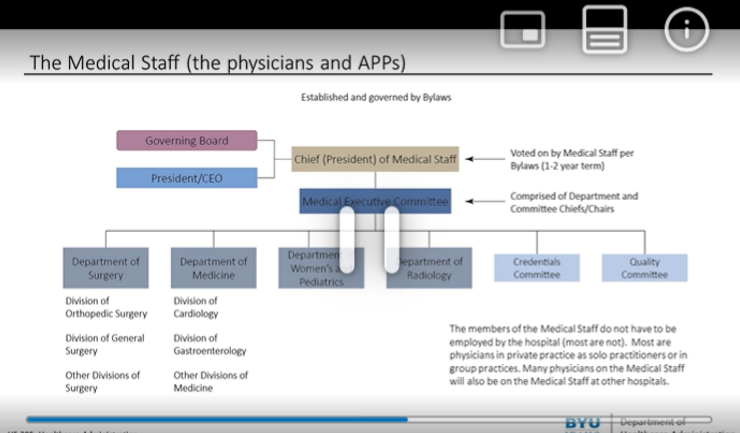
How the group is organized?
Medical Staff
What the group’s responsibilities are:
Medical Staff
sometimes also medical staff at other hospitals
medical care of the patients
Whether the group members are employed by the hospital:
Medical Staff
they do not have to be employed by the hospital → most are not
Most are physicians in private practice as solo practitioners or in group practices.
many physicians on the medical staff will also be on the medical staff at other hospitals
Governing Board: Traditional Model

Governing Board: Corporate Model

Governing Board: C-Suite Model