Advanced geometrical optics - topic 2 sections 11 & 12
 Call Kai
 Learn
 Practice Test
 Spaced Repetition
 Match
 Flashcards
 Knowt Play
1/27

There's no tags or description
Looks like no tags are added yet.
28 Terms
What are the four defaces with different refractive indecies between different media?
The interface between air and the anterior surface of the cornea.
The interface between the posterior surface of the cornea and the aqueous humour.
The interface between the aqueous humour and the anterior surface of the lens.
The interface between the posterior surface of the lens and the vitreous humour.

What are the radii of curvature, separation and refractive index for each surface if the eye?
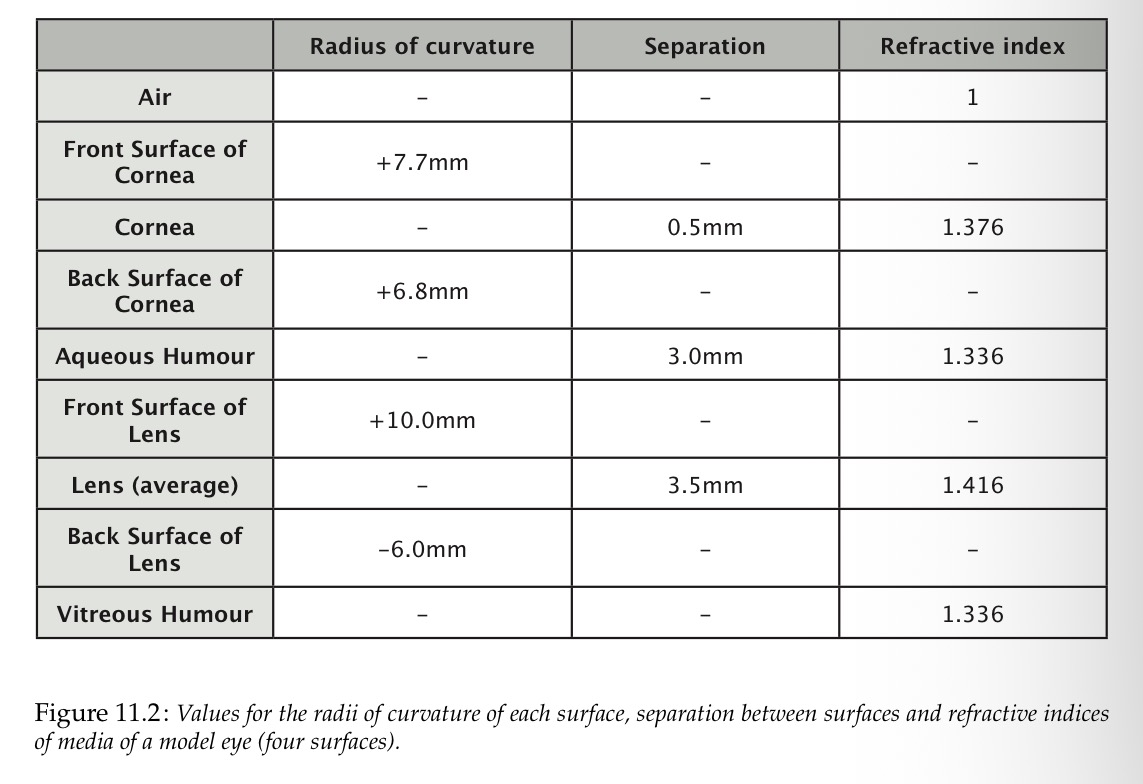
Why is the front of the cornea the most powerful and the back if the cornea the weak3st?
front most powerful as jump in refractive index from air to cornea is large
Whereas jump from cornea to aqueous is small
What are the values for radius if curvature, separation and refractive index of a model eye (three surfaces) ?


Label this 8mage in relation to the eye
Firzt lens is cornea
Second lens is front surface of the lens
Third surface is the back surface of the lens
no is the refractive index of air
n1 is the refractive index if the aqueous humor
n2 is the average index if the lens
ni is the refractive index if the vitreous humor
In an emmetropic eye, where will F’ lie?
Exactly on the retina
For an Equivilent thin lens sytem what is the equation for l?
l = AO + AP

How would you calculate the l’ from l?
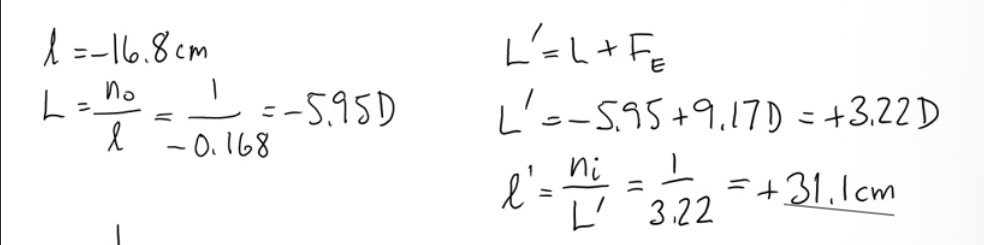
How would you calculate the magnification?
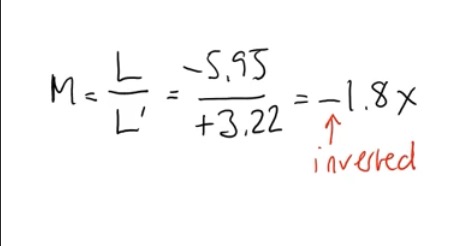
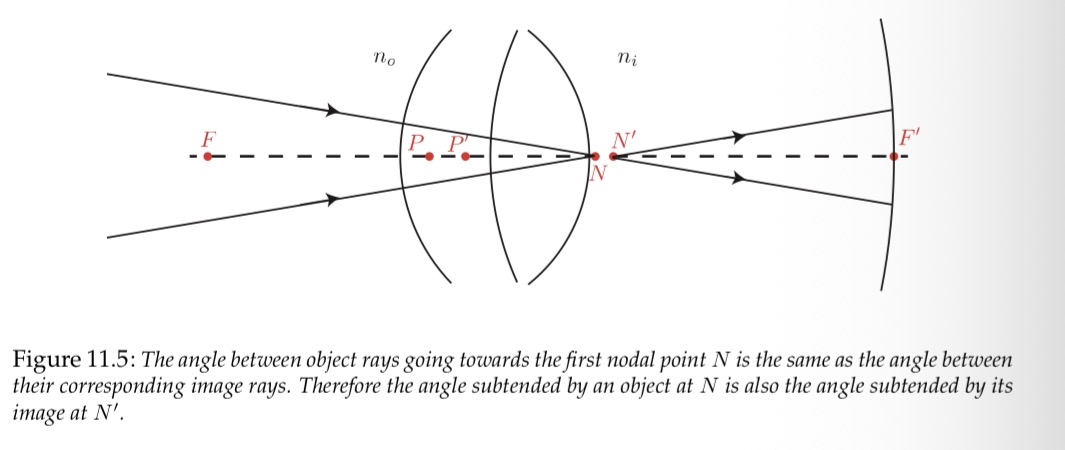
Show how you would draw ray diagrams using cardinal points

Do rays exit the same angle at the nidal ooint?


Solve this problem

How could you work out the power F if the cornea?
F1 = refractive index of vitreous humor - refractive index if air / radius of curvature for air
How do we work out the pooper if the anterior surface of the lens?
F2 = refractive index if the lens - refractive index if the vitreous humor / radius of curvature of the front surface if the lens
How do we work out the power of the back surface if the lens?
F3 = refractive index of the vitreous humor - refractive index if the lens/ radius of curvature of the back of the lens
What are the three steps for finding the cardinal points?
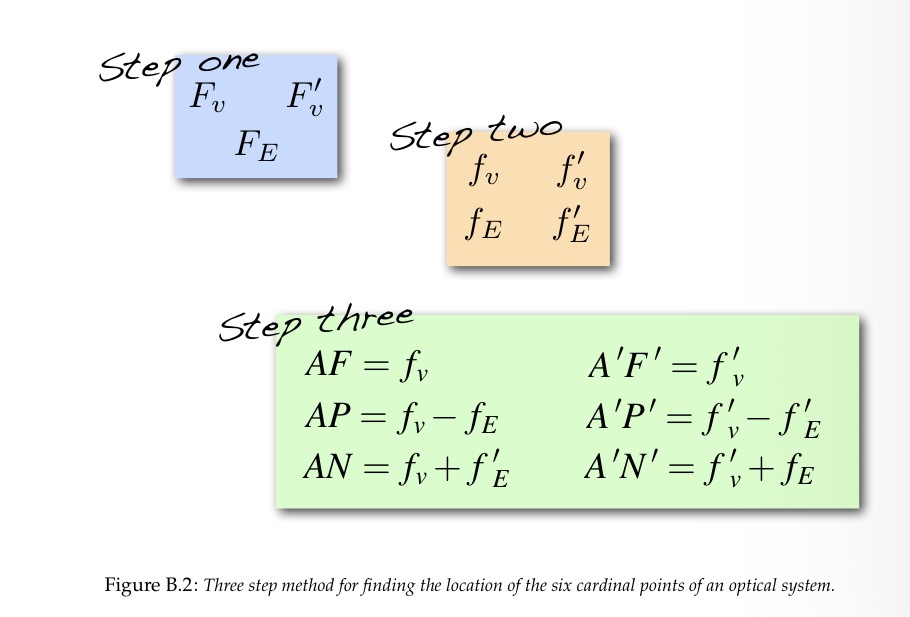
Equations for Fv, Fv’ and Fe?

What are the equations for fv, f’v, fE, and f’E?

What is the limit of resolution of a typical human eye, andwhat does this equate to in Snellen notation?
1 arc minute (1′) or 0.0167°.
This equates to 6/6 (20/20) vision.
What is the approximate distance from the second nodal point(N′) to the retina in an emmetropic eye?
Approximately 16.5 mm.
The second focal point (F′) coincides with the retina.
The angle of the image rays remains the same as theangle of the object rays: 0.0167°.
If foveal cones are 2.5 µm in diameter, how many cones areneeded to image an object at the eye's resolutionlimit?
Image size = 16.5 mm × sin(0.0167°).
Image size ≈ 5 µm.
Each cone = 2.5 µm in diameter.
Therefore:
5 ÷ 2.5 = 2 cones.
Compare myopia and hypermetropia

Where is the image formed when an object is at infinity, andwhat happens as the object moves closer?
At infinity: the image forms at the second focal point (F′).
As the object moves closer: the image moves further awayfrom F′ (to the right).
The image eventually moves behind the retina, causingblurred vision.
What is accommodation, and why does the eye need it?
Accommodation is the process by which the eye increases itsoptical power to focus on nearby objects.
When an object moves closer, the eye needs to increase its power.
This allows the image to move forward onto the retina.
Without accommodation, nearby objects would appear blurred.
How does the crystalline lens change shape during accommodation,and what happens to its optical power?
The lens becomes more curved (rounder/thicker).
Its surfaces have smaller radii of curvature.
Its optical power increases.
The image moves closer to the optical system until it coincideswith the retina.
Important: During accommodation, F′ is no longer coincident withthe retina because the optical system'sparameters have changed.

Use the cardinal points to draw a ray diagram

If we place an object between the lens and F, draw a ray diagram using the six cardinal points now
