MCR3U Lesson 6.3A: Trigonometric Ratios of Angles between 0° and 360°
 Call Kai
 Learn
 Practice Test
 Spaced Repetition
 Match
 Flashcards
 Knowt Play
1/6

Earn XP
Description and Tags
Vocabulary flashcards covering core terms, definitions, and formulas for trigonometric ratios of angles between 0° and 360° in Grade 11 Functions (MCR3U).
7 Terms
Cartesian Plane
The x,y plane on which a point is plotted by drawing a line extending outward from the origin (0,0).

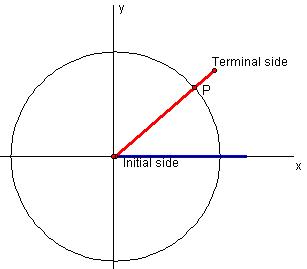
Terminal Arm
The straight line passing through a point in the Cartesian Plane, represented either by coordinates (x,y) or by an angle rotating counterclockwise from the positive x-axis.
Radius (r)
The length of the terminal arm, determined by the formula r = \root\relax\blank\blank\blank -> r = \root\relax\blank wait, calculated by the formula r=x2+y2, where (x,y) is the point on the terminal arm.
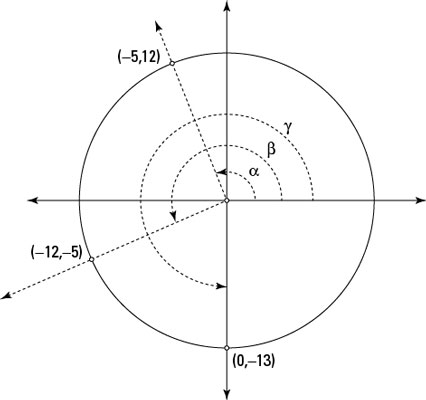
Principal Angle
The angle that describes the position of the terminal arm in the Cartesian Plane.

Related Acute Angle (β)
An angle between 0∘ and 90∘ formed between the x-axis and the terminal arm.


Coterminal Angles
Angles that serve as alternative representations of the principal angle, calculated using the relationship θc=θ±360∘.
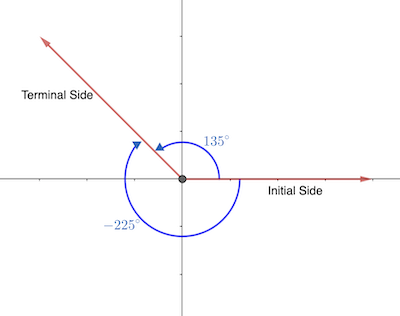
Negative Angle
An angle formed by rotating clockwise from the positive x-axis rather than counterclockwise.