Week 5: Timber + section properties
 Call Kai
 Learn
 Practice Test
 Spaced Repetition
 Match
 Flashcards
 Knowt Play
1/18

There's no tags or description
Looks like no tags are added yet.
19 Terms
3 Primary directions in wood
Longitudinal (grain): along the trunk and grain
Radial: from center of the tree outward
Tangential: around the grown rings
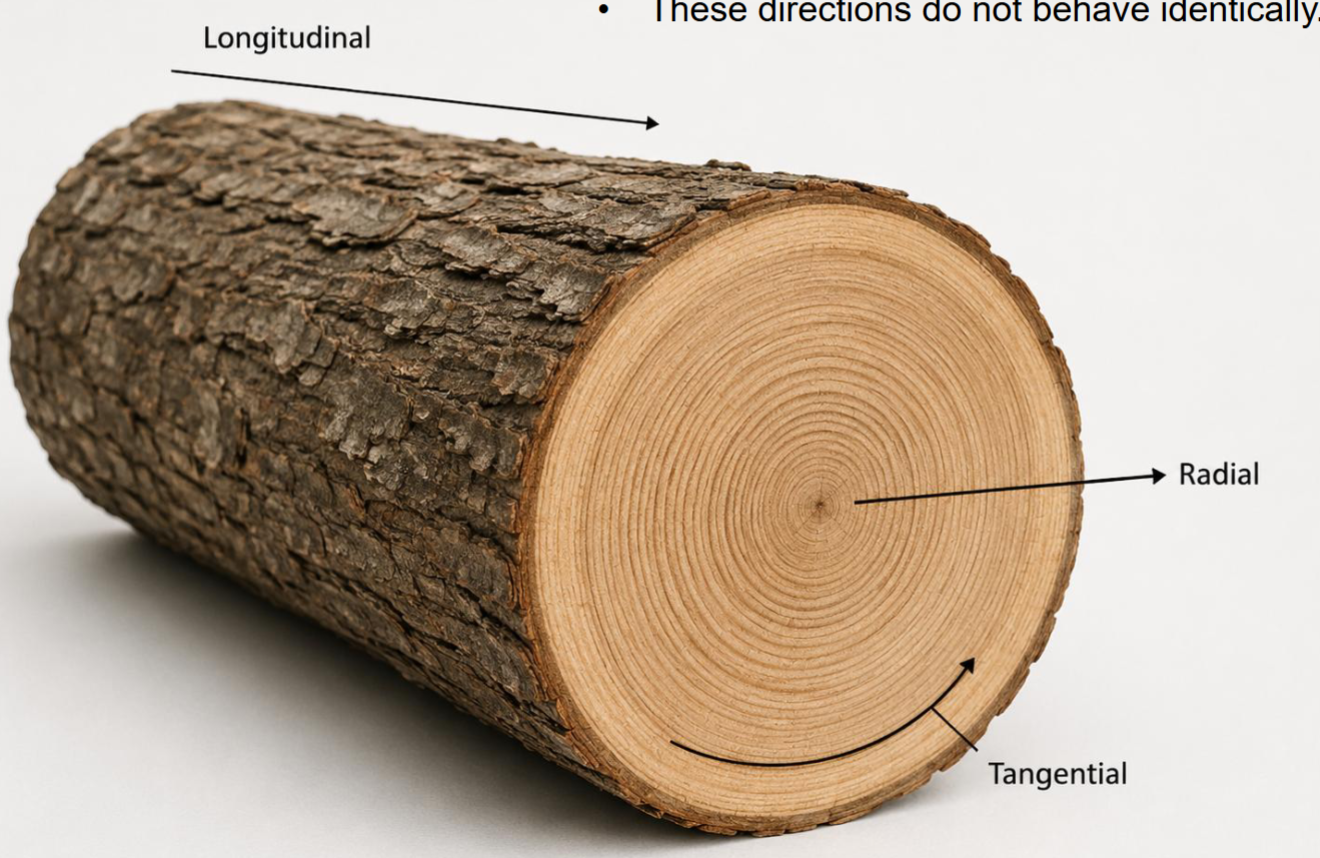
What’s anisotropic and application to timber
Material has different properties depending on the direction in which it is tested or loaded. When load is applied vertically, timber is strong and stiffer parallel to the grain (longitudinal) and weaker perpendicular (tangential) to the grain. This is because the loading across the timber’s width makes cellular structure easier to crush or deform

Hardwood
Hardwood comes from flowering trees such as oak, maple, or teak
Strength, hardness, and density is generally higher than softwood (NOT ALWAYS, depends on classification)
Trees with broad leaves and in darker colors
Tends to be used in high-quality furniture, flooring, walls
Slower growing
More expensive
Softwood: Comes from non-flowering trees such as pine, spruce, cedar
Lighter in weight
Lower strength, density, and hardness that hardwood but not always
Fast growing
Easy to work with, commonly used for structural framing
What does it mean by hygroscopic material and link its properties to timber
Ability of a material to absorb or release moisture from the surrounding atmosphere in response to environmental humidity.
Timber is a hygroscopic material because it exchanges moisture with its environment
High humidity: Timber absorb moisture from air → may cause swelling because water is absorbed into cell wall
Low humidity: Timber release moisture to air → may cause shrinking because water leave cell wall
The moisture exchange continues until timber approaches equilibrium moisture content (EMC) with the atmosphere
Environment change → moisture changes → timber changes
Dimensional movement of timber, and which timber direction has the greatest movement
Since moisture movement cause timber to shrink and swell the dimensional movement is not equal in every direction
Tangential: greatest swelling and shrinkage along the growth ring
Radial: moderate movement across growth ring towards the center
Longitudinal (grain): Least movement along the tree trunk
→ These unequal movements lead to shrinkage, checking, warping, and cupping
What does unequal movement in timber lead to
Shrinkage: Timber becomes smaller as it loses moisture
Checking: Cracks develop due to uneven shrinkage and internal stresses
Warping: Timber bend, twist, or change shape
Cupping (type of warp): Timber bend across its width, creating a U shape

What is seasoning for timber and its properties
Seasoning is the controlled drying of timber to reduce its moisture content
better for structural strength
better nail holding capacity than wet timber → wood fiber lock together better when there’s not a lot of fluid between them
better protection against decay
lighter in weight
If wet timber is installed in building and later dries, it might shrink and cause gap or distortion because loss in moisture content
What is equilibrium moisture content (EMC)
The moisture content at which timber is in balance with the surrounding air, meaning that it no longer gaining or losing moisture overall
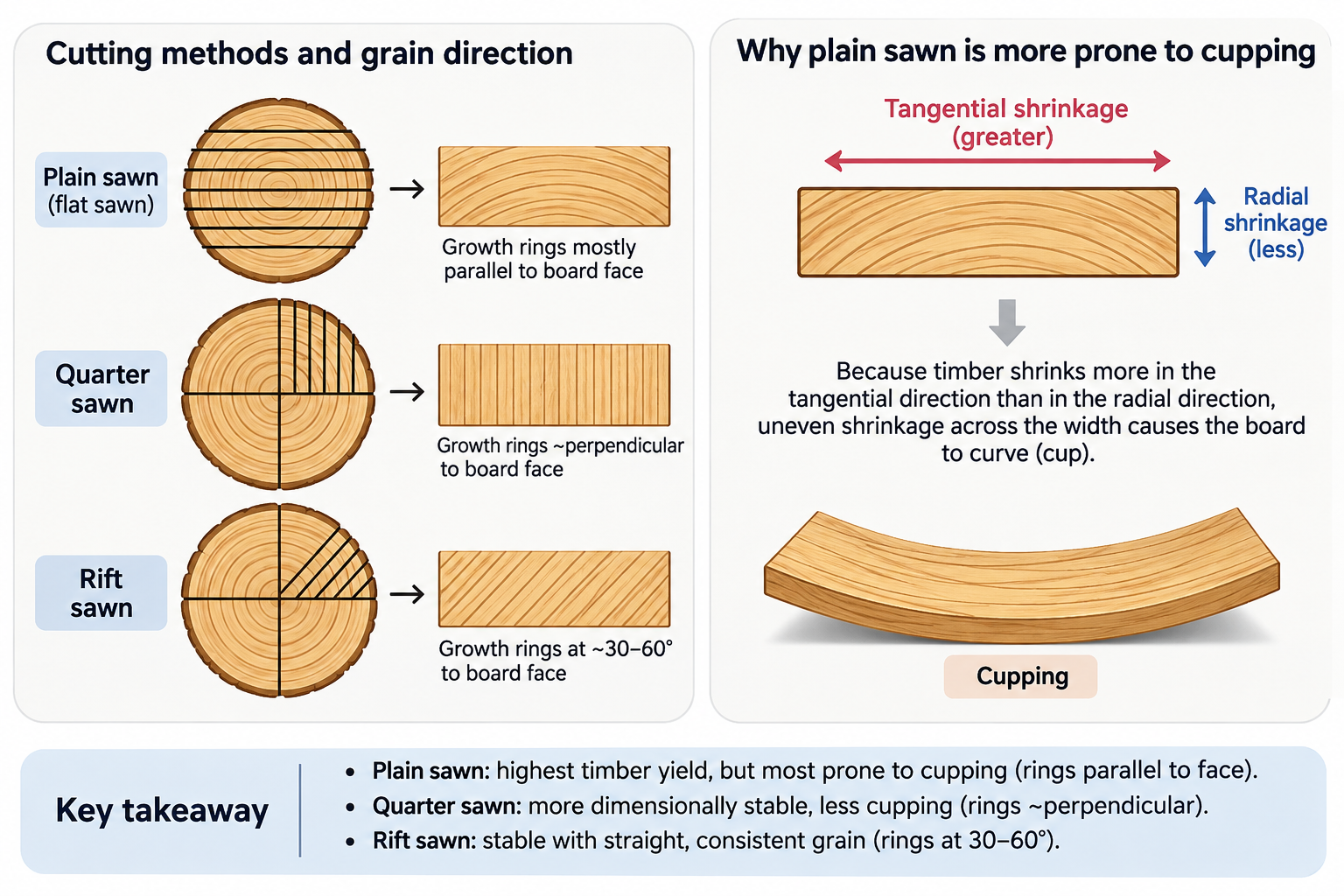
Sawn timber and its methods
Sawn timber is produced by cutting logs into structural members such as beams, joists, and rectangular sections
Plain sawn: board cut approximately tangential to growth ring (parallel through log)
efficient cutting
more likely to cup because timber shrinks more in tangential (along the growth ring) direction than radial (across growth ring) direction
less timber waste → simple parallel cut
cheapest
Quater sawn: logs are divided into quatres before boards cut approximately perpendicular to growth ring
more dimensionally stable
less cupping → growth ring in perpendicular to the board’s face
generally, more expensive
Rift sawn: Boards are cut to produce consistent grain angle of around 30-60 degree to growth ring
straight grain appearance → every grain orientates to center of log
maximum strength
most stable
more waste
higher cost
Cutting method matters because orientation of the growth rings influences dimensional stability, appearance, structural behaviors, and nail holding capacity
Engineered timber products
It’s a manufactured wood product made by bonding veneers, strips, and fiber of wood particle together using adhesive to improve structural performance.
LVL: Manufactured from multiple thin veneers bonded together
grains are aligned in the same direction
aligning grains help create a strong, consistent structural members → efficient for beams, lintels, and other similar structural elements
Plywood: Manufactured in thin veneers bonded in layers, unlike LVL each adjacent layer perpendicular to each other
reduces directional weakness and improve stability
Glulam: Manufactured by bonding layers (individual timber board) of timber together, where the grains are aligned along the length of the members
commonly used in long span beams, columns, ad curved structural elements
MDF: Make by breaking down hardwood or softwood residual into wood fibers and combining it with wax and resin binder. The panels are formed by applying high temperature and pressure
commonly used for cabinetry and interior applications rather than primary load bearing structures
unlike LVL, plywood, GLT, it is not made from intact veneers or boards

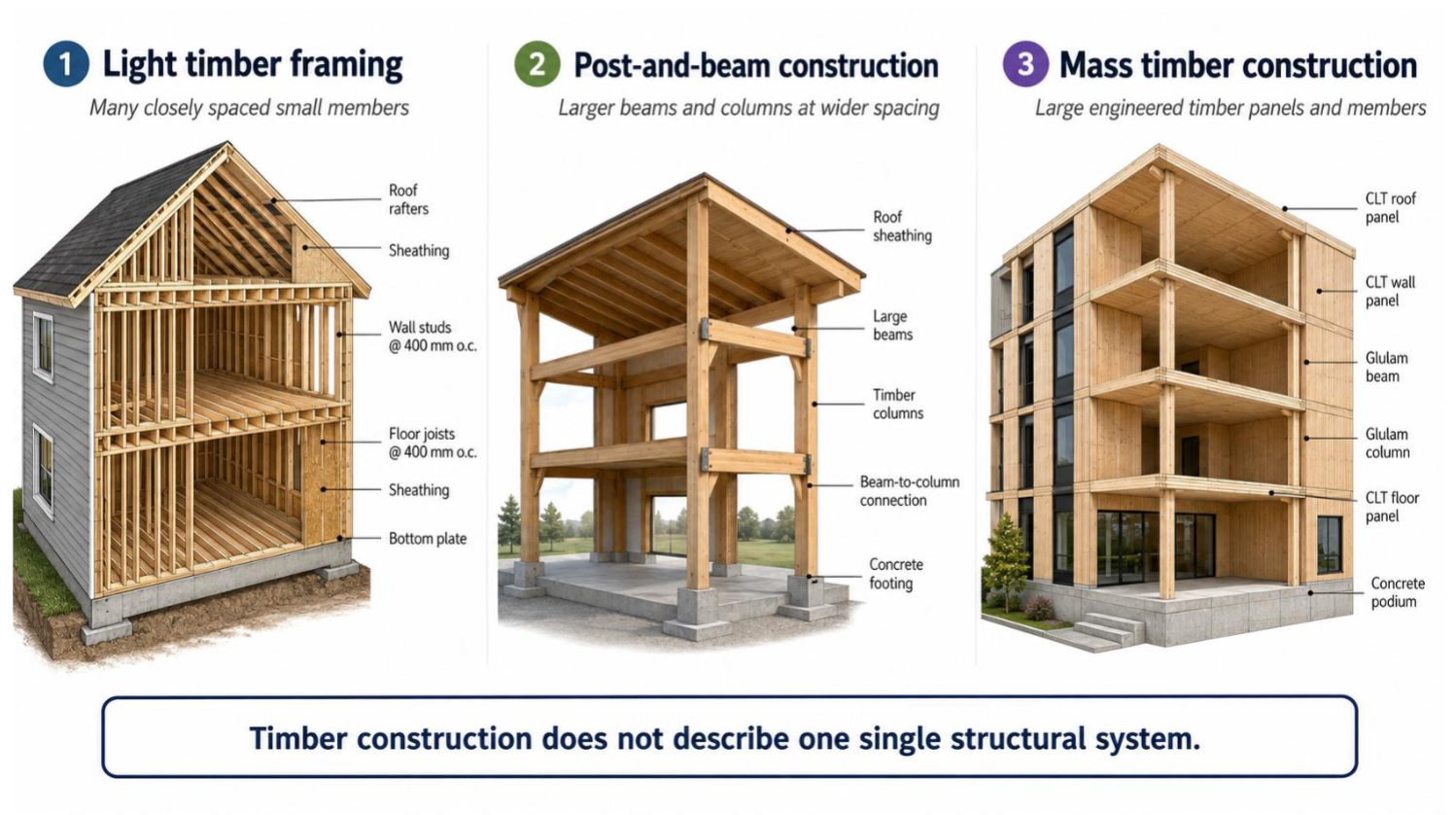
Timber structural framing: light timber framing, post-and-beam construction, mass timber construction
Light timber framing: loads are distributed through many smaller members → commonly used in residential buildings
Post-and-beam construction: All structural members are responsible for their tributary area → large beams transfer loads into widely spaced columns
Mass timber construction: Uses large, engineered timber elements, including structural panels → all is made from engineered timber
Fire behaviors in timber
When large timber member burns, a char layer forms at the exposed surface
1) Outer layer becomes charred and loses most of its structural capacity
2) The char layer acts as an insulation, slowing heat transfer into the remaining timber
3) Inner timber can continue carrying loads while enough effective cross-section remains

Structural grading of timber
Process of sorting timber into stress grades so design capacity can be assigned
Visual stress grading: person examines the timber for visible characteristic that may affect strength such as knots, cracks, grain slope, and distortion → then these identifications are classified according to grading rules
Machine stress grading: A machine applies relatively small load to the timber and measures how much it bends. Its purpose is to assess the stiffness without significantly damaging the timber → fast process around 1 sec per piece
Machine proof grading: A machine applies much higher load, closer to the timber intended design strength. The aim is to identify weak pieces through failure under proof load → slower process, around 15-20 sec per piece
Visual characteristics that affect strength of timber
Knots: They’re location of branches that grew from the trunk
It interrupts the grain pattern, making timber weak
Slope of grain: When grain is inclined, the member cannot use its longitudinal fiber strength as effectively for load along its length
Gum pockets: Cavities containing gum or resin like material, interrupting wood structure and aesthetic
Wane and want: Wane is the missing wood along the edge of sawn timber (the defect itself). Want measures the amount/dimension of the missing wood caused by the wane
Others:
check
twist
cup

Centroid and centroid axis
The geometric center of an area, the “average” position of all the points in the shape
→ basically, the point on the shape in which the object would balance when placed on a needle
Centroid axis: Line that passes through the centroid → cross section usually has two centroidal axes (y-y) (x-x)
Centroid of rectangle
The centroid lies at the intersection of (x-x) and (y-y) axis, halfway across its width and halfway up its height
→ So, coordinate of the centroid axis would be x=b/2, y=h/2

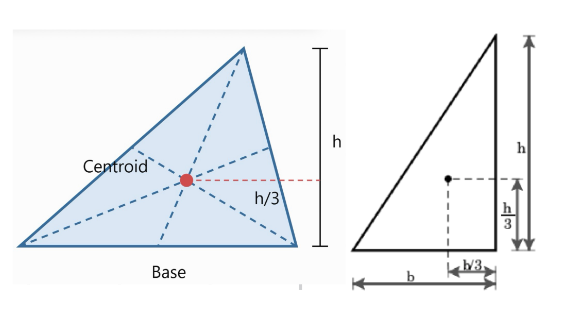
Centroid of rectangle
The centroid axis lies at the intersection of 3 medians → median is a line connecting a vertex to the midpoint of the opposite side
The centroid is located 1/3 of the distance from each side to the opposite vertex so y=h/3
For right angle triangle, the height and base from right angle corner reference point is also (x=b/3, y=h/3)
Centroid for complex shapes
Break complicated shape into simpler shapes, calculate each one’s centroid and area, then combine the result
use method of composite parts
Need to find area of each shape
Identify the X and Y coordinate based on the shape (e.g. y=h/s or h/3)

Area moment of inertia or second moment of area
Describe how the area of a cross-section is distributed relative to a particular axis. It reflects the efficiency of the shape in resisting rotation
Represented by I
Large I = greater resistance to bending → less deflection under the same load
Smaller I = lower resistance to bending → more deflection under the same load
So, more distance away from axis of rotation will have higher I