Cell Bio: Lecture 1 - Introduction to cells and prokaryotes
 Call Kai
 Learn
 Practice Test
 Spaced Repetition
 Match
 Flashcards
 Knowt Play
1/14

There's no tags or description
Looks like no tags are added yet.
15 Terms
What is cell theory?
Fundamental biological principle stating that: all organisms are made up of cells, the cell is the basic unit of life, and all cells arise from pre-existing cells.
What are the characteristics of all cells?
-cell membrane -DNA, ribosomes, cytoplasm -similar basic chemistry -replicate themselves -take energy & matter from the environment -respond to stimuli
What are the general characteristics of Prokaryotes?
-small cells -no nucleus -no membrane-bound organelles -small ribosomes -circular chromosomal DNA -unicellular -may form aggregates
What are the common prokaryotic structures?

Which types of prokaryotic ‘organelles’ contain membranes?
Either bound by protein shell or lipid monolayer or bound by lipid bilayer
What is the purpose of carboxysomes?
-contains enzymes such as rubisco that are involved in carbon fixation -concentrate carbon dioxide to allow for faster fixation of carbon dioxide -
What is the purpose of chlorosomes?
-light-harvesting organelles of photosynthetic green bacteria -contains mostly chlorophyll -enclosed by a lipid monolayer + some protein
What are photosynthetic membranes?
-found in photosynthetic bacteria -contains enzymes required for photosynthesis -structure varies
What are the two different domains of prokaryotes?
Domain archaea and Domain bacteria
What are the characteristics of Eubacteria?
-includes most bacteria -DNA is not associated with protein (naked DNA) -no introns -cell wall contains peptidoglycan -DNA replication + Transcription machinery is different than eukaryotes -rarely found in extreme environments
What are the characteristics of Archaebacteria?
-DNA is associated with protein -many genes contain introns -cell wall is made of polysaccharides -many thrive in extreme environments -biochemistry is similar to eukaryotes
What are the four extremeophilic archaea?
Halophiles (salt loving), Thermophiles (heat loving), Hyper-thermophiles (extreme heat loving), Psychrophiles (cold loving)
How do Halophiles adapt to combat salt stress?
Exclude salt
accumulate organic compounds
Increase internal water reabsorption
Salt-adaption proteins
large amounts of charged amino acids help retain water around cellular molecules
proteins function in high salt environments
How do Thermophilies adapt to combat heat stress?
Heat-resistant proteins: more stable
many large hydrophobic animo acids
increased numbers of ionic interactions & disulfide bonds
Saturated fatty acids in cell membrane
pack together tightly
allow membranes to remain stable at high temperatures
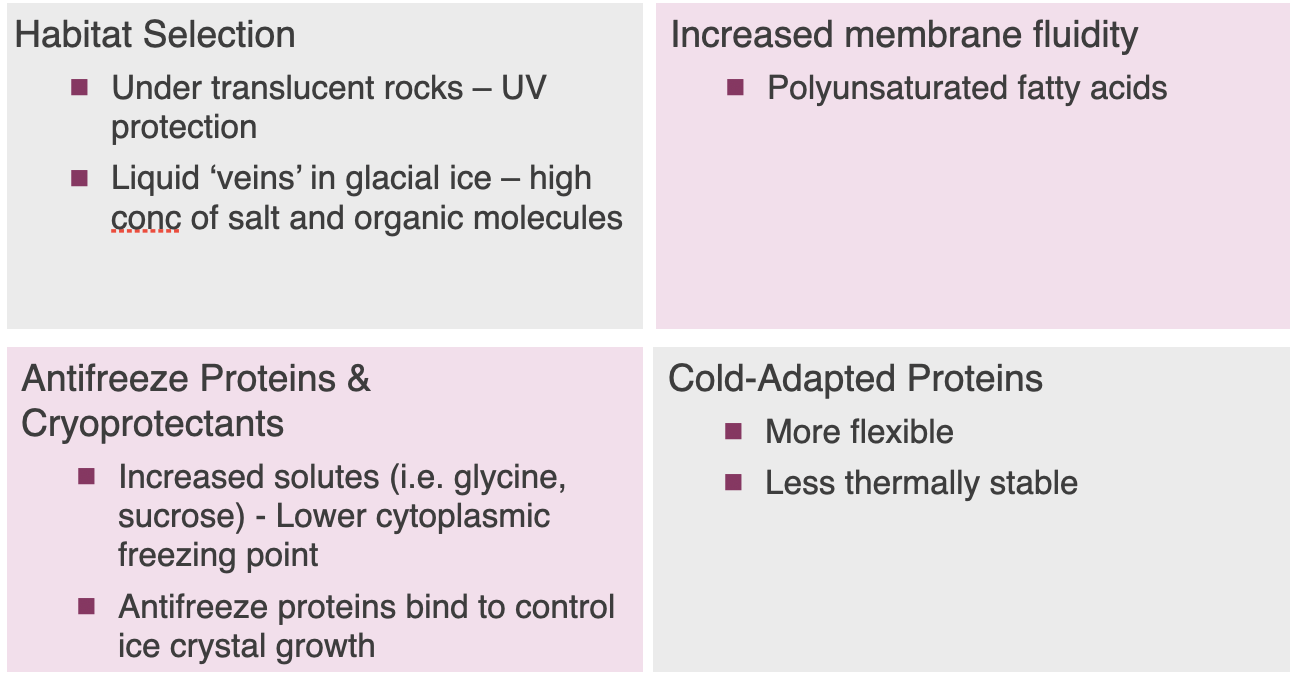
How do Psychrophilics adapt to combat freezing?